MMEJ repair of double-strand breaks (director's cut): deleted sequences and alternative endings
- PMID: 18809224
- PMCID: PMC5303623
- DOI: 10.1016/j.tig.2008.08.007
MMEJ repair of double-strand breaks (director's cut): deleted sequences and alternative endings
Abstract
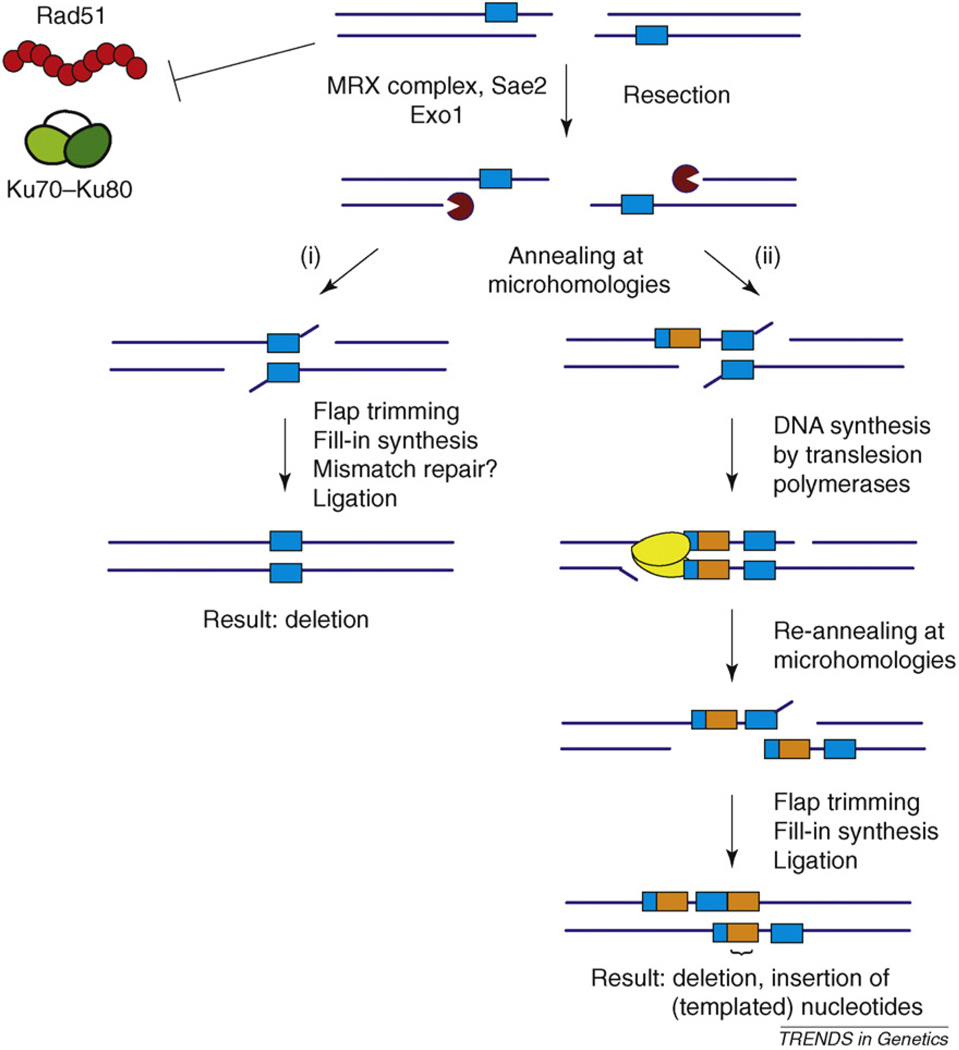
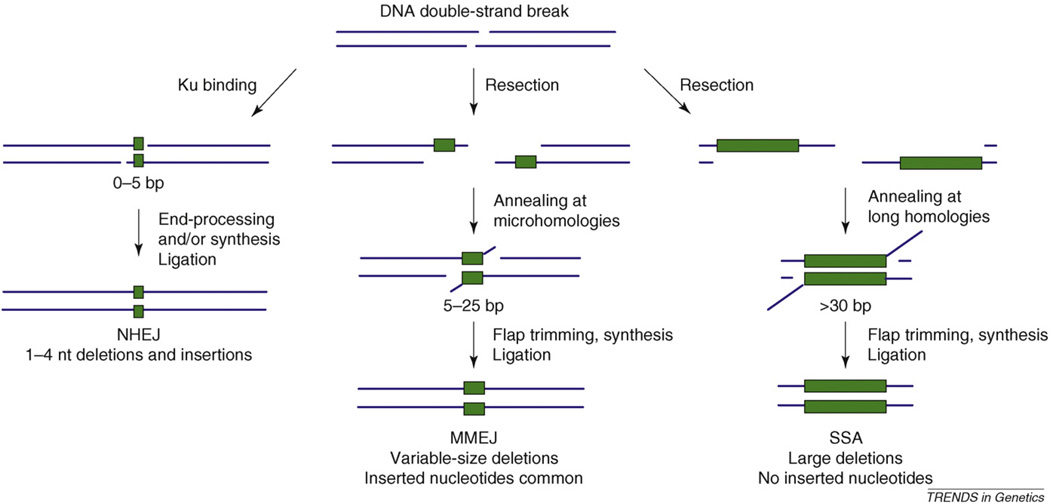
DNA double-strand breaks are normal consequences of cell division and differentiation and must be repaired faithfully to maintain genome stability. Two mechanistically distinct pathways are known to efficiently repair double-strand breaks: homologous recombination and Ku-dependent non-homologous end joining. Recently, a third, less characterized repair mechanism, named microhomology-mediated end joining (MMEJ), has received increasing attention. MMEJ repairs DNA breaks via the use of substantial microhomology and always results in deletions. Furthermore, it probably contributes to oncogenic chromosome rearrangements and genetic variation in humans. Here, we summarize the genetic attributes of MMEJ from several model systems and discuss the relationship between MMEJ and 'alternative end joining'. We propose a mechanistic model for MMEJ and highlight important questions for future research.
Figures
Similar articles
-
Microhomology Selection for Microhomology Mediated End Joining in Saccharomyces cerevisiae.Genes (Basel). 2019 Apr 8;10(4):284. doi: 10.3390/genes10040284. Genes (Basel). 2019. PMID: 30965655 Free PMC article.
-
Saccharomyces cerevisiae Sae2- and Tel1-dependent single-strand DNA formation at DNA break promotes microhomology-mediated end joining.Genetics. 2007 Aug;176(4):2003-14. doi: 10.1534/genetics.107.076539. Epub 2007 Jun 11. Genetics. 2007. PMID: 17565964 Free PMC article.
-
Yeast Mre11 and Rad1 proteins define a Ku-independent mechanism to repair double-strand breaks lacking overlapping end sequences.Mol Cell Biol. 2003 Dec;23(23):8820-8. doi: 10.1128/MCB.23.23.8820-8828.2003. Mol Cell Biol. 2003. PMID: 14612421 Free PMC article.
-
Contribution of Microhomology to Genome Instability: Connection between DNA Repair and Replication Stress.Int J Mol Sci. 2022 Oct 26;23(21):12937. doi: 10.3390/ijms232112937. Int J Mol Sci. 2022. PMID: 36361724 Free PMC article. Review.
-
Risky business: Microhomology-mediated end joining.Mutat Res. 2016 Jun;788:17-24. doi: 10.1016/j.mrfmmm.2015.12.005. Epub 2016 Jan 2. Mutat Res. 2016. PMID: 26790771 Free PMC article. Review.
Cited by
-
CRISPR-Cas9-mediated single-gene and gene family disruption in Trypanosoma cruzi.mBio. 2014 Dec 30;6(1):e02097-14. doi: 10.1128/mBio.02097-14. mBio. 2014. PMID: 25550322 Free PMC article.
-
High Quality Maize Centromere 10 Sequence Reveals Evidence of Frequent Recombination Events.Front Plant Sci. 2016 Mar 23;7:308. doi: 10.3389/fpls.2016.00308. eCollection 2016. Front Plant Sci. 2016. PMID: 27047500 Free PMC article.
-
One-step generation of mice carrying mutations in multiple genes by CRISPR/Cas-mediated genome engineering.Cell. 2013 May 9;153(4):910-8. doi: 10.1016/j.cell.2013.04.025. Epub 2013 May 2. Cell. 2013. PMID: 23643243 Free PMC article.
-
Exploiting the Microhomology-Mediated End-Joining Pathway in Cancer Therapy.Cancer Res. 2020 Nov 1;80(21):4593-4600. doi: 10.1158/0008-5472.CAN-20-1672. Epub 2020 Jul 10. Cancer Res. 2020. PMID: 32651257 Free PMC article. Review.
-
Molecular analysis of a deletion hotspot in the NRXN1 region reveals the involvement of short inverted repeats in deletion CNVs.Am J Hum Genet. 2013 Mar 7;92(3):375-86. doi: 10.1016/j.ajhg.2013.02.006. Am J Hum Genet. 2013. PMID: 23472757 Free PMC article.
References
-
- Keeney S, Neale MJ. Initiation of meiotic recombination by formation of DNA double-strand breaks: mechanism and regulation. Biochem. Soc. Trans. 2006;34:523–525. - PubMed
-
- Jung D, et al. Mechanism and control of V(D)J recombination at the immunoglobulin heavy chain locus. Annu. Rev. Immunol. 2006;24:541–570. - PubMed
-
- Shrivastav M, et al. Regulation of DNA double-strand break repair pathway choice. Cell Res. 2008;18:134–147. - PubMed
-
- Nussenzweig A, Nussenzweig MC. A backup DNA repair pathway moves to the forefront. Cell. 2007;131:223–225. - PubMed
-
- Chen C, et al. Chromosomal rearrangements occur in S. cerevisiae rfa1 mutator mutants due to mutagenic lesions processed by double-strand-break repair. Mol. Cell. 1998;2:9–22. - PubMed
Publication types
MeSH terms
Substances
Grants and funding
LinkOut - more resources
Full Text Sources
Other Literature Sources
Molecular Biology Databases