Review
. 2008 Nov;86(3):264-80.
doi: 10.1016/j.pneurobio.2008.08.003. Epub 2008 Sep 3.

The energy hypothesis of sleep revisited

Affiliations
Review

The energy hypothesis of sleep revisited

Matthew T Scharf et al. Prog Neurobiol. 2008 Nov.

Abstract

One of the proposed functions of sleep is to replenish energy stores in the brain that have been depleted during wakefulness. Benington and Heller formulated a version of the energy hypothesis of sleep in terms of the metabolites adenosine and glycogen. They postulated that during wakefulness, adenosine increases and astrocytic glycogen decreases reflecting the increased energetic demand of wakefulness. We review recent studies on adenosine and glycogen stimulated by this hypothesis. We also discuss other evidence that wakefulness is an energetic challenge to the brain including the unfolded protein response, the electron transport chain, NPAS2, AMP-activated protein kinase, the astrocyte-neuron lactate shuttle, production of reactive oxygen species and uncoupling proteins. We believe the available evidence supports the notion that wakefulness is an energetic challenge to the brain, and that sleep restores energy balance in the brain, although the mechanisms by which this is accomplished are considerably more complex than envisaged by Benington and Heller.


Figures
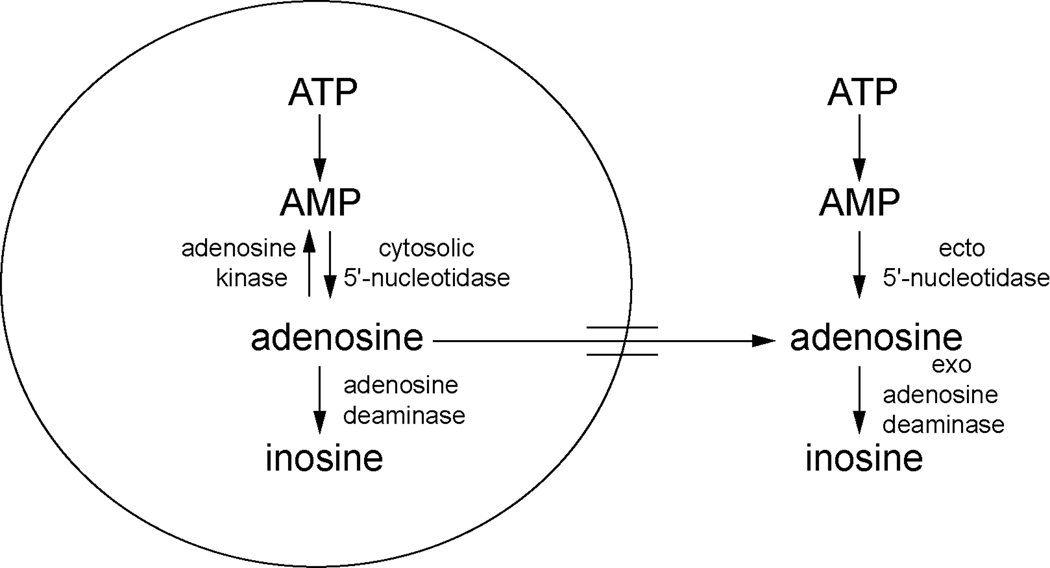
Figure 1
Figure 1
Adenosine metabolic pathways. In the cell, ATP is metabolized to AMP and then to adenosine by cytosolic 5’-nucleotidase. Adenosine can be converted back to AMP by adenosine kinase or metabolized to inosine by adenosine deaminase. Extracellularly, ATP is metabolized to AMP and then to adenosine by ecto 5’-nucleotidase. Adenosine can be converted to inosine by exo adenosine deaminase.
Figure 2
Figure 2
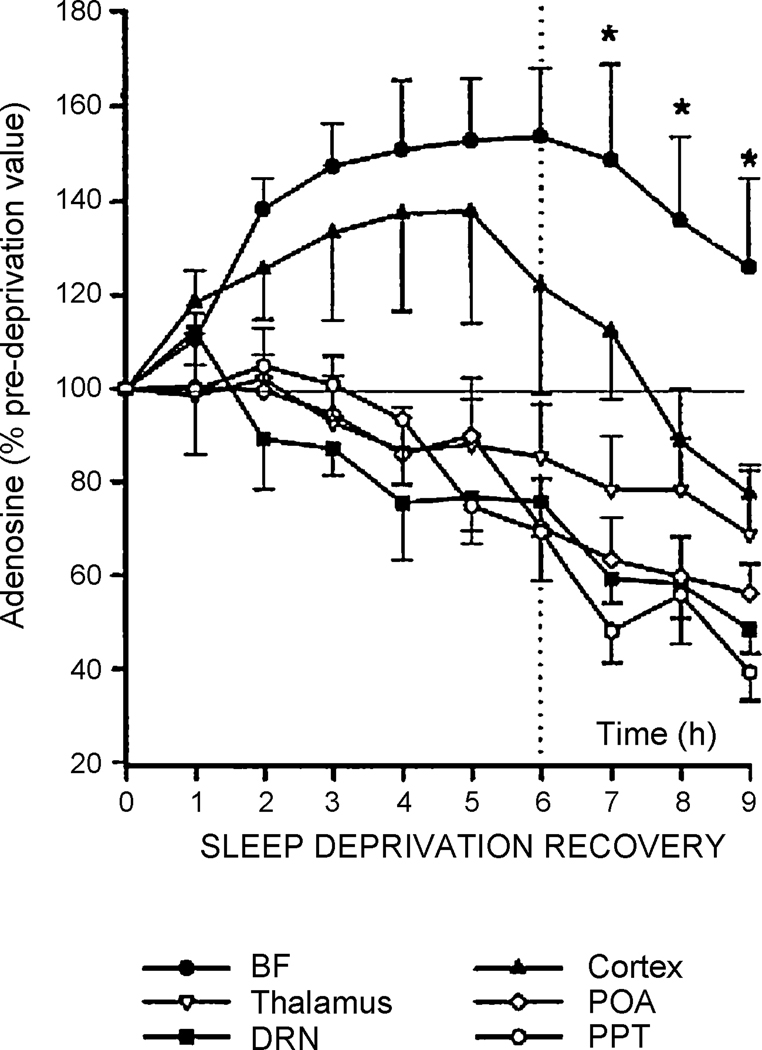
Alterations in extracellular adenosine measured by microdialysis following sleep deprivation and in subsequent recovery sleep in cats. Cats were sleep deprived for 6 hours and then allowed to sleep for 3 hours. Extracellular adenosine was measured at the beginning of the experiment by microdialysis and then in 1 hour intervals for the duration of the experiment. Adenosine is presented as a percentage of the baseline value. Extracellular adenosine increases during sleep deprivation only in the basal forebrain and cortex. In the other areas studied, adenosine levels progressively decline. Adenosine stays elevated during recovery sleep only in the basal forebrain. BF, basal forebrain; POA, preoptic area of the hypothalamus; DRN, dorsal raphe nucleus; PPT, pedunculopontine tegmental area. (Porkka-Heiskanen et al. 2000; reprinted with permission).
Figure 3
Figure 3
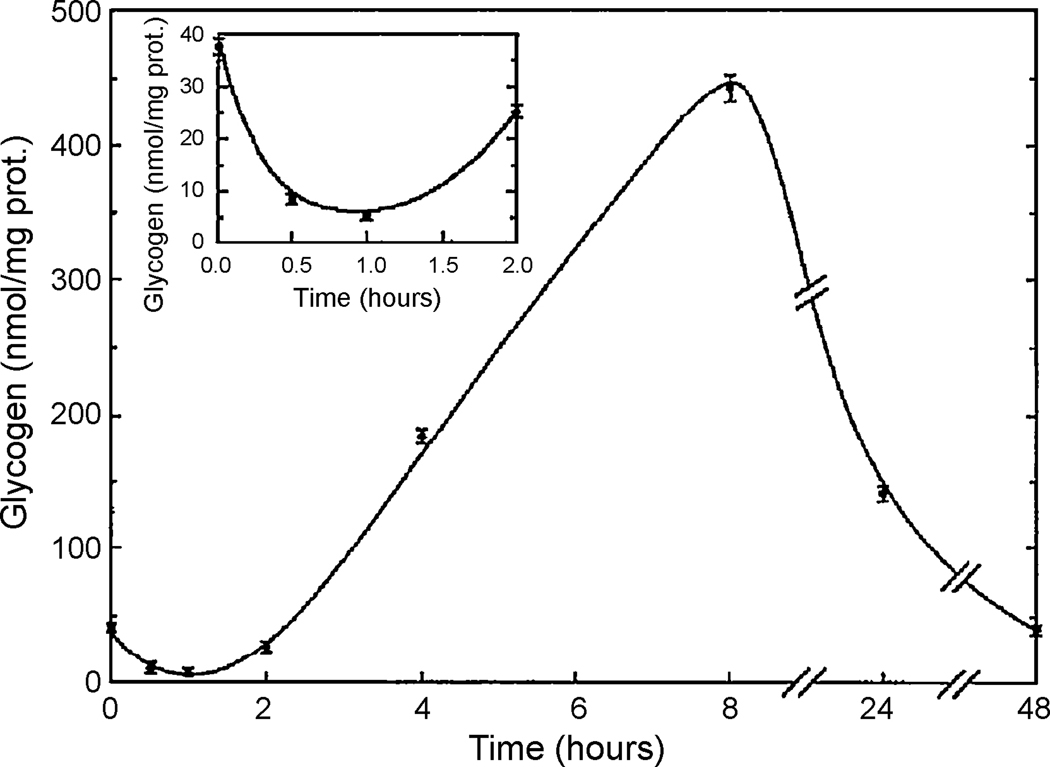
Changes in glycogen in astrocytic cell culture following application of vasoactive intestinal peptide. Primary cultures of cerebral cortical astrocytes were treated with vasoactive intestinal peptide. Glycogen (in nmol/mg protein) was measured at 0.5, 1, 2, 4, 8, 24 and 48 hours after treatment. There is an initial decrease in glycogen (see inset) followed by an increase, which peaks at 8 hours. Levels of glycogen then decline again at 24 hours and 48 hours post-treatment. (Sorg and Magistretti, 1992; reprinted with permission, copyright 1992 by the Society for Neuroscience.)
Figure 4
Figure 4
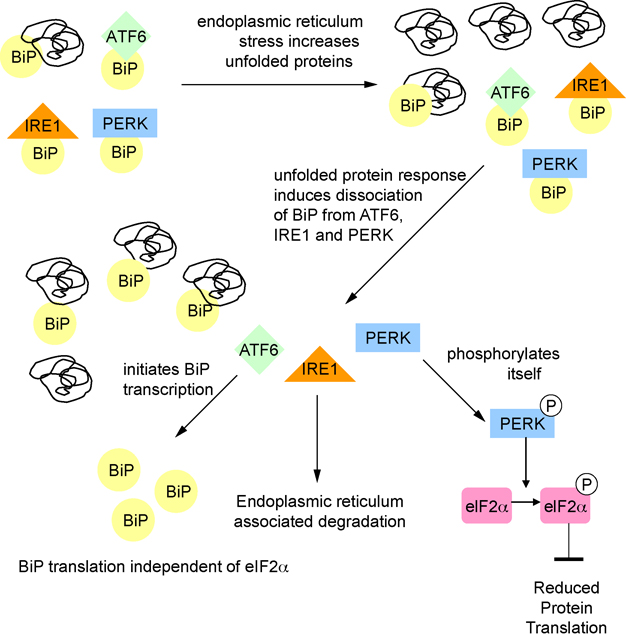
Unfolded protein response during sleep deprivation. Conditions of endoplasmic reticulum stress such as sleep deprivation lead to increases in unfolded proteins. When proteins are misfolded, the chaperone BiP binds to them. BiP dissociates from ATF6, PERK, and IRE1. PERK autophosphorylates and then phosphorylates eIF2α leading to decreases in protein translation. ATF6 initiates transcription of BiP, which is translated independent of eIF2α.
Figure 5
Figure 5
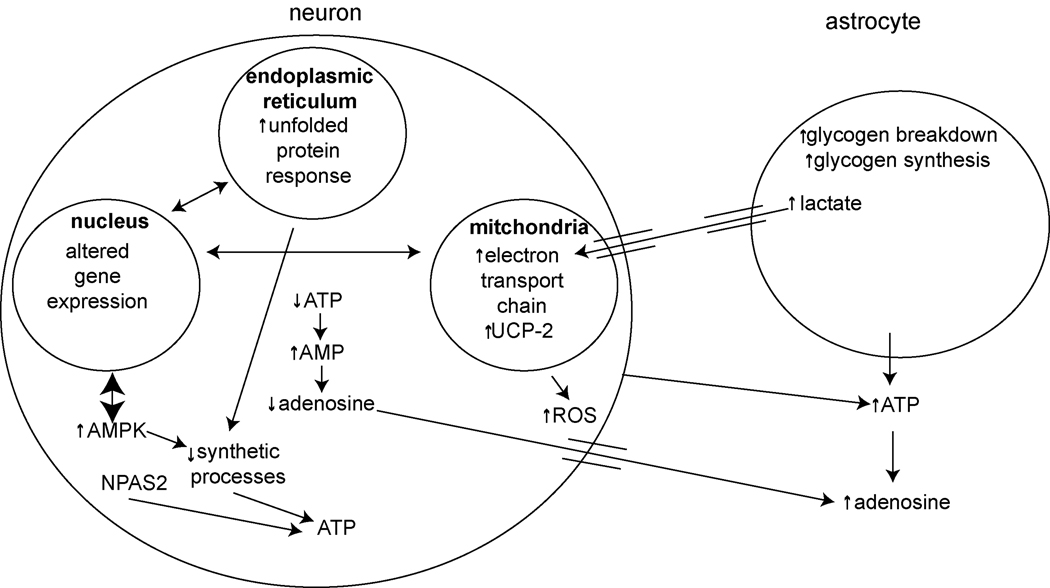
Proposed model of alterations in energy homeostasis during extended wakefulness. In astrocytes, glycogen breakdown and synthesis occur concomitantly. Lactate is transported out of astrocytes and taken up by neurons where it enters the mitochondria and the krebs cycle to produce ATP. Also within the mitochondria, there is an increase in the activity of the electron transport chain to increase ATP production. Reactive oxygen species are produced as a byproduct of this increased activity of the electron transport chain. UCP-2 increases to attenuate production of reactive oxygen species. In the endoplasmic reticulum, the unfolded protein response occurs. This ultimately leads to transcriptional changes as well as decreases in energy-consuming synthetic processes. AMPK is activated, which also attenuates energy-consuming synthetic processes. NPAS2 most likely also acts to preserve energy. Multiple pathways lead to changes in gene expression. Adenosine increases in the extracellular space either by transport out of the cell and/or by conversion of ATP released from glia or neurons into adenosine.

References

    1. Alam MN, Szymusiak R, Gong H, King J, McGinty D. Adenosinergic modulation of rat basal forebrain neurons during sleep and waking: neuronal recording with microdialysis. J Physiol. 1999;521(Pt 3):679–690. - PMC - PubMed
    1. Alberts B, Johnson A, Lewis J, Raff M, Roberts K, Walter P. Molecular Biology of the Cell. 2002
    1. Allaman I, Pellerin L, Magistretti PJ. Protein targeting to glycogen mRNA expression is stimulated by noradrenaline in mouse cortical astrocytes. Glia. 2000;30:382–391. - PubMed
    1. Allaman I, Pellerin L, Magistretti PJ. Glucocorticoids modulate neurotransmitter-induced glycogen metabolism in cultured cortical astrocytes. J Neurochem. 2004;88:900–908. - PubMed
    1. Andrews ZB, Diano S, Horvath TL. Mitochondrial uncoupling proteins in the CNS: in support of function and survival. Nat Rev Neurosci. 2005;6:829–840. - PubMed

Publication types