


Protection of wild-type and severe combined immunodeficiency mice against an intranasal challenge by passive immunization with monoclonal antibodies to the Chlamydia trachomatis mouse pneumonitis major outer membrane protein
- PMID: 18809664
- PMCID: PMC2583570
- DOI: 10.1128/IAI.00574-08
Protection of wild-type and severe combined immunodeficiency mice against an intranasal challenge by passive immunization with monoclonal antibodies to the Chlamydia trachomatis mouse pneumonitis major outer membrane protein
Abstract
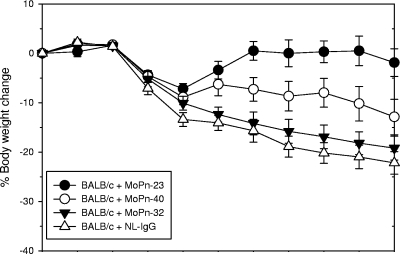
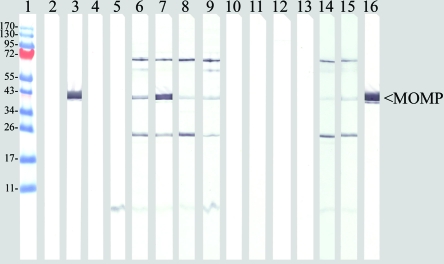
Monoclonal antibodies (MAbs) to the Chlamydia trachomatis mouse pneumonitis (MoPn) major outer membrane protein (MOMP) were characterized for their ability to neutralize the infectivity of this organism in vitro and in vivo. One of the MAbs (MoPn-23) recognizes a nonlinear epitope in the MOMP, MAb MoPn-40 binds to a linear epitope in the variable domain 1 (VD1), and MAb MoPn-32 recognizes the chlamydial lipopolysaccharide. MAb MoPn-23 neutralized 50% of the infectivity of Chlamydia, as measured in vitro by using HAK (Fc gammaIII(-)) and HeLa-229 (Fc gammaIII(+)) cells at a concentration 100 times lower than MAb MoPn-40. MAb MoPn-32 had no neutralizing ability. In comparison to the control normal mouse immunoglobulin G, passive immunization of BALB/c mice with MAb MoPn-23 resulted in a highly significant protection against an intranasal (i.n.) challenge as determined by the change in body weight, the weight of the lungs, and the yield of Chlamydia inclusion-forming units (IFU) from the lungs. Passive immunization with MAb MoPn-40 resulted in a lower degree of protection, and MAb MoPn-32 afforded no protection. MAb MoPn-23 was also tested for its ability to protect wild-type (WT) and severe combined immunodeficient (SCID) C.B-17 mice against an i.n. challenge. Protection based on total body weight, lung weight, and yield of Chlamydia IFU was as effective in SCID as in WT C.B-17 mice. In conclusion, antibodies to MOMP can protect mice against a chlamydial infection in the presence or absence of T and B cells.
Figures

References
-
- Bancroft, G. J., K. C. F. Sheehan, R. D. Schreiber, and E. R. Unanue. 1989. Tumor necrosis factor is involved in the T cell-independent pathway of macrophage activation in SCID mice. J. Immunol. 143127-130. - PubMed
-
- Brunham, R. C., and J. Rey-Ladino. 2005. Immunology of Chlamydia infection: implications for a Chlamydia trachomatis vaccine. Nat. Rev. Immunol. 5149-161. - PubMed
-
- Buzoni-Gatel, D., F. Bernard, A. Andersen, and A. Rodolakis. 1990. Protective effect of polyclonal and monoclonal antibodies against abortion in mice infected by Chlamydia psittaci. Vaccine 8342-346. - PubMed
Publication types
MeSH terms
Substances
Grants and funding
LinkOut - more resources
Full Text Sources
Medical
