


Low prevalence of antibodies to preerythrocytic but not blood-stage Plasmodium falciparum antigens in an area of unstable malaria transmission compared to prevalence in an area of stable malaria transmission
- PMID: 18809666
- PMCID: PMC2583556
- DOI: 10.1128/IAI.00591-08
Low prevalence of antibodies to preerythrocytic but not blood-stage Plasmodium falciparum antigens in an area of unstable malaria transmission compared to prevalence in an area of stable malaria transmission
Abstract
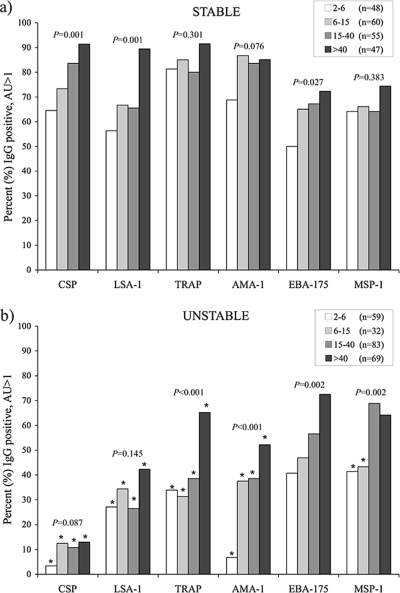
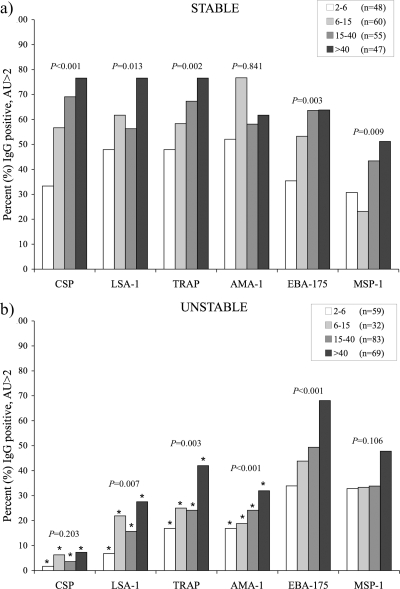
In areas where levels of transmission of Plasmodium falciparum are high and stable, the age-related acquisition of high-level immunoglobulin G (IgG) antibodies to preerythrocytic circumsporozoite protein (CSP) and liver-stage antigen 1 (LSA-1) has been associated with protection from clinical malaria. In contrast, age-related protection from malaria develops slowly or not at all in residents of epidemic-prone areas with unstable low levels of malaria transmission. We hypothesized that this suboptimal clinical and parasitological immunity may in part be due to reduced antibodies to CSP or LSA-1 and/or vaccine candidate blood-stage antigens. Frequencies and levels of IgG antibodies to CSP, LSA-1, thrombospondin-related adhesive protein (TRAP), apical membrane antigen 1 (AMA-1), erythrocyte binding antigen 175 (EBA-175), and merozoite surface protein 1 (MSP-1) were compared in 243 Kenyans living in a highland area of unstable transmission and 210 residents of a nearby lowland area of stable transmission. Levels of antibodies to CSP, LSA-1, TRAP, and AMA-1 in the oldest age group (>40 years) in the unstable transmission area were lower than or similar to those of children 2 to 6 years old in the stable transmission area. Only 3.3% of individuals in the unstable transmission area had high levels of IgG (>2 arbitrary units) to both CSP and LSA-1, compared to 43.3% of individuals in the stable transmission area. In contrast, antibody levels to and frequencies of MSP-1 and EBA-175 were similar in adults in areas of stable and unstable malaria transmission. Suboptimal immunity to malaria in areas of unstable malaria transmission may relate in part to infrequent high-level antibodies to preerythrocytic antigens and AMA-1.
Figures
References
-
- Alonso, P. L., J. Sacarlal, J. J. Aponte, A. Leach, E. Macete, P. Aide, B. Sigauque, J. Milman, I. Mandomando, Q. Bassat, C. Guinovart, M. Espasa, S. Corachan, M. Lievens, M. M. Navia, M. C. Dubois, C. Menendez, F. Dubovsky, J. Cohen, R. Thompson, and W. R. Ballou. 2005. Duration of protection with RTS,S/AS02A malaria vaccine in prevention of Plasmodium falciparum disease in Mozambican children: single-blind extended follow-up of a randomised controlled trial. Lancet 3662012-2018. - PubMed
-
- al-Yaman, F., B. Genton, R. F. Anders, M. Falk, T. Triglia, D. Lewis, J. Hii, H. P. Beck, and M. P. Alpers. 1994. Relationship between humoral response to Plasmodium falciparum merozoite surface antigen-2 and malaria morbidity in a highly endemic area of Papua New Guinea. Am. J. Trop. Med. Hyg. 51593-602. - PubMed
-
- Beier, J. C., P. V. Perkins, F. K. Onyango, T. P. Gargan, C. N. Oster, R. E. Whitmire, D. K. Koech, and C. R. Roberts. 1990. Characterization of malaria transmission by Anopheles (Diptera: Culicidae) in western Kenya in preparation for malaria vaccine trials. J. Med. Entomol. 27570-577. - PubMed
-
- Bojang, K. A., P. J. Milligan, M. Pinder, L. Vigneron, A. Alloueche, K. E. Kester, W. R. Ballou, D. J. Conway, W. H. Reece, P. Gothard, L. Yamuah, M. Delchambre, G. Voss, B. M. Greenwood, A. Hill, K. P. McAdam, N. Tornieporth, J. D. Cohen, and T. Doherty. 2001. Efficacy of RTS,S/AS02 malaria vaccine against Plasmodium falciparum infection in semi-immune adult men in The Gambia: a randomised trial. Lancet 3581927-1934. - PubMed
-
- Branch, O. H., V. Udhayakumar, A. W. Hightower, A. J. Oloo, W. A. Hawley, B. L. Nahlen, P. B. Bloland, D. C. Kaslow, and A. A. Lal. 1998. A longitudinal investigation of IgG and IgM antibody responses to the merozoite surface protein-1 19-kiloDalton domain of Plasmodium falciparum in pregnant women and infants: associations with febrile illness, parasitemia, and anemia. Am. J. Trop. Med. Hyg. 58211-219. - PubMed
Publication types
MeSH terms
Substances
Grants and funding
LinkOut - more resources
Full Text Sources
Research Materials
