Chronic immune stimulation and subsequent Waldenström macroglobulinemia
- PMID: 18809818
- PMCID: PMC2670401
- DOI: 10.1001/archinternmed.2008.4
Chronic immune stimulation and subsequent Waldenström macroglobulinemia
Abstract
Background: Certain autoimmune and infectious conditions are associated with increased risks of subtypes of non-Hodgkin lymphoma. A few previous studies suggest that chronic inflammation may particularly elevate risk of the distinct non-Hodgkin lymphoma subtype Waldenström macroglobulinemia (WM).
Methods: We assessed WM risk in relation to a variety of chronic immune stimulatory conditions in 4 million US veterans. We identified 361 patients with WM with up to 27 years of follow-up. Using time-dependent Poisson regression, we estimated rate ratios (RRs) and 95% confidence intervals (CIs) for WM risk in relation to history of autoimmune diseases that typically have autoantibodies (with systemic or organ involvement) or do not have autoantibodies, infections, and allergies. All the models were adjusted for attained age, calendar year, race, number of hospital visits, and latency between study entry and exit.
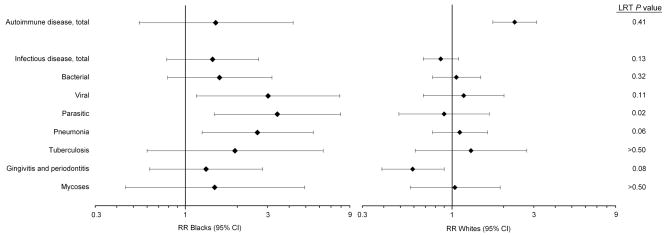
Results: The age-standardized incidence of WM was 0.34 per 100,000 person-years. Risk of WM was elevated in individuals with any previous autoimmune condition (RR, 2.23; 95% CI, 1.68-2.97), autoantibodies with systemic involvement (2.50; 1.55-4.02), or autoantibodies with organ involvement (2.30; 1.57-3.37). Risks of WM were also increased with hepatitis (RR, 3.39; 95% CI, 1.38-8.30), human immunodeficiency virus (12.05; 2.83-51.46), and rickettsiosis (3.35; 1.38-8.14).
Conclusions: In the largest investigation of WM risk factors to date, we found a 2- to 3-fold elevated risk of WM in persons with a personal history of autoimmune diseases with autoantibodies and notably elevated risks associated with hepatitis, human immunodeficiency virus, and rickettsiosis. These findings provide novel insights into the still unknown etiology of WM.
Figures
References
-
- Berger F, Isaacson PG, Piris MA, et al. Lymphoplasmacytic lymphoma/Waldenstrom macroglobulinemia. In: Jaffe ES, Harris NL, Stein H, Vardiman JW, editors. Pathology and Genetics of Tumours of Haematopoietic and Lymphoid Tissues. Lyon: IARC Press; 2001. pp. 132–134.
-
- Owen RG, Treon SP, Al Katib A, et al. Clinicopathological definition of Waldenstrom’s macroglobulinemia: consensus panel recommendations from the Second International Workshop on Waldenstrom’s Macroglobulinemia. Semin Oncol. 2003;30:110–115. - PubMed
-
- Fonseca R, Hayman S. Waldenstrom macroglobulinaemia. Br J Haematol. 2007;138:700–720. - PubMed
-
- Vijay A, Gertz MA. Waldenstrom macroglobulinemia. Blood. 2007;109:5096–5103. - PubMed
-
- Groves FD, Travis LB, Devesa SS, Ries LA, Fraumeni JF., Jr Waldenstrom’s macroglobulinemia: incidence patterns in the United States, 1988–1994. Cancer. 1998;82:1078–1081. - PubMed
Publication types
MeSH terms
Substances
Grants and funding
LinkOut - more resources
Full Text Sources
Other Literature Sources
Medical