


Midterm to long-term followup of staged reimplantation for infected hip arthroplasty
- PMID: 18813895
- PMCID: PMC2600996
- DOI: 10.1007/s11999-008-0480-4
Midterm to long-term followup of staged reimplantation for infected hip arthroplasty
Abstract
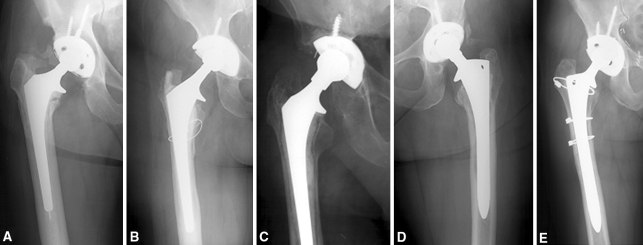
Most reports on two-stage reimplantation have focused on the short-term cure rate of infection, but little is known about long-term reinfection-free survival or mechanical durability. We retrospectively reviewed 168 patients (169 hips) with infected arthroplasty, all of whom had two-stage reimplantation for the treatment of an infected total hip arthroplasty between 1988 and 1998. In the second stage, the femoral component was fixed with antibiotic-loaded bone cement in 121 hips; the remaining femoral components and all acetabular components were uncemented. The minimum followup time was 2 years (mean, 7 years; range, 2-16 years). At most recent followup, 12 hips (7.1%) were reoperated on for reinfection and 13 hips (7.7%) were revised for aseptic loosening or osteolysis. Apparently aseptic loosening occurred on one or both sides of the joint in 24 hips (14.2%). The 10-year survivals free of reinfection and mechanical failure were 87.5% and 75.2% respectively. Nineteen hips dislocated and eight underwent revision surgery for instability. The method of femoral component fixation, either with or without cement, did not correlate with risk of infection, loosening, or mechanical failure. Based on these results, the method of fixation used for the femoral component during two-stage reimplantation surgery should be based on the surgeon's preference for fixation combined with the assessment of femoral bone stock.
Level of evidence: Level IV, case series. See the Guidelines for Authors for a complete description of levels of evidence.
Figures

References
-
- Colyer RA, Capello WN. Surgical treatment of the infected hip implant. Two-stage reimplantation with a one-month interval. Clin Orthop Relat Res. 1994;298:75–79. - PubMed
-
- Davis CM 3rd, Berry DJ, Harmsen WS. Cemented revision of failed uncemented femoral components of total hip arthroplasty. J Bone Joint Surg Am. 2003;85:1264–1269. - PubMed
-
- Duncan CP, Masri BA. The role of antibiotic-loaded cement in the treatment of an infection after a hip replacement. Instr Course Lect. 1995;44:305–313. - PubMed
MeSH terms
Substances
LinkOut - more resources
Full Text Sources
Medical
