


Cross-regulation between distinct natural killer T cell subsets influences immune response to self and foreign antigens
- PMID: 18814145
- PMCID: PMC2653050
- DOI: 10.1002/jcp.21597
Cross-regulation between distinct natural killer T cell subsets influences immune response to self and foreign antigens
Abstract
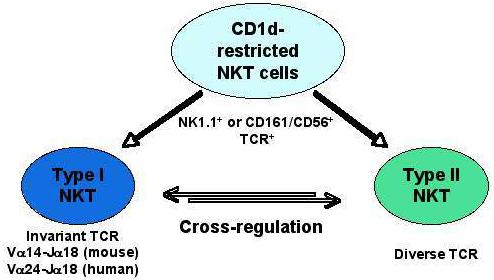
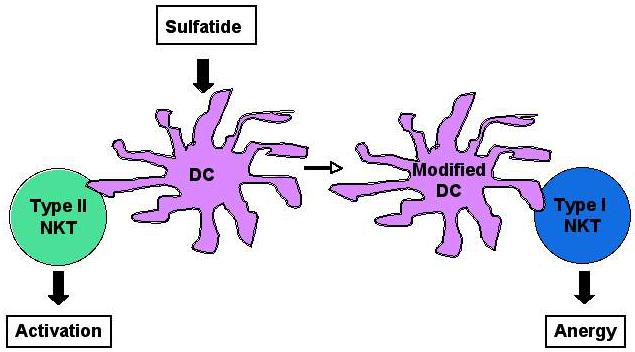
Natural killer T (NKT) cells generally recognize lipid-antigens presented in the context of the MHC class I-like molecule CD1d. CD1d-restricted NKT cells consist of two broad subsets: Type I, which express an invariant T cell receptor (TCR) and type II, which utilize diverse TCR gene segments. A major type II NKT subset has been shown to recognize a self-glycolipid, sulfatide. Both subsets play important roles in autoimmune diseases, tumor surveillance, and infectious diseases. While type I NKT cells protect from tumor growth by enhancing tumor surveillance, type II NKT cells may suppress anti-tumor immune responses. In a murine autoimmune hepatitis model, type I NKT cells contribute to pathogenesis, whereas activation of sulfatide-reactive type II NKT cells protects from disease. Sulfatide-mediated activation of type II NKT cells results in modification of dendritic cells and induction of anergy in type I NKT cells. Elucidation of this novel pathway of cross-regulation among NKT cell subsets will provide tools for intervention in autoimmune diseases and for designing strategies for effective anti-tumor immunity.
(c) 2008 Wiley-Liss, Inc.
Figures
References
-
- Akbari O, Faul JL, Hoyte EG, Berry GJ, Wahlstrom J, Kronenberg M, DeKruyff RH, Umetsu DT. CD4+ invariant T-cell-receptor+ natural killer T cells in bronchial asthma. N Engl J Med. 2006;354(11):1117–1129. - PubMed
-
- Akbari O, Stock P, Meyer E, Kronenberg M, Sidobre S, Nakayama T, Taniguchi M, Grusby MJ, DeKruyff RH, Umetsu DT. Essential role of NKT cells producing IL-4 and IL-13 in the development of allergen-induced airway hyperreactivity. Nat Med. 2003;9(5):582–588. - PubMed
-
- Ambrosino E, Terabe M, Halder RC, Peng J, Takaku S, Miyake S, Yamamura T, Kumar V, Berzofsky JA. Cross-regulation between type I and type II NKT cells in regulating tumor immunity: a new immunoregulatory axis. J Immunol. 2007;179(8):5126–5136. - PubMed
-
- Barral DC, Brenner MB. CD1 antigen presentation: how it works. Nat Rev Immunol. 2007;7(12):929–941. - PubMed
-
- Behar SM, Podrebarac TA, Roy CJ, Wang CR, Brenner MB. Diverse TCRs recognize murine CD1. J Immunol. 1999;162(1):161–167. - PubMed
Publication types
MeSH terms
Substances
Grants and funding
LinkOut - more resources
Full Text Sources
Research Materials
