


Effects of aging and arm swing on the metabolic cost of stability in human walking
- PMID: 18814873
- PMCID: PMC2741013
- DOI: 10.1016/j.jbiomech.2008.06.039
Effects of aging and arm swing on the metabolic cost of stability in human walking
Abstract
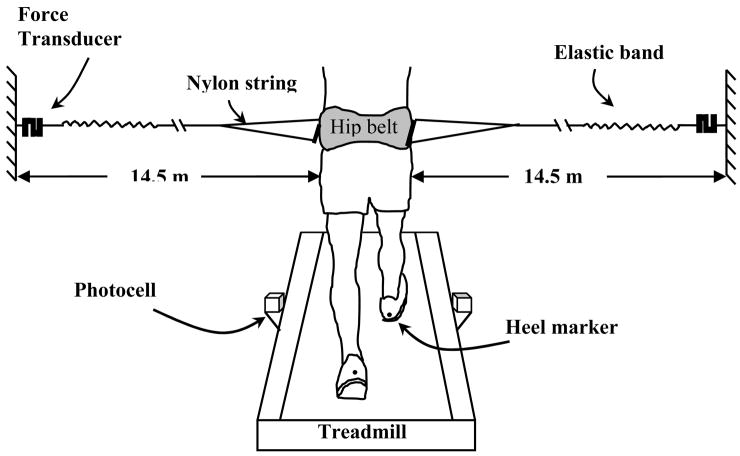
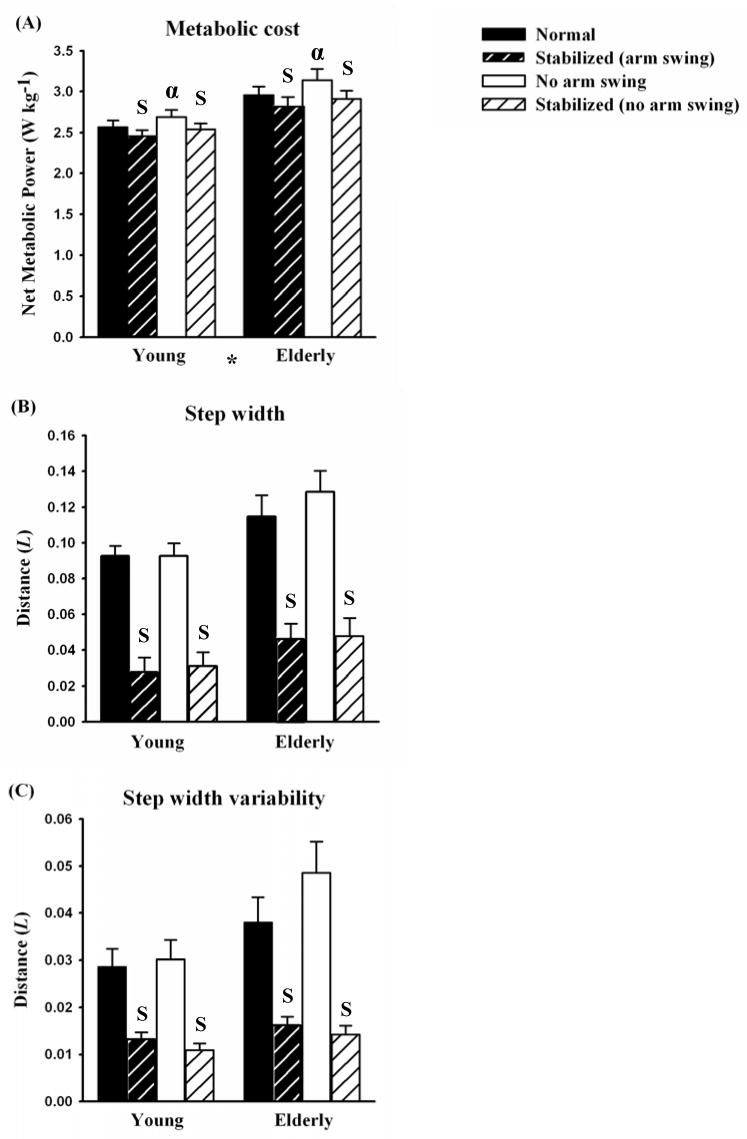
To gain insight into the mechanical determinants of walking energetics, we investigated the effects of aging and arm swing on the metabolic cost of stabilization. We tested two hypotheses: (1) elderly adults consume more metabolic energy during walking than young adults because they consume more metabolic energy for lateral stabilization, and (2) arm swing reduces the metabolic cost of stabilization during walking in young and elderly adults. To test these hypotheses, we provided external lateral stabilization by applying bilateral forces (10% body weight) to a waist belt via elastic cords while young and elderly subjects walked at 1.3m/s on a motorized treadmill with arm swing and with no arm swing. We found that the external stabilizer reduced the net rate of metabolic energy consumption to a similar extent in elderly and young subjects. This reduction was greater (6-7%) when subjects walked with no arm swing than when they walked normally (3-4%). When young or elderly subjects eliminated arm swing while walking with no external stabilization, net metabolic power increased by 5-6%. We conclude that the greater metabolic cost of walking in elderly adults is not caused by a greater cost of lateral stabilization. Moreover, arm swing reduces the metabolic cost of walking in both young and elderly adults likely by contributing to stability.
Figures
References
-
- Bauby CE, Kuo AD. Active control of lateral balance in human walking. Journal of Biomechanics. 2000;33:1433–1440. - PubMed
-
- Benjuya N, Melzer I, Kaplanski J. Aging-induced shifts from a reliance on sensory input to muscle cocontraction during balanced standing. Journals of Gerontology. Series A, Biological Sciences and Medical Sciences. 2004;59:166–171. - PubMed
-
- Blanke DJ, Hageman PA. Comparison of gait of young men and elderly men. Physical Therapy. 1989;69:144–148. - PubMed
-
- Brockway JM. Derivation of formulae used to calculate energy expenditure in man. Human Nutrition: Clinical Nutrition. 1987;41:463–471. - PubMed
Publication types
MeSH terms
Grants and funding
LinkOut - more resources
Full Text Sources
Medical
