Glomerular function, structure, and number in renal allografts from older deceased donors
- PMID: 18815243
- PMCID: PMC2615719
- DOI: 10.1681/ASN.2008030306
Glomerular function, structure, and number in renal allografts from older deceased donors
Abstract
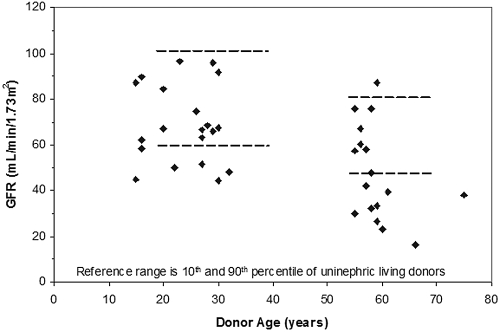
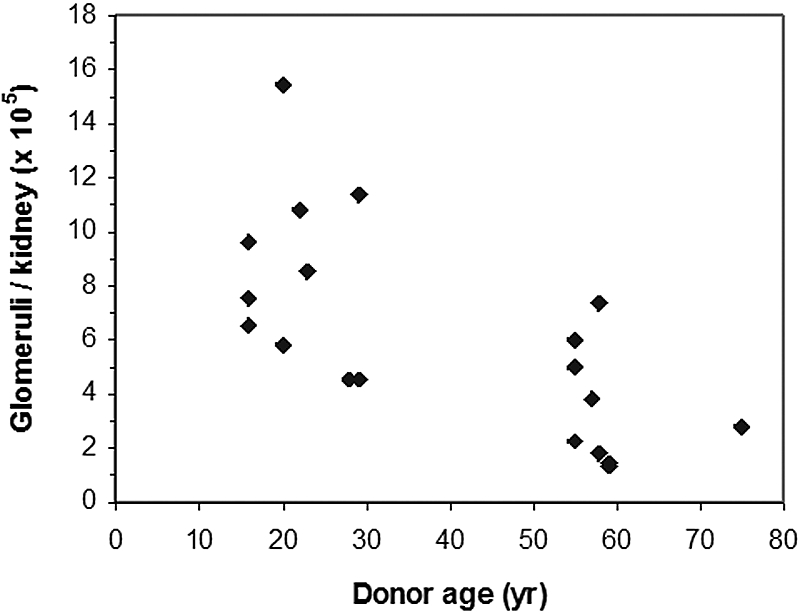
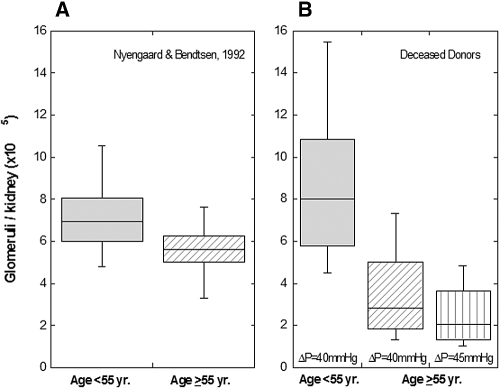
The 5-yr survival rate of renal allografts is significantly lower for grafts from older deceased donors than from younger deceased donors. For evaluation of the potential contribution of renal senescence in this shortened graft survival, glomerular function and structure were analyzed in allografts from deceased donors older than 55 yr ("aging") or younger than 40 yr ("youthful"). Aging donors had a significantly higher prevalence of sclerotic glomeruli (P < 0.002), and their nonsclerotic glomeruli tended to be larger, had a larger filtration surface area (P = 0.02), and had a higher single-nephron ultrafiltration coefficient (K(f); P = 0.07), suggesting a compensatory response to functional loss of glomeruli. After serum creatinine reached a stable nadir in the transplant recipients, GFR and its hemodynamic determinants were evaluated and the whole allograft K(f) was computed. Compared with the allografts from youthful donors, allografts from aging donors exhibited a 32% lower GFR, which was exclusively attributable to a 45% reduction in allograft K(f) (both P < 0.001). In addition, the number of functioning glomeruli per allograft was profoundly lower in grafts from aging donors than from youthful donors (3.6 +/- 2.1 x 10(5) versus 8.5 +/- 3.4 x 10(5); P < 0.01), and this could not be explained by the relatively modest 17% prevalence of global glomerulosclerosis in the aging group. The marked reduction in overall glomerular number in many aging donors may lead to a "remnant kidney" phenomenon, potentially explaining the shorter mean survival of these allografts.
Figures
References
-
- U.S. Transplantation Data, United Network for Organ Sharing (UNOS), 2008
-
- Hoang K, Tan JC, Derby G, Blouch KL, Masek M, Ma I, Lemley KV, Myers BD: Determinants of glomerular hypofiltration in aging humans. Kidney Int 64: 1417–1424, 2003 - PubMed
-
- Wesson LG: Renal hemodynamics in physiological states. In: Physiology of the Human Kidney, edited by Wesson LG, New York, Grune & Stratton, 1969, pp 96–108
-
- Lindeman RD: Overview: Renal physiology and pathophysiology of aging. Am J Kidney Dis 16: 275–282, 1990 - PubMed
Publication types
MeSH terms
Grants and funding
LinkOut - more resources
Full Text Sources
Medical