doi: 10.1371/journal.pbio.0060237.
It's not how fat you are, it's what you do with it that counts
Affiliations
- PMID: 18816166
- PMCID: PMC2553843
- DOI: 10.1371/journal.pbio.0060237
Item in Clipboard
It's not how fat you are, it's what you do with it that counts
PLoS Biol.
.
Abstract
Mechanisms underlying obesity-related metabolic disorders are poorly understood. Samuel Virtue and Antonio Vidal-Puig explore the evidence for an emerging hypothesis that attributes metabolic complications not to obesity per se, but to an individual's capacity for adipose tissue expandability.
Figures
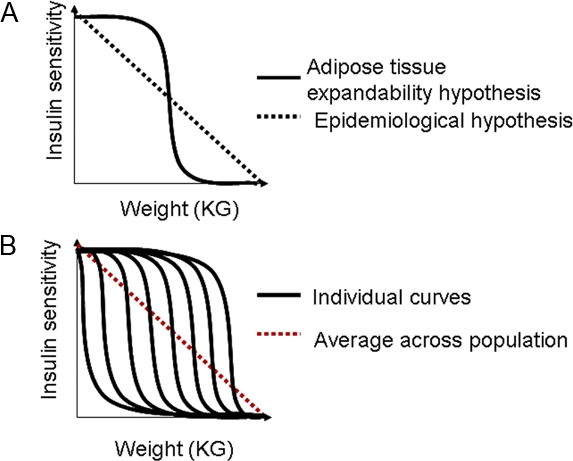
(A) Diagram showing the different models of how weight loss affects insulin sensitivity within an individual. (B) Diagram showing how multiple individuals with sigmoid responses in insulin sensitivity can add to form a linear alteration in insulin sensitivity across a population.
References
-
- UK Government Foresight Program. Modelling Future Trends in Obesity and the Impact on Health, Foresight. 2008. Available: http://www.foresight.gov.uk/Obesity/14.pdf. Accessed 24 August 2008.
-
- Haffner MS. Relationship of metabolic risk factors and development of cardiovascular disease and diabetes. Obesity. 2006;14:121S–127S. - PubMed
-
- Barroso I, Gurnell M, Crowley VE, Agostini M, Schwabe JW, et al. Dominant negative mutations in human PPARgamma associated with severe insulin resistance, diabetes mellitus and hypertension. Nature. 1999;402:880–883. - PubMed
-
- Savage DB, Tan GD, Acerini CL, Jebb SA, Agostini M, et al. Human metabolic syndrome resulting from dominant-negative mutations in the nuclear receptor peroxisome proliferator-activated receptor-gamma. Diabetes. 2003;52:910–917. - PubMed
-
- Karelis AD, Brochu M, Rabasa-Lhoret R. Can we identify metabolically healthy but obese individuals (MHO) Diabetes Metab. 2004;30:569–572. - PubMed
Publication types
MeSH terms
Grants and funding
LinkOut - more resources
Full Text Sources
Other Literature Sources
Medical