


Comprehensive study of proteasome inhibitors against Plasmodium falciparum laboratory strains and field isolates from Gabon
- PMID: 18816382
- PMCID: PMC2569964
- DOI: 10.1186/1475-2875-7-187
Comprehensive study of proteasome inhibitors against Plasmodium falciparum laboratory strains and field isolates from Gabon
Abstract
Background: The emergence and spread of Plasmodium falciparum resistance to almost all available antimalarial drugs necessitates the search for new chemotherapeutic compounds. The ubiquitin/proteasome system plays a major role in overall protein turnover, especially in fast dividing eukaryotic cells including plasmodia. Previous studies show that the 20S proteasome is expressed and catalytically active in plasmodia and treatment with proteasome inhibitors arrests parasite growth. This is the first comprehensive screening of proteasome inhibitors with different chemical modes of action against laboratory strains of P. falciparum. Subsequently, a selection of inhibitors was tested in field isolates from Lambaréné, Gabon.
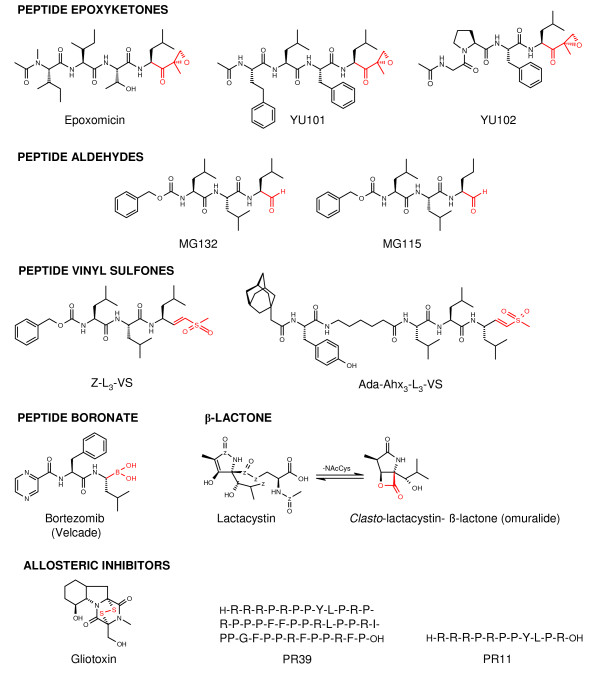
Methods: Epoxomicin, YU101, YU102, MG132, MG115, Z-L(3)-VS, Ada-Ahx(3)-L(3)-VS, lactacystin, bortezomib (Velcade), gliotoxin, PR11 and PR39 were tested and compared to chloroquine- and artesunate-activities in a standardized in vitro drug susceptibility assay against P. falciparum laboratory strains 3D7, D10 and Dd2. Freshly obtained field isolates from Lambaréné, Gabon, were used to measure the activity of chloroquine, artesunate, epoxomicin, MG132, lactacystin and bortezomib. Parasite growth was detected through histidine-rich protein 2 (HRP2) production. Raw data were fitted by a four-parameter logistic model and individual inhibitory concentrations (50%, 90%, and 99%) were calculated.
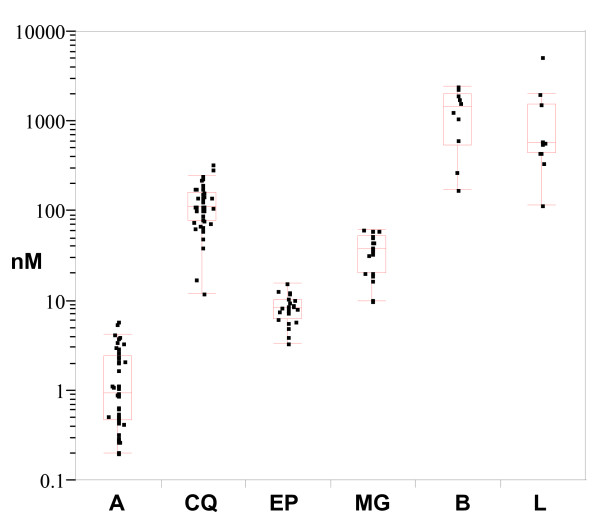
Results: Amongst all proteasome inhibitors tested, epoxomicin showed the highest activity in chloroquine-susceptible (IC50: 6.8 nM [3D7], 1.7 nM [D10]) and in chloroquine-resistant laboratory strains (IC50: 10.4 nM [Dd2]) as well as in field isolates (IC50: 8.5 nM). The comparator drug artesunate was even more active (IC50: 1.0 nM), whereas all strains were chloroquine-resistant (IC50: 113 nM).
Conclusion: The peptide alpha',beta'-epoxyketone epoxomicin is highly active against P. falciparum regardless the grade of the parasite's chloroquine susceptibility. Therefore, inhibition of the proteasome is a highly promising strategy to develop new antimalarials. Epoxomicin can serve as a standard to compare new inhibitors with species-specific activity.
Figures
References
-
- Hatabu T, Hagiwara M, Taguchi N, Kiyozawa M, Suzuki M, Kano S, Sato K. Plasmodium falciparum: the fungal metabolite gliotoxin inhibits proteasome proteolytic activity and exerts a plasmodicidal effect on P. falciparum. Exp Parasitol. 2006;112:179–183. doi: 10.1016/j.exppara.2005.11.012. - DOI - PubMed
Publication types
MeSH terms
Substances
LinkOut - more resources
Full Text Sources
Other Literature Sources
Research Materials
