Review
. 2009 Apr;24(4):697-705.
doi: 10.1007/s00467-008-0968-x. Epub 2008 Sep 26.

Inherited forms of renal hypomagnesemia: an update

Affiliations
Review

Inherited forms of renal hypomagnesemia: an update

Nine V A M Knoers. Pediatr Nephrol. 2009 Apr.

Abstract

The kidney plays an important role in ion homeostasis in the human body. Several hereditary disorders characterized by perturbations in renal magnesium reabsorption leading to hypomagnesemia have been described over the past 50 years, with the most important of these being Gitelman syndrome, familial hypomagnesemia with hypercalciuria and nephrocalcinosis, familial hypomagnesemia with secondary hypocalcemia, autosomal dominant hypomagnesemia with hypocalciuria, and autosomal recessive hypomagnesemia. Only recently, following positional cloning strategies in affected families, have mutations in renal ion channels and transporters been identified in these diseases. In this short review, I give an update on these hypomagnesemic disorders. Elucidation of the genetic etiology and, for most of these disorders, also the underlying pathophysiology of the disease, has greatly increased our understanding of the normal physiology of renal magnesium handling. This is yet another example of the importance of studying rare disorders in order to unravel physiological and pathophysiological processes in the human body.


Figures
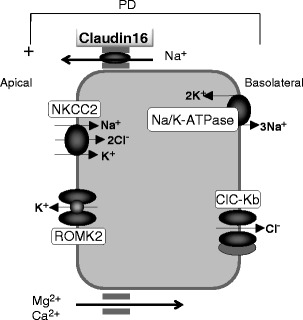
Fig. 1
Fig. 1
Speculative model of magnesium transport in the thick ascending limb of Henle’s loop. Sodium chloride enters the cell via the apical Na+, K+, 2Cl cotransporter (NKCC2). Potassium is recycled into the lumen via the luminal ATP-regulated inwardly rectifying potassium channel (ROMK2). Chloride leaves the cell through the basolateral Cl- channel (ClC-Kb) and sodium via the basolateral Na+/K+-ATPase complex. A lumen-positive potential (PD) is established by the actions of NKCC2 and ROMK2. Sodium partially leaks back into the lumen via claudin-16, increasing this lumen positive potential, thereby driving magnesium and calcium reabsorption via the paracellular pathway
Fig. 2
Fig. 2
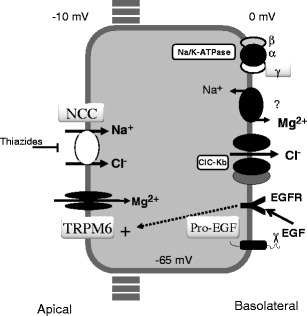
Speculative cellular model of magnesium transport in the distal convoluted tubule. Magnesium is reabsorbed by the apical transient receptor potential channel melastatin 6 (TRPM6) channel. Indicated also is a putative Na/Mg exchanger in the basolateral membrane, which may be responsible for extrusion of Mg2+. The Na+/K+-ATPase complex, including the γ-subunit, controls this transcellular Mg2+ transport. Pro-epithelial growth factor (Pro-EGF) expressed on the basolateral membrane is cleaved to yield EGF, engaging the EGF receptor (EGFR) which in turn stimulates TRPM6 activity. Also indicated are the apical thiazide-sensitive NaCl cotransporter (NCC), through which sodium chloride enters the cell, and the basolateral Cl- channel (ClC-Kb) and Na+/K+-ATPase that are responsible for extrusion of these ions. Both the NCC and CLC-Kb are involved in GS

References

    1. Voets T, Nilius B, Hoefs S, van der Kemp AW, Droogmans G, Bindels RJ, Hoenderop JG. TRPM6 forms the Mg2+ influx channel involved in intestinal and renal Mg2+ absorption. J Biol Chem. 2004;279:19–25. doi: 10.1074/jbc.M311201200. - DOI - PubMed
    1. Tejpar S, Piessevaux H, Claes K, Piront P, Hoenderop JG, Verslype C, Van Cutsem E. Magnesium wasting associated with epidermal-growth-factor receptor-targeting antibodies in colorectal cancer: a prospective study. Lancet Oncol. 2007;8:387–394. doi: 10.1016/S1470-2045(07)70108-0. - DOI - PubMed
    1. Praga M, Vara J, González-Parra E, Andrés A, Alamo C, Araque A, Ortiz A, Rodicio JL. Familial hypomagnesemia with hypercalciuria and nephrocalcinosis. Kidney Int. 1995;47:1419–1425. doi: 10.1038/ki.1995.199. - DOI - PubMed
    1. Manz F, Scharer K, Janka P, Lombeck J. Renal magnesium wasting, incomplete tubular acidosis, hypercalciuria, and nephrocalcinosis in siblings. Eur J Pediatr. 1978;128:67–79. doi: 10.1007/BF00496992. - DOI - PubMed
    1. Evans RA, Carter JN, George CR, Walls RS, Newland RC, McDonnell GD, Lawrence JR. The congenital “magnesium-loosing kidney”. Report of two patients. QJM. 1981;50:39–52. - PubMed

MeSH terms