. 2009 Jan;103(2):281-93.
doi: 10.1093/aob/mcn177. Epub 2008 Sep 26.

Measuring and interpreting respiratory critical oxygen pressures in roots

Affiliations

Measuring and interpreting respiratory critical oxygen pressures in roots

William Armstrong et al. Ann Bot. 2009 Jan.

Abstract

Background and aims: Respiratory critical oxygen pressures (COPR) determined from O(2)-depletion rates in media bathing intact or excised roots are unreliable indicators of respiratory O(2)-dependency in O(2)-free media and wetlands. A mathematical model was used to help illustrate this, and more relevant polarographic methods for determining COPR in roots of intact plants are discussed.

Methods: Cortical [O(2)] near the root apex was monitored indirectly (pea seedlings) from radial oxygen losses (ROL) using sleeving Pt electrodes, or directly (maize) using microelectrodes; [O(2)] in the root was controlled by manipulating [O(2)] around the shoots. Mathematical modelling of radial diffusive and respiratory properties of roots used Michaelis-Menten enzyme kinetics.

Key results: Respiration declined only when the O(2) partial pressure (OPP) in the cortex of root tips fell below 0.5-4.5 kPa, values consistent with depressed respiration near the centre of the stele as confirmed by microelectrode measurements and mathematical modelling. Modelling predictions suggested that the OPP of a significant core at the centre of roots could be below the usual detection limits of O(2)-microelectrodes but still support some aerobic respiration.

Conclusions: In O(2)-free media, as in wetlands, the COPR for roots is likely to be quite low, dependent upon the respiratory demands, dimensions and diffusion characteristics of the stele/stelar meristem and the enzyme kinetics of cytochrome oxidase. Roots of non-wetland plants may not differ greatly in their COPRs from those of wetland species. There is a possibility that trace amounts of O(2) may still be present in stelar 'anaerobic' cores where fermentation is induced at low cortical OPPs.


Figures
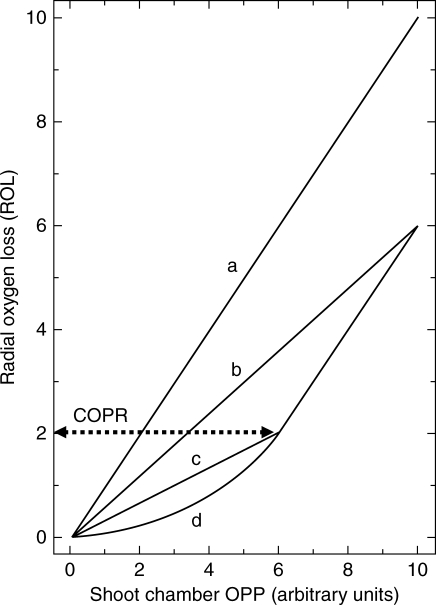
Fig. 1.
Fig. 1.
Predicted relationships between apical radial O2 loss (ROL) and shoot chamber O2 concentration (OPPshoot) when respiration is (a) zero, (b) a linear function of OPPshoot, (c) initially a linear function of OPPshoot but becoming constant at the critical O2 pressure (COPR) and (d) initially a curvilinear function of OPPshoot but becoming constant at the COPR. Arbitrary units used for shoot chamber OPP.
Fig. 2.
Fig. 2.
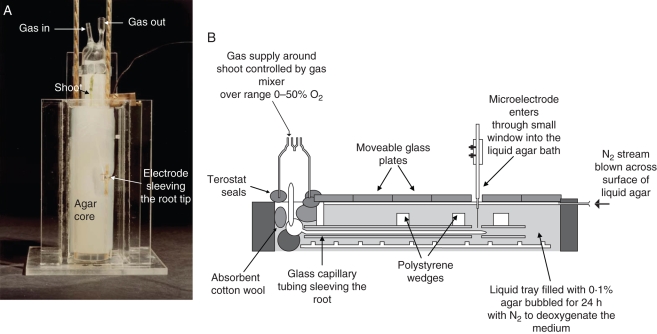
(A) Pea seedling with root system, except the apical region, held in a solid agar jacket and arranged in anaerobic 0·05 % agar/water medium with root apex ensheathed by a cylindrical Pt electrode. Shoot enclosed in humidified glass hood with gas-ports to enable changes to OPPshoot. (B) Assembly for effecting changes to OPPshoot for maize root COPR measurement by O2-microlectrodes.
Fig. 3.
Fig. 3.
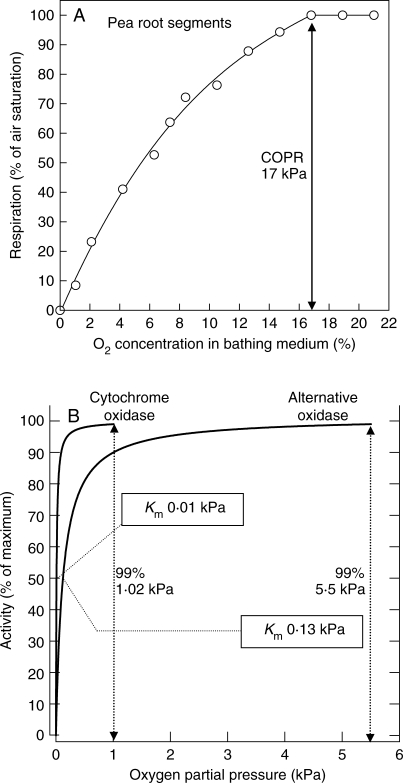
(A) The relationship between respiratory activity of pea root segments and O2 concentration in the bathing medium of a Rank (Clark-type) polarographic respirometer assembly with magnetic stirrer. The measurements were made at 22·5 °C using 30 4-mm-long segments from the apical 4 cm of three 12-cm-long roots bathed in 3 ml of 3 % glucose solution. (B) Michaelis–Menten curves derived by mathematical modelling and based on published Km values (Longmuir, 1954) for cytochrome oxidase and the alternative oxidase at the cellular level.
Fig. 4.
Fig. 4.
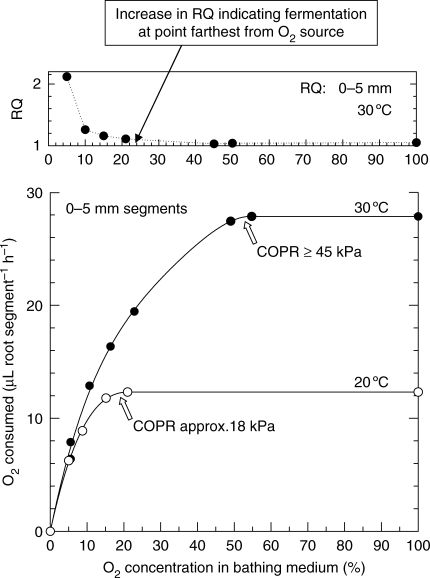
Oxygen consumption (μL root segment h−1) and corresponding RQ values (CO2 evolved: O2 consumed) for 0–5-mm root tips of onion in relation to O2 concentration in the bathing medium and at two temperatures. Measurements by Warburg respirometry using 2-d-old roots. Drawn from Berry and Norris (1949).
Fig. 5.
Fig. 5.
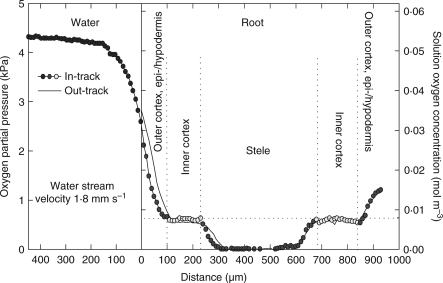
In-track (symbols) and out-track (continuous line) microelectrode radial O2 profiles across an excised primary root of maize lying in a nutrient medium that was streamed lengthwise past it at a velocity of 1·8 mm s−1. The dissolved O2 concentration in the medium was 0·054 mol m−3 (4·3 kPa); the profile was at 75 mm from the apex and total root length was 135 mm. Temperature, 25 °C. (Modified from Gibbs et al., 1998, where the depth of the vessel was wrongly given as 100 mm instead of 10 mm and the flow velocity given was incorrect.)
Fig. 6.
Fig. 6.
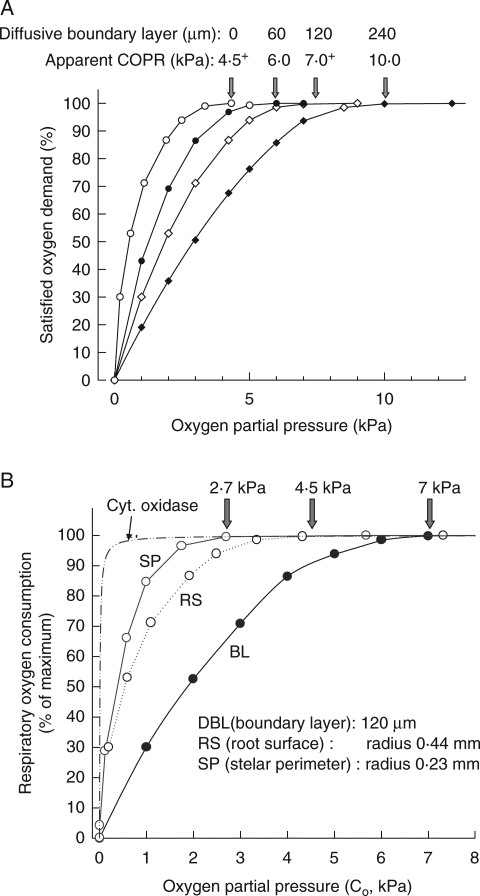
(A) Mathematical modelling predictions of root respiratory activity based on maize root characteristics and showing the effect on apparent COPR (measured in the bathing medium) of different diffusive boundary layer thicknesses (DBL) from zero to 240 µm. (B) Mathematical modelling predictions of root respiratory activity based on maize root characteristics and showing how the perceived COPR varies with point at which OPP is measured; the DBL of 120 µm and the OPP of 7 kPa in the bathing medium was just sufficient to begin to reduce respiration at the root centre.
Fig. 7.
Fig. 7.
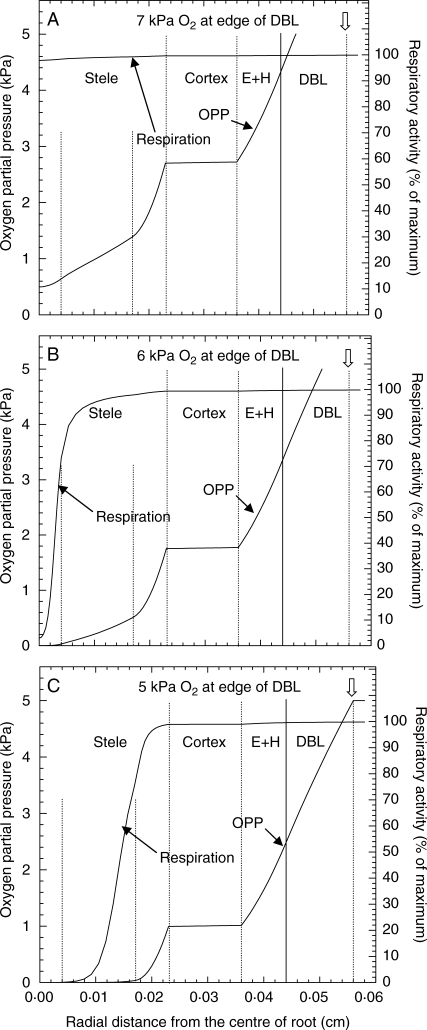
Modelling predictions of the radial oxygen profile and levels of respiratory activity across a maize root, with partial pressures of (A) 7 kPa, (B) 6 kPa and (C) 5 kPa, at the edge of the diffusive boundary layer (DBL). The predictions were based on simulations where the only oxygen source was in stirred solution culture bathing the root. The model assumed a Michaelis–Menten relationship for the oxygen dependency of respiration using a Km of 0·0108 kPa and the respiratory and diffusive characteristics of the various tissue cylinders as shown in the Methods section.
Fig. 8.
Fig. 8.
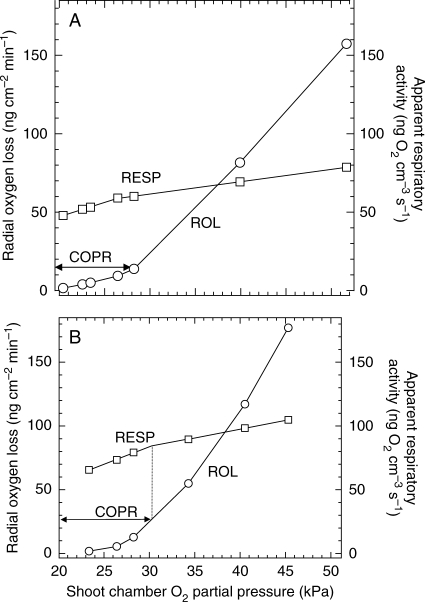
Examples of apical ROL versus OPPshoot and corresponding rates of apparent respiratory activity for roots of intact pea seedlings. In plots of type A the COPRs were calculated from the ROL values at the inflexion point; for those of type B extrapolations based on the inflexion point on the respiratory plot were used to estimate the ROL value at the inflexion point. Temperatures were approximately 23 °C.
Fig. 9.
Fig. 9.
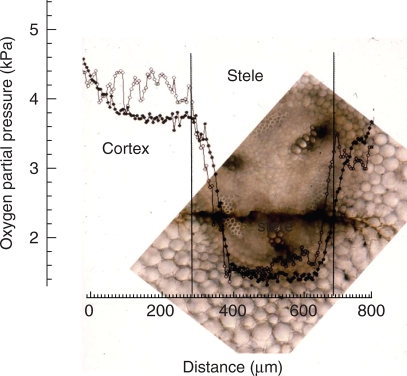
In-track (open circles) and out-track (closed circles) partial radial O2 profiles through the cortex and stele at 40 mm from the apex of a 90-mm-long pea root on a 5-d-old plant. The profiles overlay a photomicrograph of the root taken 24 h after penetration; the tracks taken by the O2 microelectrode are visible as a dark stain running from left to right through the pericycle phloem and one of the xylem arms of the triarch stele. Temperature was 21 °C.
Fig. 10.
Fig. 10.
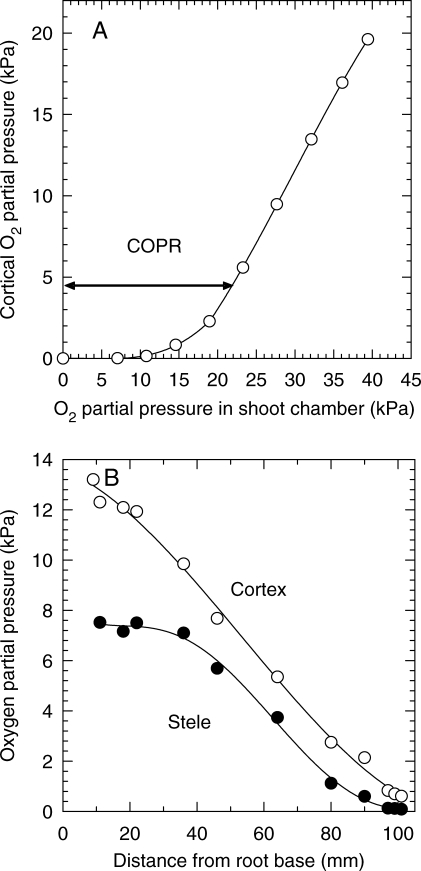
(A) Typical example of changes in equilibrium cortex OPPs versus OPPshoot in maize primary root. Root was 95 mm long and the O2-microelectrode was inserted at 5 mm from the tip. The COPR is indicated by the inflexion point (see arrow). Root had been grown in agar and probably had aerenchyma sub-apically. (B) Longitudinal OPP distribution in the cortex and stelar centre of a 6-d-old, 105-mm-long, non-aerenchymatous maize seedling root; shoot in air; temperature was 21 °C. After Darwent et al. (2003).

References

    1. Armstrong W. Aeration in higher plants. In: Woolhouse HWW, editor. Advances in botanical research. Vol. 7. New York: Academic Press; 1979. pp. 225–332.
    1. Armstrong W, Beckett PM. Root aeration in unsaturated soil: a multi-shelled model of oxygen distribution and diffusion with and without sectoral blocking of the diffusion path. New Phytologist. 1985;100:293–311.
    1. Armstrong W, Beckett PM. Internal aeration and the development of stelar anoxia in submerged roots: a multishelled mathematical model combining axial diffusion of oxygen in the cortex with radial losses to the stele, the wall layers and the rhizosphere. New Phytologist. 1987;105:221–245.
    1. Armstrong W, Drew MC. Root growth and metabolism under oxygen deficiency. In: Waisel Y, Eshel A, Kafkafi U, editors. Roots the hidden half. 3rd edn. New York: Marcel Dekker Inc; 2002. pp. 729–761.
    1. Armstrong W, Gaynard TJ. The critical oxygen pressure for root respiration in intact plants. Physiologia Plantarum. 1976;37:200–206. - PubMed