


Evidence for recombination between a sialidase (nanH) of Actinomyces naeslundii and Actinomyces oris, previously named 'Actinomyces naeslundii genospecies 1 and 2'
- PMID: 18823396
- PMCID: PMC2667307
- DOI: 10.1111/j.1574-6968.2008.01336.x
Evidence for recombination between a sialidase (nanH) of Actinomyces naeslundii and Actinomyces oris, previously named 'Actinomyces naeslundii genospecies 1 and 2'
Abstract
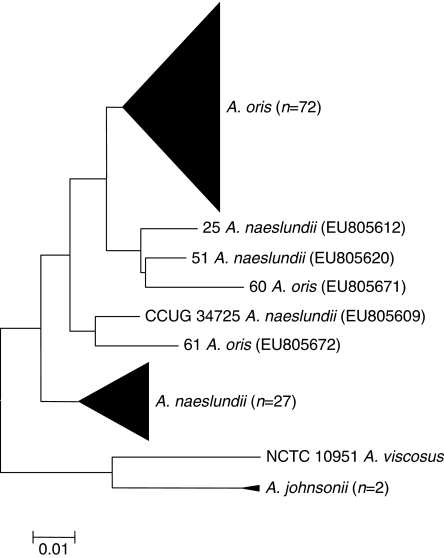
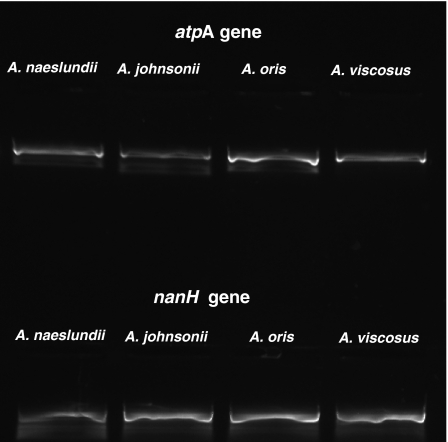
Actinomyces spp., predominant members of human oral biofilms, may use extracellular sialidase to promote adhesion, deglycosylate immunoglobulins and liberation of nutrients. Partial nanH gene sequences (1,077 bp) from Actinomyces oris (n=74), Actinomyces naeslundii (n=30), Actinomyces viscosus (n=1) and Actinomyces johnsonii (n=2) which included the active-site region and the bacterial neuraminidase repeats (BNRs) were compared. The sequences were aligned and each species formed a distinct cluster with five isolates having intermediate positions. These five isolates (two A. oris and three A. naeslundii) exhibited interspecies recombination. The nonsynonymous/synonymous ratio was <1 for both A. oris and A. naeslundii indicating that nanH in both species is under stabilizing selective pressure; nonsynonymous mutations are not selected. However, for A. oris significant negative values in tests for neutral selection suggested the rate of mutation in A. oris was greater than in A. naeslundii but with selection against nonsynonymous mutations. This was supported by the observation that the frequency of polymorphic sites in A. oris, which were monomorphic in A. naeslundii was significantly greater than the frequency of polymorphic sites in A. naeslundii which were monomorphic in A. oris (chi(2)=7.011; P=0.00081). The higher proportions of A. oris in the oral biofilm might be explained by the higher mutation rate facilitating an increased ability to respond successfully to environmental stress.
Figures

References
-
- Beighton D, Smith K. The modulation of exoglycosidic enzymes in the supragingival plaque of macaque monkeys. Arch Oral Biol. 1986;34:319–322. - PubMed
-
- Beighton D, Hardie JM, Whiley RA. A scheme for the identification of viridans streptococci. J Med Microbiol. 1991;35:367–372. - PubMed
-
- Bjedov I, Tenaillon O, Gérard B, Souza V, Denamur E, Radman M, Taddei F, Matic I. Stress-induced mutagenesis in bacteria. Science. 2003;300:1404–1409. - PubMed
-
- Bowden GH, Nolette N, Ryding H, Cleghorn BM. The diversity and distribution of the predominant ribotypes of Actinomyces naeslundii genospecies 1 and 2 in samples from enamel and from healthy and carious root surfaces of teeth. J Dent Res. 1999;78:1800–1809. - PubMed
Publication types
MeSH terms
Substances
Associated data
- Actions
- Actions
- Actions
- Actions
- Actions
- Actions
- Actions
- Actions
- Actions
- Actions
- Actions
- Actions
- Actions
- Actions
- Actions
- Actions
- Actions
- Actions
- Actions
- Actions
- Actions
- Actions
- Actions
- Actions
- Actions
- Actions
- Actions
- Actions
- Actions
- Actions
- Actions
- Actions
- Actions
- Actions
- Actions
- Actions
- Actions
- Actions
- Actions
- Actions
- Actions
- Actions
- Actions
- Actions
- Actions
- Actions
- Actions
- Actions
- Actions
- Actions
- Actions
- Actions
- Actions
- Actions
- Actions
- Actions
- Actions
- Actions
- Actions
- Actions
- Actions
- Actions
- Actions
- Actions
- Actions
- Actions
- Actions
- Actions
- Actions
- Actions
- Actions
- Actions
- Actions
- Actions
- Actions
- Actions
- Actions
- Actions
- Actions
- Actions
- Actions
- Actions
- Actions
- Actions
- Actions
- Actions
- Actions
- Actions
- Actions
- Actions
- Actions
- Actions
- Actions
- Actions
- Actions
- Actions
- Actions
- Actions
- Actions
- Actions
- Actions
- Actions
- Actions
Grants and funding
LinkOut - more resources
Full Text Sources
Molecular Biology Databases
Miscellaneous
