


Parental assessments of internalizing and externalizing behavior and executive function in children with primary hypertension
- PMID: 18823913
- PMCID: PMC2633107
- DOI: 10.1016/j.jpeds.2008.08.017
Parental assessments of internalizing and externalizing behavior and executive function in children with primary hypertension
Abstract
Objective: To determine the relations between hypertension and parental ratings of behavior and executive functions in children with primary hypertension and to examine the potential moderating influence of obesity.
Study design: Hypertensive and normotensive control groups were matched for age, sex, race, intelligence quotient, maternal education, household income, and obesity. Parents completed the Child Behavior Checklist to assess Internalizing and Externalizing problems and the Behavior Rating Inventory of Executive Function to assess behavioral correlates of executive function.
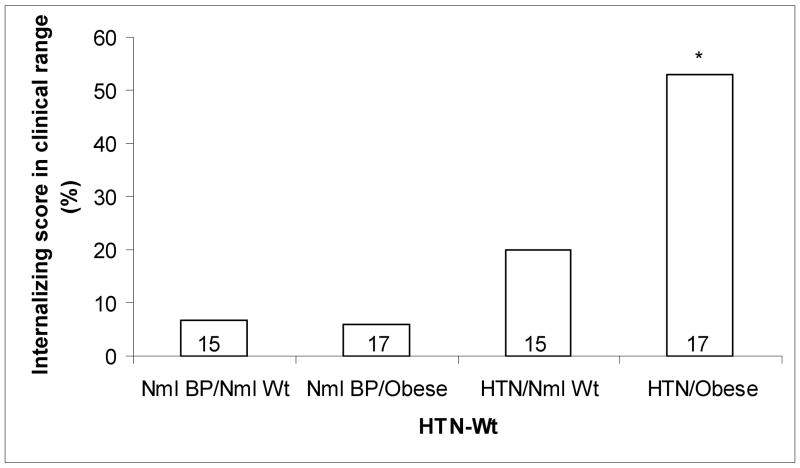
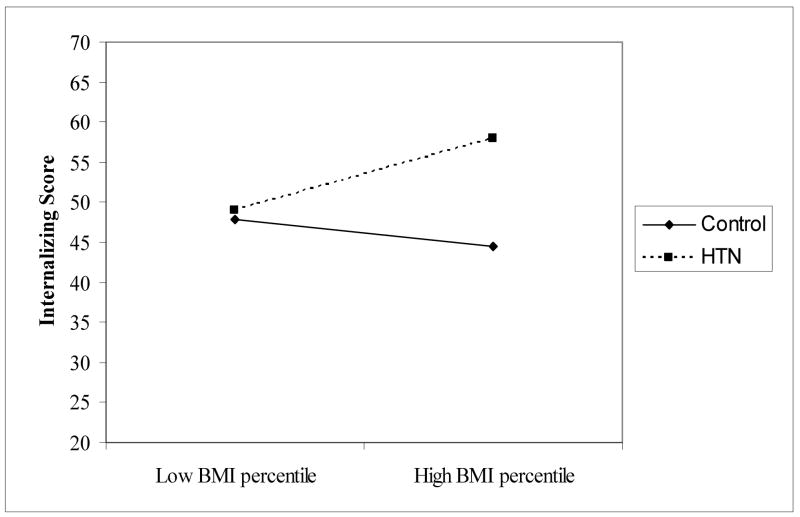
Results: Thirty-two hypertensive subjects and 32 normotensive control subjects (aged 10 to 18 years) were enrolled. On the Child Behavior Checklist, hypertensives had higher Internalizing T-scores (53 vs 44.5, P = .02) with 37% falling within the clinically significant range vs 6% of control subjects (P = .005). Internalizing score increased with increasing body mass index percentile in hypertensive but not normotensive subjects. Hypertensives had worse Behavior Rating Inventory of Executive Function Global Executive Composite T-scores compared with control subjects (50 vs 43, P = .009).
Conclusions: Children with both hypertension and obesity demonstrate higher rates of clinically significant internalizing problems, and hypertensives (irrespective of obesity) demonstrate lower parental ratings of executive function compared with normotensive control subjects.
Figures
References
-
- Alexander F. Emotional factors in essential hypertension: presentation of a tentative hypothesis. Pyschosom Med. 1939;1:175–9.
-
- Pickering TG. Mental stress as a causal factor in the development of hypertension and cardiovascular disease. Curr Hypertens Rep. 2001;3:249–54. - PubMed
-
- Markovitz JH, Jonas BS, Davidson K. Psychologic factors as precursors to hypertension. Curr Hypertens Rep. 2001;3:25–32. - PubMed
-
- Raikkonen K, Matthews KA, Kuller LH. Trajectory of psychological risk and incident hypertension in middle-aged women. Hypertension. 2001;38:798–802. - PubMed
-
- Yan LL, Liu K, Matthews KA, Daviglus ML, Ferguson TF, Kiefe CI. Psychosocial factors and risk of hypertension: the coronary artery risk development in young adults (CARDIA) study. JAMA. 2003;290:2138–48. - PubMed
Publication types
MeSH terms
Grants and funding
LinkOut - more resources
Full Text Sources
Medical
