Review
. 2008 Nov;13(11):567-73.
doi: 10.1016/j.tplants.2008.08.005. Epub 2008 Sep 27.

L-Ascorbate biosynthesis in higher plants: the role of VTC2

Affiliations
Review

L-Ascorbate biosynthesis in higher plants: the role of VTC2

Carole L Linster et al. Trends Plant Sci. 2008 Nov.

Abstract

In the past year, the last missing enzyme of the L-galactose pathway, the linear form of which appears to represent the major biosynthetic route to L-ascorbate (vitamin C) in higher plants, has been identified as a GDP-L-galactose phosphorylase. This enzyme catalyzes the first committed step in the synthesis of that vital antioxidant and enzyme cofactor. Here, we discuss how GDP-L-galactose phosphorylase enzymes, encoded in Arabidopsis by the paralogous VTC2 and VTC5 genes, function in concert with the other enzymes of the L-galactose pathway to provide plants with the appropriate levels of L-ascorbate. We hypothesize that regulation of L-ascorbate biosynthesis might occur at more than one step and warrants further investigation to allow for the manipulation of vitamin C levels in plants.


Figures
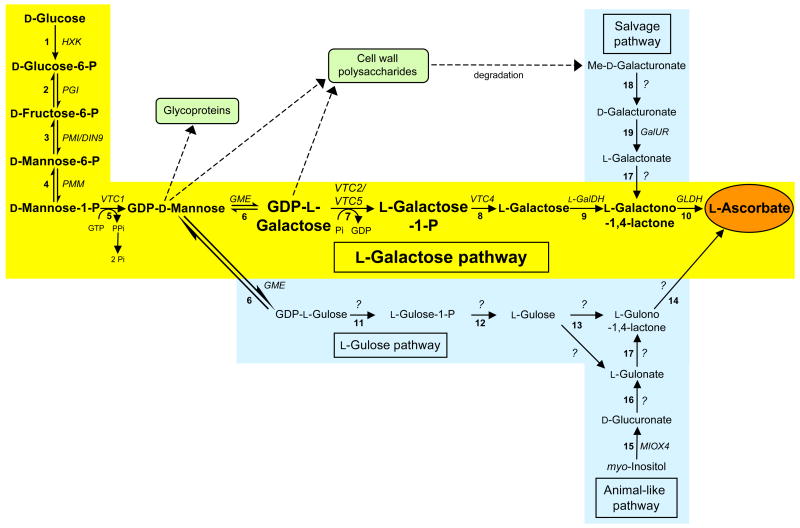
Figure 1
Figure 1
Biosynthetic routes to L-ascorbate in higher plants. The major L-galactose pathway is highlighted in yellow with intermediates in bold type [12]; alternative proposed biosynthetic routes are highlighted in blue [–15]. Designations are given in italics for genes encoding known enzymes of the pathways; question marks indicate possible reactions where the gene and the specific enzyme have not yet been identified. The central reaction (and the first committed step for L-ascorbate synthesis) in the L-galactose pathway, which is catalyzed by VTC2 and VTC5, is shown in a larger font. Enzymes catalyzing the numbered reactions are: 1, hexokinase; 2, phosphoglucose isomerase; 3, phosphomannose isomerase (PMI); 4, phosphomannomutase (PMM); 5, GDP-D-mannose pyrophosphorylase; 6, GDP-D-mannose 3′,5′-epimerase (GME); 7, GDP-L-galactose phosphorylase; 8, L-galactose-1-P phosphatase; 9, L-galactose dehydrogenase; 10, L-galactono-1,4-lactone dehydrogenase (GLDH); 11, nucleotide pyrophosphatase or sugar-1-P guanylyltransferase; 12, sugar phosphatase; 13, sugar dehydrogenase; 14, L-gulono-1,4-lactone dehydrogenase/oxidase; 15, myo-inositol oxygenase; 16, uronate reductase; 17, aldonolactonase; 18, methylesterase; 19, D-galacturonate reductase.
Figure 2
Figure 2
Proposed VTC2 cycles. (a) The original VTC2 cycle proposed by Laing et al. [17] requires only two enzymes, VTC2 and GDP-D-mannose 3′,5′-epimerase (3′,5′-GME), to generate L-galactose-1-P from D-mannose-1-P for L-ascorbate biosynthesis. In this scheme, GDP-D-mannose generated by the transferase activity of VTC2 is recycled to the GDP-L-galactose substrate of VTC2 by 3′,5′-GME. VTC1 activity is only required to compensate for the GDP-D-mannose molecules that are drained from the cycle for polysaccharide and glycoprotein synthesis. (b) The extended VTC2 cycle proposed by Wolucka and Van Montagu [23] involves an additional putative enzyme that interconverts GDP-D-glucose and GDP-D-mannose (2′-GME). Here, D-glucose-1-P, derived from photosynthesis, is converted to L-galactose-1-P by the VTC2 transferase activity. L-Galactose-1-P is used for L-ascorbate synthesis; the other VTC2 product (GDP-D-glucose) can be converted to other GDP-hexoses for polysaccharide and glycoprotein synthesis or can be recycled to GDP-L-galactose through the successive action of the putative 2′-GME and 3′,5′-GME. The priming reaction to start this VTC2 cycle could involve a GDP-D-glucose pyrophosphorylase or VTC1 (not shown). Given the low transferase activities measured with VTC2 and the hypothetical nature of the 2′-GME activity, further work is needed to determine whether either of these cycles is physiologically relevant in plants.
Figure 3
Figure 3
Proposed VTC2-catalyzed reactions. The reaction catalyzed by VTC2 proceeds in two steps. In the first step, VTC2 forms a covalent guanylylated active site His intermediate with the -phosphate of GDP-L-galactose, releasing L-galactose-1-P. In the second step, the enzyme could alternatively transfer the guanylyl group to inorganic phosphate, leading to a phosphorylase activity generating GDP (pathway A), or to a hexose-1-P, leading to a transferase activity generating a GDP-hexose (pathway B). Pathway A appears to be the major route in higher plants because the phosphorylase activity of VTC2 was found to be more than 100-fold higher than its transferase activity (see the main text).

References

    1. De Tullio MC, Arrigoni O. Hopes, disillusions and more hopes from vitamin C. Cell Mol Life Sci. 2004;61:209–219. - PMC - PubMed
    1. Linster CL, Van Schaftingen E. Vitamin C. Biosynthesis, recycling and degradation in mammals. FEBS J. 2007;274:1–22. - PubMed
    1. Smirnoff N. Ascorbic acid: metabolism and functions of a multi-facetted molecule. Curr Opin Plant Biol. 2000;3:229–235. - PubMed
    1. Pignocchi C, Foyer CH. Apoplastic ascorbate metabolism and its role in the regulation of cell signalling. Curr Opin Plant Biol. 2003;6:379–389. - PubMed
    1. de Pinto MC, et al. Hydrogen peroxide, nitric oxide and cytosolic ascorbate peroxidase at the crossroad between defence and cell death. Plant J. 2006;48:784–795. - PubMed

Publication types

MeSH terms
