


Modulation of aquaporin-2/vasopressin2 receptor kidney expression and tubular injury after endotoxin (lipopolysaccharide) challenge
- PMID: 18824919
- PMCID: PMC2745282
- DOI: 10.1097/CCM.0b013e318186a938
Modulation of aquaporin-2/vasopressin2 receptor kidney expression and tubular injury after endotoxin (lipopolysaccharide) challenge
Abstract
Objective: Sepsis-induced organ dysfunctions remain prevalent and account for >50% of intensive care unit admissions for acute renal failure with a mortality rate nearing 75%. In addition to the fact that the mechanisms underlying the pathophysiology of sepsis-related acute renal failure are unclear, the impact on septic-induced acute renal failure of either norepinephrine, a gold-standard vasopressor, and arginine vasopressin, a candidate alternative, are not well understood.
Design: Randomized and controlled in vivo study.
Setting: Research laboratory and animal facilities.
Subjects: Adult rats treated with endotoxin (lipopolysaccharide) and/or vasopressors.
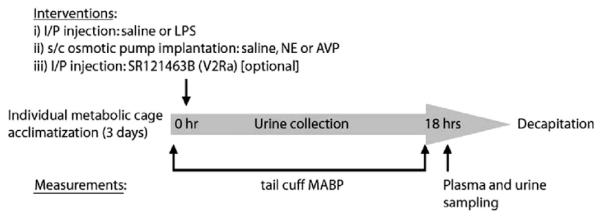
Interventions: Rats were intraperitoneally injected with lipopolysaccharide (12 mg/kg) or saline and then infused with either saline, 0.375 microg/microL arginine vasopressin, or 32.5 microg/microL norepinephrine for 18 hrs. These vasopressor rates yielded respective targeted blood levels observed in human septic shock.
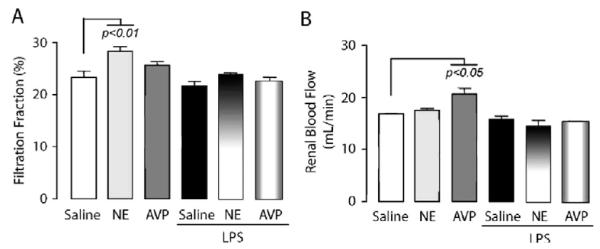
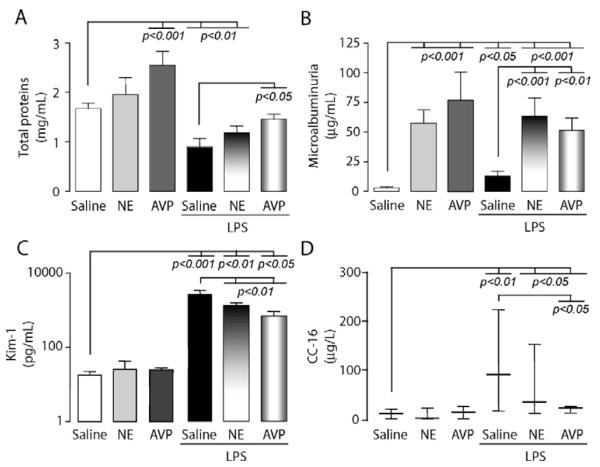
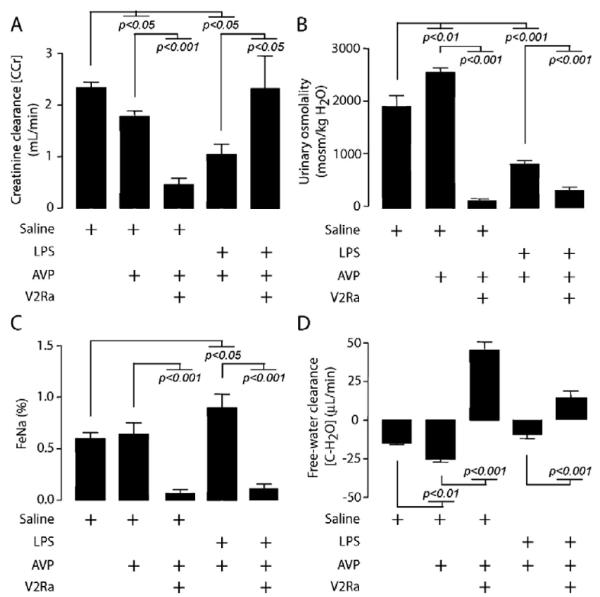
Measurements and main results: Renal function, including glomerular filtration rate and fraction, renal blood flow, aquaporin-2, and arginine vasopressin-2 (V2 receptor) networking, water and salt handling, and urinary protein excretion, were evaluated. After lipopolysaccharide challenge arginine vasopressin infusion: 1) impaired creatinine clearance without affecting renal blood flow, glomerular filtration rate, and fraction but reduced free-water clearance, both of which being partially restored by the V2 receptor antagonist SR-121463B; 2) decreased the recognized ability of arginine vasopressin alone to recruit aquaporin-2 to the apical membrane increase its mRNA expression and urinary release; 3) increased urinary protein content but decreased specific kidney injury molecule-1, and Clara cell protein-16 release (p < 0.05 vs. lipopolysaccharide alone). Conversely, norepinephrine infusion did not add to lipopolysaccharide-induced alteration of urine biochemistry, except for improved creatinine clearance and increased microalbuminuria.
Conclusion: In this endotoxic model, dose-targeted arginine vasopressin infusion increased lipopolysaccharide-induced renal dysfunction without affecting renal blood flow and glomerular function, but with particular disruption of aquaporin-2/V2 receptor networking, consecutive decreased salt and water handling ability. This is in clear contrast with norepinephrine infusion and suggests specific arginine vasopressin-induced "tubular epithelial dysfunction."
Figures



Comment in
-
Vasopressin and the kidney: two false friends?Crit Care Med. 2008 Nov;36(11):3111-2. doi: 10.1097/CCM.0b013e318187b7b3. Crit Care Med. 2008. PMID: 18941319 No abstract available.
References
-
- DeMendonca A, Vincent JL, Suter PM, et al. Acute renal failure in the ICU: Risk factors and outcome evaluated by the SOFA score. Intensive Care Med. 2000;26:915–921. - PubMed
-
- Schrier RW, Wang W. Acute renal failure and sepsis. N Engl J Med. 2004;351:159–169. - PubMed
-
- Wan L, Bellomo R, Di Giantomasso D, et al. The pathogenesis of septic acute renal failure. Cur Opin Crit Care. 2003;9:496–502. - PubMed
Publication types
MeSH terms
Substances
Grants and funding
LinkOut - more resources
Full Text Sources
Molecular Biology Databases
Research Materials
Miscellaneous
