Review
. 2009 Feb 19;113(8):1619-30.
doi: 10.1182/blood-2008-03-144790. Epub 2008 Sep 30.

Molecular biology of bcr-abl1-positive chronic myeloid leukemia

Affiliations
Review

Molecular biology of bcr-abl1-positive chronic myeloid leukemia

Alfonso Quintás-Cardama et al. Blood. .

Abstract

Chronic myeloid leukemia (CML) has been regarded as the paradigmatic example of a malignancy defined by a unique molecular event, the BCR-ABL1 oncogene. Decades of research zeroing in on the role of BCR-ABL1 kinase in the pathogenesis of CML have culminated in the development of highly efficacious therapeutics that, like imatinib mesylate, target the oncogenic kinase activity of BCR-ABL1. In recent years, most research efforts in CML have been devoted to developing novel tyrosine kinase inhibitors (TKIs) as well as to elucidating the mechanisms of resistance to imatinib and other TKIs. Nonetheless, primordial aspects of the pathogenesis of CML, such as the mechanisms responsible for the transition from chronic phase to blast crisis, the causes of genomic instability and faulty DNA repair, the phenomenon of stem cell quiescence, the role of tumor suppressors in TKI resistance and CML progression, or the cross-talk between BCR-ABL1 and other oncogenic signaling pathways, still remain poorly understood. Herein, we synthesize the most relevant and current knowledge on such areas of the pathogenesis of CML.


Figures
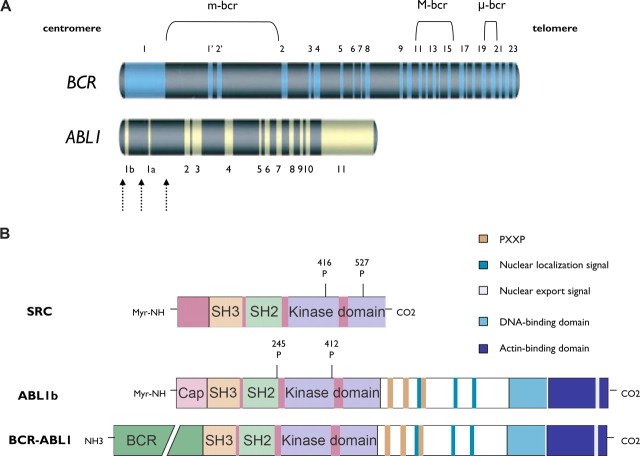
Figure 1
Figure 1
Schematic representation of the ABL1 and BCR genes and the BCR-ABL1 kinase. (A) BCR contains 23 exons. Exons 1′ and 2′ of BCR are alternative exons within the first intron. The 3 main breakpoint cluster regions (m-bcr, M-bcr, and μ-bcr) in BCR are presented. ABL1 contains 2 alternative first exons (1b and 1a). The dashed arrows represent the breakpoints within ABL1. The combination of breakpoints within BCR and ABL1 genes generates different fusion transcripts encoding proteins with distinct molecular weights. (B) The structural modularity of SRC, ABL1b, and BCR-ABL1 kinases is shown. SRC and ABL1 kinases share a common central core (42% overall homology) composed of a tyrosine kinase domain, an SRC-homology-2 (SH2) domain, and an SH3 domain. The domains upstream of the SH3 domain and downstream of the kinase domain differ significantly between SRC and ABL1 kinases. The NH2 terminus in ABL1 and BCR-ABL1 kinases is the “Cap” region. Two isoforms of ABL1 (human types 1a and 1b) are generated by alternative splicing of the first ABL1 exon. ABL1b contains a myristate site (Myr-NH) at the extreme end of the amino-terminal segment, which binds to the kinase domain and keeps the SH2-SH3 autoinhibitory structure in place (ie, in the “off state”). The homology region in SRC family kinase is the N-terminal membrane-localization domain (also referred to as the SH4 domain). Tyrosine phosphorylation sites are shown.
Figure 2
Figure 2
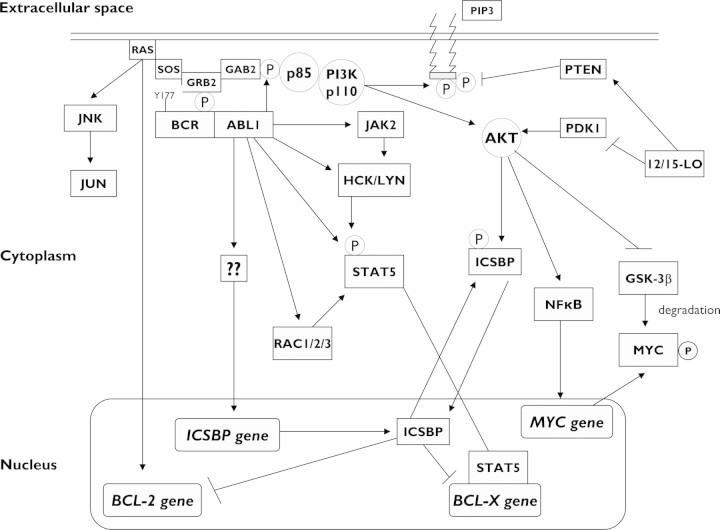
Molecular signaling in BCR-ABL1–positive myeloid progenitors. The phosphorylated Tyr177 residue of BCR serves as a docking site for growth factor receptor-bound protein 2 (GRB2), which binds GRB2-associated binding protein 2 (GAB2), as well as SOS (a guanine-nucleotide exchanger of RAS), resulting in RAS-MAPK activation, which in turn results in BCL-2 gene transcription. Upon phosphorylation by BCR-ABL1, GAB2 recruits phosphatidylinositol 3-kinase (PI3K), which activates AKT. AKT activation results in increased transcription of MYC gene and stabilization of MYC protein via inhibition of its degradation by GSK-3β. BCR-ABL1 also activates STAT5, both directly and indirectly through activation of JAK2 and the SRC kinases HCK and LYN. The end result is the activation of BCL-X gene transcription. By contrast, BCR-ABL1 abrogates the transcription of interferon consensus sequence binding protein (ICSBP) through an unknown mechanism, which releases the ISCBP-mediated inhibition of BCL-2 and BCL-X gene transcription and results in increased survival of myeloid progenitors. The same effect is attained via 12/15-lipoxygenase (12/15-LO), which may either inhibit PDK1 or activate PTEN (both regulators of AKT), thus resulting in increased phosphorylation of ICSBP. The net effect of BCR-ABL1 kinase activation is the promotion of cell proliferation and survival. Pointed arrows indicate direct interactions and/or activation. Blunt-ended arrows indicate inhibitory effects. GSK-3β, glycogen synthase kinase-3β; PIP3, phosphatidylinositol-3,4,5-triphosphate.
Figure 3
Figure 3
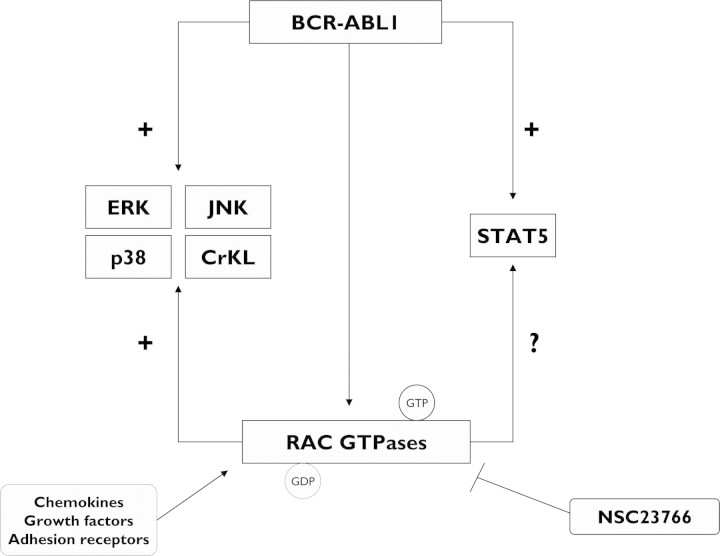
BCR-ABL1 kinase regulates the activation of RAC guanosine triphosphatases (RAC GTPases). In CML progenitors, RAC GTPases include RAC1, RAC2, and RAC3, which integrate signal chemokines, growth factors, and adhesion receptors to coordinate cell responses. BCR-ABL1 activates a variety of effectors to promote cell proliferation, including RAC GTPases. In turn, RAC GTPases may mediate STAT5 phosphorylation. Inhibition of RAC GTPases by the specific RAC inhibitor NSC23766 abrogates BCR-ABL1–induced cell proliferation. GDP, guanosine diphosphate; GTP, guanosine triphosphate.
Figure 4
Figure 4
BCR-ABL1–induced inactivation of PP2A. BCR-ABL1 mediates the post-transcriptional up-regulation of SET, a phosphoprotein that functions as an inhibitor of the serine/threonine phosphatase PP2A. This activity is mediated via the heterogeneous nuclear ribonucleoprotein A1 (HNRNPA1). The activation of PP2A recruits the SH2 domain–containing protein tyrosine phosphatase 1 (SHP1), which dephosphorylates BCR-ABL1, resulting in BCR-ABL1 down-regulation through proteosomal degradation. Pharmacologic activation of PP2A with forskolin or fingolimod (FTY720) results in abrogation of CML cell proliferation, including cells expressing the pan-resistant mutation T315I.
Figure 5
Figure 5
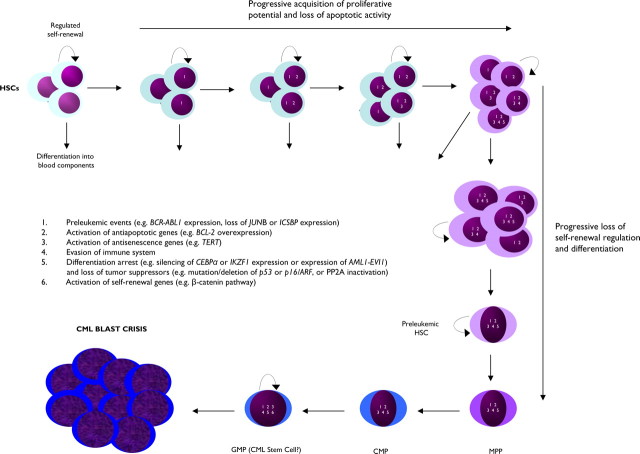
Theoretical model of chronic myeloid leukemia. BCR-ABL1 fails to transform cells lacking inherent self-renewal potential, thus supporting the notion of CP CML as an HSC disorder. HSCs, through successive accumulation of preleukemic genetic abnormalities (eg, BCR-ABL1 expression, BCL-2 overexpression, or loss of JUNB or ICSBP expression), acquire a proliferative and survival advantage and lose the ability to undergo apoptosis. Further genetic and/or epigenetic events in BCR-ABL1–positive committed myeloid cells (eg, common myeloid progenitors [CMP] and granulocyte-monocyte progenitors [GMP]) endow the latter with self-renewal potential (eg, aberrant β-catenin activation) and arrest myeloid differentiation (eg, loss of CEBPα or IKZF1 expression), thus facilitating the emergence of a leukemic stem cell (LSC) clone driving the transition to blast-phase CML (partially adapted from Weissman).
Figure 6
Figure 6
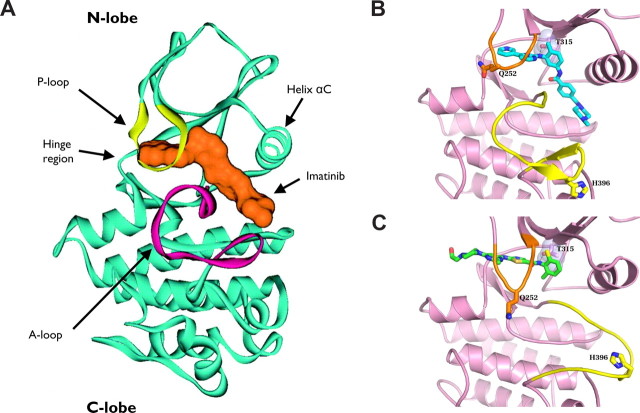
Ribbon representation of ABL1 kinase in complex with tyrosine kinase inhibitors. (A) Ribbon representation of 3-dimensional structure of ABL1 kinase domain (blue) in complex with imatinib (orange). The ATP-binding site in the ABL1 kinase domain is located between the activation loop (A-loop; magenta) and the phosphate-binding loop (P-loop; yellow). The A-loop controls the ABL1 catalytic activity by switching between different states in a phosphorylation-dependent manner. Imatinib inserts its pyridinyl group underneath the helix αC in the NH2-terminal lobe of ABL1 kinase, displacing ATP and trapping the kinase in its inactive conformation. (B,C) The imatinib:ABL1 (blue) and the dasatinib:ABL1 (green) complexes are shown. The A-loop (yellow) adopts diverging positions in the 2 complexes. Conformational changes in the A-loop prevent imatinib binding to the active form of the enzyme. By contrast, dasatinib binds ABL1 in its active conformation and is not involved in critical interactions with most mutated residues involved in imatinib resistance. For instance, the H396 residue is involved in a hydrogen bond that stabilizes the inactive conformation of the A-loop in the imatinib:ABL1 complex (B), whereas no discernible interactions are observed between His396 and ABL1 or dasatinib (C). Thr315 makes a critical hydrogen bond with dasatinib. T315I mutation disrupts this interaction and causes steric clash, impairing the activity of dasatinib, as well as of imatinib and nilotinib, against this mutant.
Figure 7
Figure 7
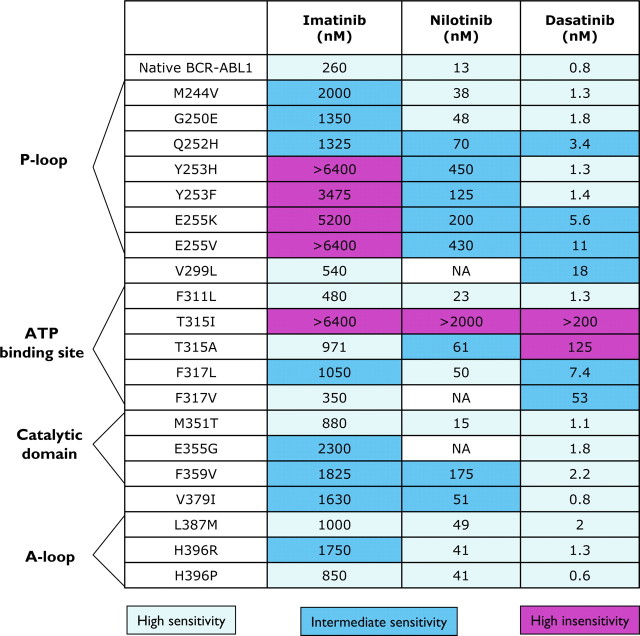
Activity of imatinib mesylate and the second generation tyrosine kinase inhibitors nilotinib and dasatinib against a selection of BCR-ABL1 mutants found in patients with CML. All concentrations are shown in nanomoles per milliliter and represent IC50 values.

References

    1. Quintás-Cardama A, Cortes JE. Chronic myeloid leukemia: diagnosis and treatment. Mayo Clin Proc. 2006;81:973–988. - PubMed
    1. Druker BJ, Sawyers CL, Kantarjian H, et al. Activity of a specific inhibitor of the BCR-ABL tyrosine kinase in the blast crisis of chronic myeloid leukemia and acute lymphoblastic leukemia with the Philadelphia chromosome. N Engl J Med. 2001;344:1038–1042. - PubMed
    1. Ramaraj P, Singh H, Niu N, et al. Effect of mutational inactivation of tyrosine kinase activity on BCR/ABL-induced abnormalities in cell growth and adhesion in human hematopoietic progenitors. Cancer Res. 2004;64:5322–5331. - PubMed
    1. Zhao RC, Jiang Y, Verfaillie CM. A model of human p210(bcr/ABL)-mediated chronic myelogenous leukemia by transduction of primary normal human CD34(+) cells with a BCR/ABL-containing retroviral vector. Blood. 2001;97:2406–2412. - PubMed
    1. Heisterkamp N, Jenster G, ten Hoeve J, Zovich D, Pattengale PK, Groffen J. Acute leukaemia in bcr/abl transgenic mice. Nature. 1990;344:251–253. - PubMed

Publication types

MeSH terms

Substances