


Effects of alcoholism typology on response to naltrexone in the COMBINE study
- PMID: 18828797
- PMCID: PMC2626136
- DOI: 10.1111/j.1530-0277.2008.00804.x
Effects of alcoholism typology on response to naltrexone in the COMBINE study
Abstract
Background: This study investigated whether subgroups of alcohol-dependent patients responded differently to naltrexone versus placebo in the NIAAA COMBINE study. In particular, the A versus B and the Early Onset versus Late Onset typologies were examined. Relative to Type A alcoholics, Type B alcoholics are characterized by greater severity, earlier onset, stronger family history, more childhood risk factors (e.g., conduct disorder), and greater frequency of comorbid psychiatric and substance use disorders.
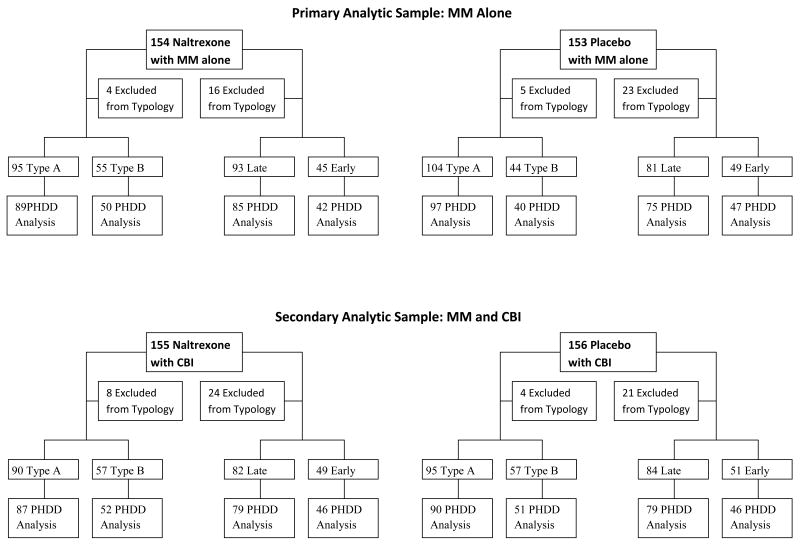
Methods: COMBINE study participants were categorized as Type A or Type B using k-means cluster analysis and variables from 5 domains that have been shown to replicate the original Babor typology efficiently. Early Onset was defined as alcohol dependence beginning before age 25. For the planned analyses, the sample was reduced to the 618 participants receiving naltrexone alone or placebo, either with medical management (MM) alone or with MM plus the Combined Behavioral Intervention (CBI). The a priori primary outcome was percent heavy drinking days during treatment in the groups receiving MM without CBI.
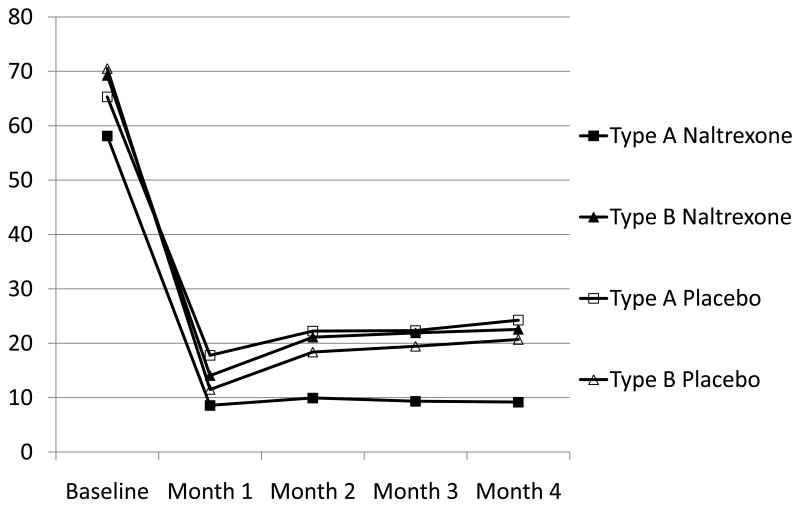
Results: Among those receiving MM without CBI, Type A alcoholics had better drinking outcomes with naltrexone than placebo, whereas medication condition did not influence outcomes significantly in the Type Bs. Age of onset was not significantly related to outcome. For those receiving CBI, no significant effects were found for either typology.
Conclusions: In this sample, the beneficial effects of opioid antagonism were limited to Type A alcoholics receiving treatment in a MM model. Future studies should investigate the relationship between clinically relevant genotypes, phenotypes such as typologies, and treatment response. More work is also needed to develop practical algorithms for phenotypic assignment.
Figures
References
-
- Anton RF, O'Malley SS, Ciraulo DA, Cisler RA, Couper D, Donovan DM, Gastfriend DR, Hosking JD, Johnson BA, Locastro JS, Longabaugh R, Mason BJ, Mattson ME, Miller WR, Pettinati HM, Randall CL, Swift R, Weiss RD, Williams LD, Zweben A. Combined pharmacotherapies and behavioral interventions for alcohol dependence: the COMBINE study: a randomized controlled trial. JAMA. 2006;295:2003–17. - PubMed
-
- Anton RF, Oroszi G, O'Malley S, Couper D, Swift R, Pettinati H, Goldman D. An evaluation of mu-opioid receptor (OPRM1) as a predictor of naltrexone response in the treatment of alcohol dependence: results from the Combined Pharmacotherapies and Behavioral Interventions for Alcohol Dependence (COMBINE) study. Arch Gen Psychiatry. 2008;65:135–44. - PMC - PubMed
-
- Anton RF, Randall CL. Measurement and choice of drinking outcome variables in the COMBINE Study. J Stud Alcohol Suppl. 2005:104–9. discussion 92-3. - PubMed
-
- Babor TF, Hofmann M, Delboca FK, Hesselbrock V, Meyer RE, Dolinsky ZS, Rounsaville B. Types of alcoholics, I. Evidence for an empirically derived typology based on indicators of vulnerability and severity. Arch Gen Psychiatry. 1992;49:599–608. - PubMed
-
- Chick J, Aschauer H, Hornik K. Efficacy of fluvoxamine in preventing relapse in alcohol dependence: a one-year, double-blind, placebo-controlled multicentre study with analysis by typology. Drug Alcohol Depend. 2004;74:61–70. - PubMed
Publication types
MeSH terms
Substances
Grants and funding
LinkOut - more resources
Full Text Sources
Medical
