


Hazard of recurrence and adjuvant treatment effects over time in lymph node-negative breast cancer
- PMID: 18830816
- PMCID: PMC2711214
- DOI: 10.1007/s10549-008-0200-5
Hazard of recurrence and adjuvant treatment effects over time in lymph node-negative breast cancer
Abstract
Background: For patients with axillary lymph node-negative breast cancer, benefits from adjuvant therapy are smaller than in node-positive disease and thus more selective use is warranted, prompting development of risk profiling to identify those most likely to benefit. Examination of the magnitude and changes in the hazard of failure over time in node-negative breast cancer may also be informative in this regard.
Methods: Among 9,444 participants from five randomized trials (accrual 1982-1998) investigating chemotherapy and tamoxifen for node-negative breast cancer, we estimated recurrence hazards over time by tumor estrogen receptor (ER) status and adjuvant treatment.
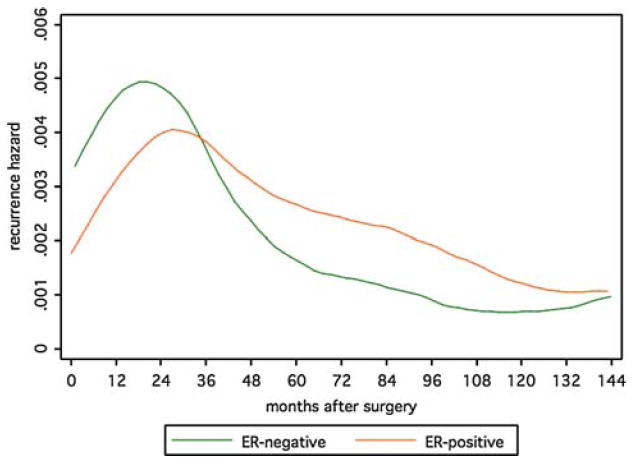
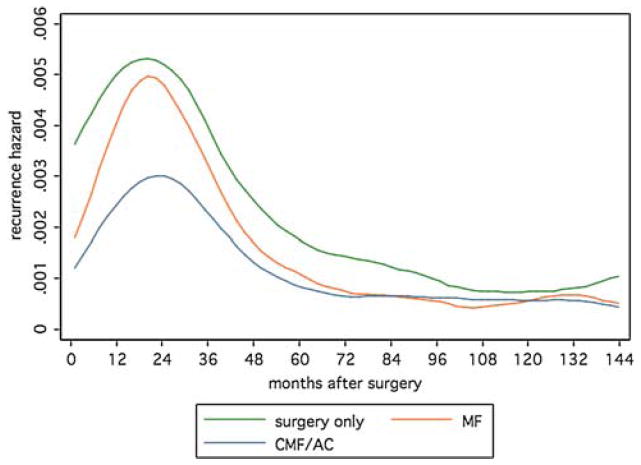
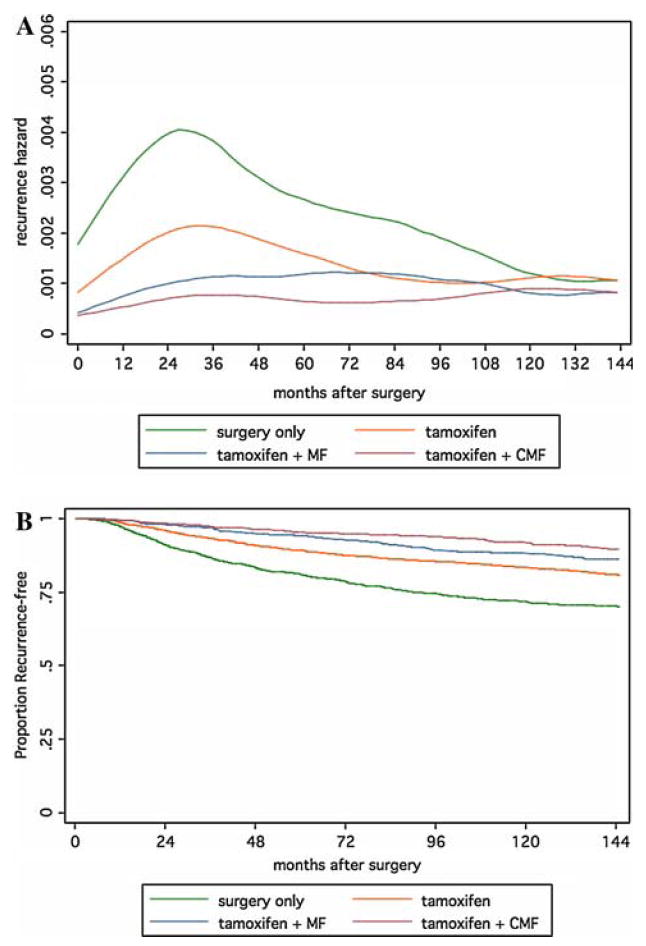
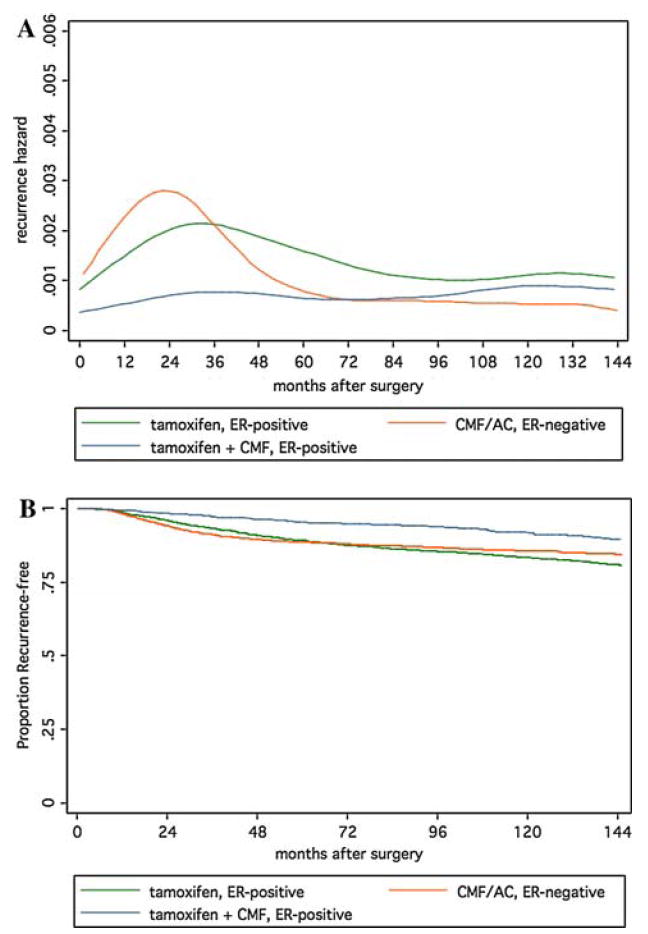
Results: In patients treated by surgery only, we observed the previously noted larger hazard peak followed by a rapid decrease in ER-negative patients and smaller but more persistent hazard in ER-positive patients. After approximately 48 months, the ER-positive hazard is greater. For adjuvant treatment, while tamoxifen decreases the early hazard in ER-positive patients to that of the chemotherapy-treated ER-negative group, in later follow-up (beyond 5 years) the hazard for ER-positive patients again exceeds that of ER-negative patients. Adding chemotherapy to tamoxifen in ER-positive patients results in large early hazard reduction, but in later follow-up the hazard converges with those of patients treated by surgery only or tamoxifen.
Conclusions: Recurrence hazards over time reveal changes in risk that may have biologic and therapeutic strategy relevance. In ER-negative tumors, a large early chemotherapy benefit is followed by a consistently low recurrence hazard over time. In ER-positive patients, the chemotherapy benefit appears concentrated mostly in earlier follow-up, and a greater recurrence risk remains.
Figures
References
-
- National Institutes of Health Consensus Development Panel. National Institutes of Health Consensus Development Conference statement: adjuvant therapy for breast cancer, November 1–3, 2000. J Natl Cancer Inst Monogr. 2001;30:5–15. - PubMed
-
- Early Breast Cancer Trialists’ Collaborative Group. Effects of chemotherapy and hormonal therapy for early breast cancer on recurrence and 15-year survival. Lancet. 2005;365:1687–1717. - PubMed
-
- Paik S, Shak S, Tang G, et al. A multigene assay to predict recurrence of tamoxifen-treated, node-negative breast cancer. N Engl J Med. 2004;351:2817–2826. - PubMed
-
- Paik S, Tang G, Shak S, et al. Gene expression and benefit of chemotherapy in women with node-negative, estrogen receptor-positive breast cancer. J Clin Oncol. 2006;24:3726–3734. - PubMed
-
- Robbins GF, Berg J. Curability of patients with invasive breast carcinoma based on a 30-year study. World J Surg. 1977;1:284–286. - PubMed
Publication types
MeSH terms
Substances
Grants and funding
LinkOut - more resources
Full Text Sources
Medical
