. 2008 Oct 14;105(41):15866-71.
doi: 10.1073/pnas.0806641105. Epub 2008 Oct 2.

Dissociation of in vitro DNA deamination activity and physiological functions of AID mutants

Affiliations

Dissociation of in vitro DNA deamination activity and physiological functions of AID mutants

Velizar Shivarov et al. Proc Natl Acad Sci U S A. .

Abstract

Activation-induced cytidine deaminase (AID) is essential for the DNA cleavage that initiates both somatic hypermutation (SHM) and class switch recombination (CSR) of the Ig gene. Two alternative mechanisms of DNA cleavage by AID have been proposed: RNA editing and DNA deamination. In support of the latter, AID has DNA deamination activity in cell-free systems that is assumed to represent its physiological function. To test this hypothesis, we generated various mouse AID mutants and compared their DNA deamination, CSR, and SHM activities. Here, we compared DNA deamination, CSR, and SHM activities of various AID mutants and found that most of their CSR or SHM activities were disproportionate with their DNA deamination activities. Specifically, we identified a cluster of mutants (H48A, L49A, R50A, and N51A) with low DNA deamination activity but relatively intact CSR activity. Of note is an AID mutant (N51A) that retained CSR function but lost DNA deamination activity. In addition, an APOBEC1 mutation at N57, homologous to N51 of AID, also abolished DNA deamination activity but retained RNA editing activity. These results indicate that DNA deamination activity does not represent the physiological function of AID.


Conflict of interest statement

The authors declare no conflict of interest.

Figures

Fig. 1.
Fig. 1.
In vitro DNA deamination activity of AID and its mutants. (A) Representative polyacrylamide gel electrophoresis analysis of the deamination activity by AID and its mutants. The 13- and 26-base bands indicate the product (deaminated and cleaved) ssDNA and substrate ssDNA, respectively. Western blot analysis shows that comparable amounts of AID protein were used. (B) Titration of AID and its mutants. All reactions contained 5 nM oligonucleotide and proteins at the indicated enzyme/substrate molar ratios, and each assay was repeated more than three times. (C) The relative deamination activity of each mutant was determined as a percentage of the wtAID activity at the enzyme concentration showing 50% cleavage by wtAID. Bars above columns represent mean ± SD. (D) Frequencies of RifR mutants generated after overnight culture of E. coli BL21 carrying an expression plasmid for AID, its mutants, or a vector control in the presence of isopropyl β-d-thiogalactoside. Each point represents the RifR colony number per 109 viable cells from an independent overnight culture. The median number of RifR colonies is indicated. Western blot analysis of whole lysates (107 viable cells) shows that the protein amounts of the mutant AIDs were not less than that of wtAID.
Fig. 2.
Fig. 2.
CSR activities of AID mutants. (A) The N51A mutant of mouse AID showed a significant level of CSR. Representative FACS plots show the level of CSR as assessed by the percentage of IgG1+ cells among the infected AID−/− spleen cells (GFP+). The level of expression of AID for all infections was comparable is shown by GFP+ percentages in total lymphocyte gate. (B) RT-PCR determination of the level of γ1 switch transcripts from the same infected cells shown above confirmed the CSR activity of the mutant AID. (C) Summary of the CSR activity of all of the tested mutants as determined by FACS analysis. Bars above columns represent mean ± SD. More than three independent experiments were performed. (D) SHM activity of AID mutants. The point mutation frequency was determined by sequencing a GFP construct from infectants of each AID mutant. The genomic DNA used for this analysis was pooled from three independent experiments. (E) Comparison of the ssDNA deamination, CSR, and SHM activities of all of the tested mutants relative to WT AID (100%).
Fig. 3.
Fig. 3.
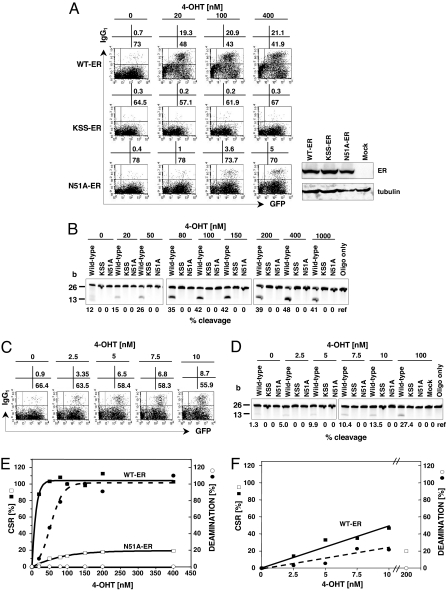
Determination of CSR and ssDNA deamination activities of ER-tagged wtAID and its mutants (KSS and N51A). (A) FACS plots after titration of 4-OHT. One day after retroviral infection and stimulation with LPS and IL-4, 4-OHT at increasing concentrations was added to each culture and the percentage of IgG1+ cells was determined 48 h later. Western blots represent the protein amounts after addition of 100 nM 4-OHT. (B) Polyacrilamide gel electrophoresis for determination of the DNA deamination activity of whole-cell lysates from the same experimental set used for CSR assay. Protein was extracted from cells incubated with 4-OHT at indicated concentrations by Dounce homogenization in PBS containing 10 μM ZnCl2 and 1% Nonidet P-40. Deamination assays were performed as described in Fig. 1. Percent cleavage was calculated by using densitometry. (C) FACS plots from an independent set of experiment for determination of wtAID-ER CSR activity at lower 4-OHT concentrations. (D) Deamination activity for wtAID-ER, KSS-ER, and N51A-ER determined in the same experiment as C. (E) Curve-fitted graph describing the relative activities of wtAID-ER (solid symbols) and N51A-ER (open symbols) based on the experiment described in A and B after subtraction of the levels at 0 nM 4-OHT. (F) Curve-fitted graph describing the relative activities of wtAID-ER based on the experiment described in C and D after subtraction of the levels at 0 nM 4-OHT. The activities of N51A-ER at 200 nM 4-OHT are taken from E.
Fig. 4.
Fig. 4.
In vitro DNA deamination and RNA editing activities of APOBEC1 mutant. (A) Representative polyacrylamide gel electrophoresis analysis of deamination activity by AID, APOBEC1, and its mutant. The experimental condition is the same as in Fig. 1A. (B) Titration of AID, APOBEC1 and its mutant proteins for deamination activity. The experimental condition is the same as in Fig. 1B except for the molar ratio of enzyme to substrate. Each assay was repeated more than three times. (C) Apolipoprotein B RNA editing activities of AID, APOBEC1, and its mutant were determined by sequencing from two independent experiments. An RNA fragment (239 b)containing C at nt 6,666 of human apoB100 cDNA was synthesized in vitro and incubated at 30°C for 2 h with the indicated proteins synthesized in vitro. RNA was extracted, reverse-transcribed, and amplified by using PCR for cloning. p, frequency of mutations was compared with AID+ACF (Fisher's exact test).

References

    1. Muramatsu M, et al. Specific expression of activation-induced cytidine deaminase (AID), a novel member of the RNA-editing deaminase family in germinal center B cells. J Biol Chem. 1999;274:18470–18476. - PubMed
    1. Revy P, et al. Activation-induced cytidine deaminase (AID) deficiency causes the autosomal recessive form of the Hyper-IgM syndrome (HIGM2) Cell. 2000;102:565–575. - PubMed
    1. Chaudhuri J, et al. Evolution of the immunoglobulin heavy chain class switch recombination mechanism. Adv Immunol. 2007;94:157–214. - PubMed
    1. Chaudhuri J, Tian M, Khuong C, Chua K, Pinaud E, Alt FW. Transcription-targeted DNA deamination by the AID antibody diversification enzyme. Nature. 2003;422:726–730. - PubMed
    1. Petersen-Mahrt SK, Harris RS, Neuberger MS. AID mutates E. coli suggesting a DNA deamination mechanism for antibody diversification. Nature. 2002;418:99–103. - PubMed

Publication types

LinkOut - more resources