. 2008 Nov;173(5):1518-27.
doi: 10.2353/ajpath.2008.080475. Epub 2008 Oct 2.

Specific mutations in the beta-catenin gene (CTNNB1) correlate with local recurrence in sporadic desmoid tumors

Affiliations

Specific mutations in the beta-catenin gene (CTNNB1) correlate with local recurrence in sporadic desmoid tumors

Alexander J F Lazar et al. Am J Pathol. 2008 Nov.

Abstract

Desmoid fibromatosis is a rare, nonmetastatic neoplasm marked by local invasiveness and relentless recurrence. Molecular determinants of desmoid recurrence remain obscure. beta-Catenin deregulation has been commonly identified in sporadic desmoids although the incidence of CTNNB1 (the gene encoding beta-catenin) mutations is uncertain. Consequently, we evaluated the prevalence of CTNNB1 mutations in a large cohort of sporadic desmoids and examined whether mutation type was relevant to desmoid outcome. Desmoid specimens (195 tumors from 160 patients, 1985 to 2005) and control dermal scars were assembled into a clinical data-linked tissue microarray. CTNNB1 genotyping was performed on a 138-sporadic desmoid subset. Immunohistochemical scoring was performed per standard criteria and data were analyzed using Kaplan-Meier and other indicated methods. CTNNB1 mutations were observed in 117 of 138 (85%) of desmoids. Three discrete mutations in two codons of CTNNB1 exon 3 were identified: 41A (59%), 45F (33%), and 45P (8%, excluded from further analysis because of rarity). Five-year recurrence-free survival was significantly poorer in 45F-mutated desmoids (23%, P < 0.0001) versus either 41A (57%) or nonmutated tumors (65%). Nuclear beta-catenin expression was observed in 98% of specimens and intensity was inversely correlated with incidence of desmoid recurrence (P < 0.01). In conclusion, CTNNB1 mutations are highly common in desmoid tumors. Furthermore, patients harboring CTNNB1 (45F) mutations are at particular risk for recurrence and therefore may especially benefit from adjuvant therapeutic approaches.


Figures
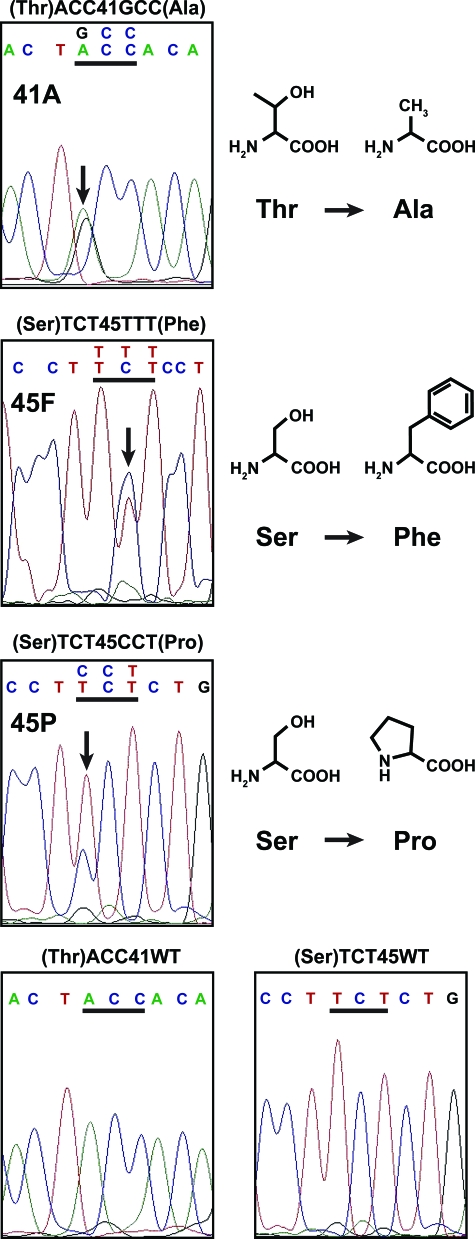
Figure 1
Figure 1
CTNNB1 exon 3 sequencing of desmoid tumor was available from 154 of the 160 patients (96%) on the TMA. Of these, 138 had sufficient clinical data (and no evidence of FAP) for inclusion and 85% showed one of three specific mutations in CTNNB1. Examples of Sanger sequencing for each mutational type encountered (abbreviated 41A, 45F, and 45P, respectively) and lack of mutation are displayed. In the top three panels, the mutated bp is denoted by a black arrow on the DNA sequence tracing and the codon change is shown directly above the affected codon (underlined in black). In the bottom two panels, unaltered codons 41 and 45 are displayed. Additional data are presented in Table 1. The chemical structures of the amino acids in the normal and mutated codons are depicted on the right. A, adenine; C, cytosine; G, guanine; T, thymine; Thr, threonine; Ala, alanine; Ser, serine; Phe, phenylalanine; Pro, proline; WT, wild type.
Figure 2
Figure 2
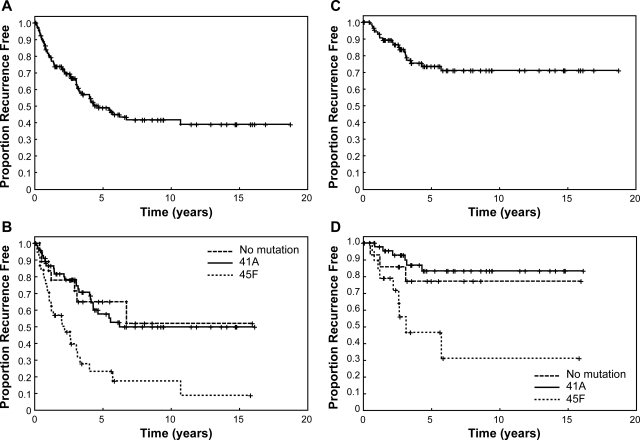
A: Kaplan-Meier plot of time from first surgery on the primary tumor to initial local recurrence. The entire cohort (n = 133) is shown in A. B: Patients with the 45F (Ser-TCT45TTT-Phe) mutation showed significantly greater hazard of recurrence compared to that of the 41A (Thr-ACC41GCC-Ala) mutation or no mutation groups. The 45P (Ser-TCT45CCT-Pro mutation) had too few patients for definitive analysis (n = 9), but recurrence experience resembled that of the 41A and no mutation groups. C and D: The equivalent data for the tumors of the patients who presented for surgery to UTMDACC with primary tumors (n = 88).
Figure 3
Figure 3
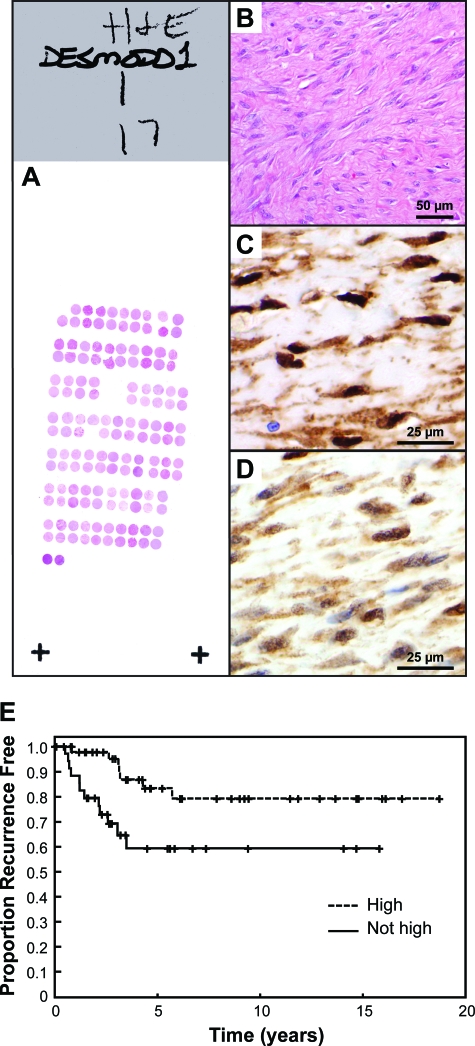
A: Representative H&E-stained slide from one of the three TMA blocks. B: H&E of desmoid tumor on the TMA. Immunohistochemistry shows high (C) and moderate (D) levels of nuclear β-catenin. Nuclear reactivity was considered high (=3) when the immunoreactivity completely precluded visualization of the nuclear hematoxylin counterstain whereas moderate (=2) and weak (=1) staining allowed such visualization to varying degrees. This determination was made at ×200 magnification with advancement to ×400 when necessary for cases with minimal reactivity. E: Kaplan-Meier analysis of time to recurrence from primary surgery for desmoid tumor in patients (n = 84) in which the actual primary tumors were available for TMA immunohistochemistry. Desmoid tumors showing attenuated nuclear β-catenin intensity levels [moderate (=2), minimal (=1), or rarely, negative (=0)] demonstrated by immunohistochemistry increased propensity to recurrence when compared to desmoids with high (=3) levels (P = 0.0406). Moderate, minimal, and negative staining groups were combined (not high) because they behaved similarly and because there were few patients in the minimal and negative groups. Original magnifications: ×200 (B); ×400 (C, D).

References

    1. Reitamo JJ, Hayry P, Nykyri E, Saxen E. The desmoid tumor. I. Incidence, sex-, age- and anatomical distribution in the Finnish population. Am J Clin Pathol. 1982;77:665–673. - PubMed
    1. Lev D, Kotilingam D, Wei C, Ballo MT, Zagars GK, Pisters PW, Lazar AA, Patel SR, Benjamin RS, Pollock RE. Optimizing treatment of desmoid tumors. J Clin Oncol. 2007;25:1785–1791. - PubMed
    1. Eccles DM, van der Luijt R, Breukel C, Bullman H, Bunyan D, Fisher A, Barber J, du Boulay C, Primrose J, Burn J, Fodde R. Hereditary desmoid disease due to a frameshift mutation at codon 1924 of the APC gene. Am J Hum Genet. 1996;59:1193–1201. - PMC - PubMed
    1. Kinzler KW, Nilbert MC, Su LK, Vogelstein B, Bryan TM, Levy DB, Smith KJ, Preisinger AC, Hedge P, McKechnie D, Finner R, Markham A, Groffen J, Boguski MS, Altschul SF, Horii A, Andoh H, Miyoshi Y, Miki Y, Nishisho I, Nakamura Y. Identification of FAP locus genes from chromosome 5q21. Science. 1991;253:661–665. - PubMed
    1. Giardiello FM, Petersen GM, Piantadosi S, Gruber SB, Traboulsi EI, Offerhaus GJ, Muro K, Krush AJ, Booker SV, Luce MC, Laken SJ, Kinzler KW, Vogelstein B, Hamilton SR. APC gene mutations and extraintestinal phenotype of familial adenomatous polyposis. Gut. 1997;40:521–525. - PMC - PubMed

Publication types

MeSH terms