. 2008 Oct 7;14(4):335-43.
doi: 10.1016/j.ccr.2008.08.014.

Single-cell profiling identifies aberrant STAT5 activation in myeloid malignancies with specific clinical and biologic correlates

Affiliations

Single-cell profiling identifies aberrant STAT5 activation in myeloid malignancies with specific clinical and biologic correlates

Nikesh Kotecha et al. Cancer Cell. .

Abstract

Progress in understanding the molecular pathogenesis of human myeloproliferative disorders (MPDs) has led to guidelines incorporating genetic assays with histopathology during diagnosis. Advances in flow cytometry have made it possible to simultaneously measure cell type and signaling abnormalities arising as a consequence of genetic pathologies. Using flow cytometry, we observed a specific evoked STAT5 signaling signature in a subset of samples from patients suspected of having juvenile myelomonocytic leukemia (JMML), an aggressive MPD with a challenging clinical presentation during active disease. This signature was a specific feature involving JAK-STAT signaling, suggesting a critical role of this pathway in the biological mechanism of this disorder and indicating potential targets for future therapies.


Figures
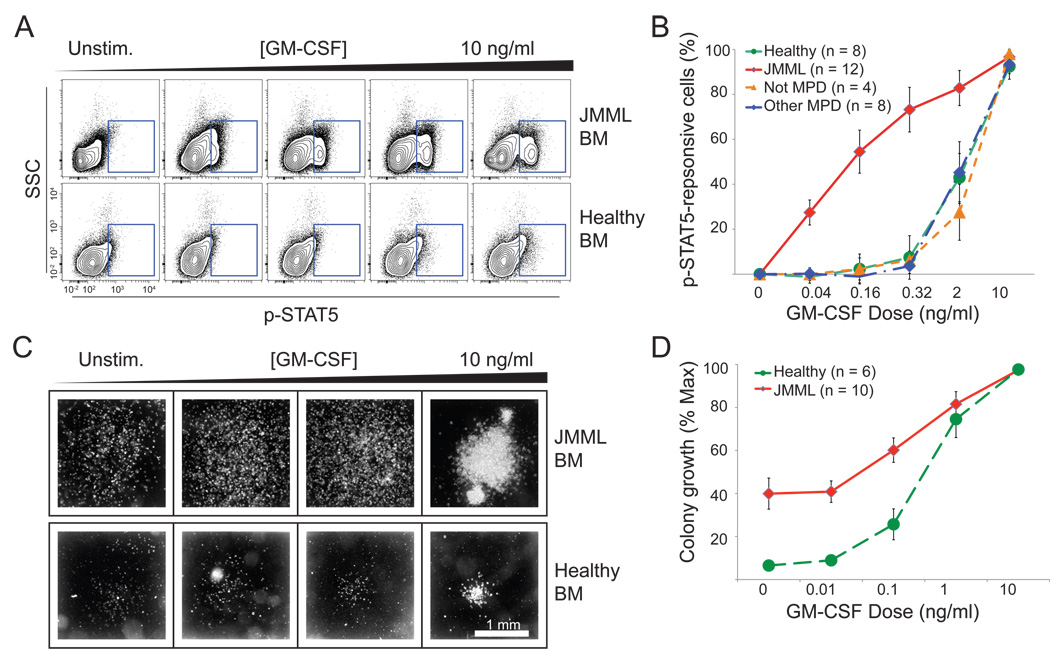
Figure 1
Figure 1. Hyperphosphorylation of STAT5 is seen in primary JMML cells at low concentrations of GM-CSF
The diagnosis of JMML is confirmed through an in vitro CFU-GM assay showing colony formation at low concentrations of GM-CSF. Colonies form over 2 weeks at various doses of GM-CSF. (A) Phospho-specific flow cytometry based assay demonstrated that GM-CSF hypersensitivity can be measured via p-STAT5. Primary cells from JMML and normal bone marrow (BM) were stimulated at varying concentrations of GM-CSF. The JMML samples showed a subset of cells responding via p-STAT5 at low concentrations of GM-CSF. In (B), increase in p-STAT5 response to GM-CSF concentration was quantified as a function of maximal response. A higher percentage of p-STAT5+ cells were present at 0.16 and 0.32 ng/ml of GM-CSF concentrations in JMML (n = 12) samples than in healthy samples (n = 8), samples with NS or DS related TMD (n = 8) or non-MPD samples that were initially suspected to be JMML (n = 4). In (C) we show colonies formed in a JMML and a normal sample at increasing doses of GM-CSF. These are the same samples measured using phosphospecific flow cytometry in (A). (D) Colony formation from JMML patients (n=10) was quantified as a function of maximum colony growth, plotted over varying concentrations of GM-CSF and compared against growth from normal samples (n = 6). Error bars in (B) and (D) represent standard error of the mean (s.e.m).
Figure 2
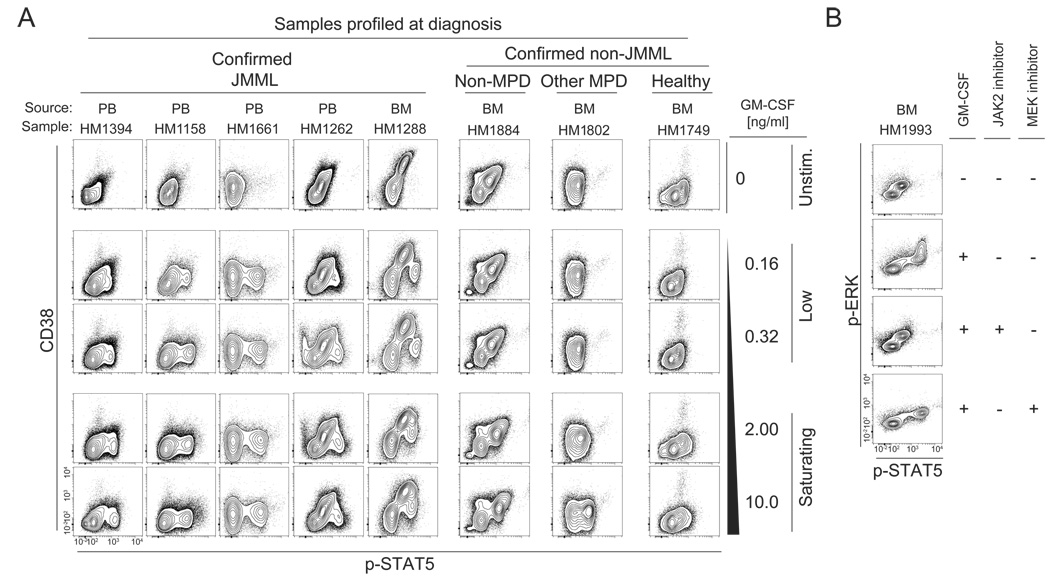
Figure 2. The p-STAT5 responsive population can distinguish JMML from other myeloproliferative disorders of childhood at diagnosis
(A) CD38 and p-STAT5 stratify the responsive population present in JMML peripheral blood and bone marrow samples at diagnosis. (B) Exposure to an oral JAK2 inhibitor, XL019, abrogated both the p-STAT5 and p-ERK response while exposure to a MEK inhibitor, CI-1040, only inhibited the p-ERK response.
Figure 3
Figure 3. The p-STAT5 responsive population is indicative of active JMML
(A) Clinically similar myeloproliferative disorders such as Noonan Syndrome/MPD and, Down Syndrome/TMD were distinguishable from JMML via phosphoflow cytometry. 11/12 JMML patient samples at diagnosis showed a GM-CSF hypersensitive population. 7/8 Normal BM samples did not have a GM-CSF hypersensitive population. (B)Samples post diagnosis show a p-STAT5 response in patients who have relapsed or transformed into AML M4/M5. Samples in remission do not show the p-STAT5 response. (C) The signature was also present in CMML (a similar disease to JMML that is diagnosed in adults) and AML M4/M5 (myeloid leukemia with myelomonocytic and monocytic differentiation). (D) Samples sorted by the normalized p-STAT5 response at 0.32ng/ml. Samples >40 showed JMML activity (Signaling profiles 1 and 2). 8/12 JMML samples at diagnosis had a normalized p-STAT5 response >95 (Signaling profile 1). Remiss. = Remission PMAIO = PMA/Ionomyocin
Figure 4
Figure 4. The p-STAT5 responsive population disappears in remission and reappears during relapse
Cells from JMML patients were profiled at diagnosis and later following a change in disease status. Both patients exhibited the characteristic JMML signature of hypersensitivity of STAT5 to 0.16 and 0.32 ng GM-CSF at diagnosis. Patient HM1394 responded poorly to upfront therapy, relapsed, and eventually transformed to AML M4. As the disease worsened, a greater percentage of cells were hyper-responsive. Likewise, patient HM1158 went into remission and no longer displayed the JMML signature.

Comment in

References

    1. Ahmadian MR, Zor T, Vogt D, Kabsch W, Selinger Z, Wittinghofer A, Scheffzek K. Guanosine triphosphatase stimulation of oncogenic Ras mutants. Proc Natl Acad Sci U S A. 1999;96:7065–7070. - PMC - PubMed
    1. Araki T, Mohi MG, Ismat FA, Bronson RT, Williams IR, Kutok JL, Yang W, Pao LI, Gilliland DG, Epstein JA, Neel BG. Mouse model of Noonan syndrome reveals cell type- and gene dosage-dependent effects of Ptpn11 mutation. Nat Med. 2004;10:849–857. - PubMed
    1. Archambeault S, Flores NJ, Yoshimi A, Kratz CP, Reising M, Fischer A, Noellke P, Locatelli F, Sedlacek P, Flotho C, et al. Development of an allele-specific minimal residual disease assay for patients with juvenile myelomonocytic leukemia. Blood. 2008;111:1124–1127. - PMC - PubMed
    1. Arico M, Biondi A, Pui CH. Juvenile myelomonocytic leukemia. Blood. 1997;90:479–488. - PubMed
    1. Bacher U, Haferlach T, Schoch C, Kern W, Schnittger S. Implications of NRAS mutations in AML: a study of 2502 patients. Blood. 2006;107:3847–3853. - PubMed

Publication types

MeSH terms

Substances