Review
. 2008 Aug;18(4):445-51.
doi: 10.1016/j.conb.2008.09.008. Epub 2008 Oct 27.

Crowding: a cortical constraint on object recognition

Affiliations
Review

Crowding: a cortical constraint on object recognition

Denis G Pelli. Curr Opin Neurobiol. 2008 Aug.

Abstract

The external world is mapped retinotopically onto the primary visual cortex (V1). We show here that objects in the world, unless they are very dissimilar, can be recognized only if they are sufficiently separated in visual cortex: specifically, in V1, at least 6mm apart in the radial direction (increasing eccentricity) or 1mm apart in the circumferential direction (equal eccentricity). Objects closer together than this critical spacing are perceived as an unidentifiable jumble. This is called 'crowding'. It severely limits visual processing, including speed of reading and searching. The conclusion about visual cortex rests on three findings. First, psychophysically, the necessary 'critical' spacing, in the visual field, is proportional to (roughly half) the eccentricity of the objects. Second, the critical spacing is independent of the size and kind of object. Third, anatomically, the representation of the visual field on the cortical surface is such that the position in V1 (and several other areas) is the logarithm of eccentricity in the visual field. Furthermore, we show that much of this can be accounted for by supposing that each 'combining field', defined by the critical spacing measurements, is implemented by a fixed number of cortical neurons.


Figures

Figure 1
Figure 1
Crowding. While fixating the (red) minus, it is easy to identify the isolated letter on the left, but impossible to identify the middle letter on the right. The flankers, “a” and “e,” spoil recognition of the target. Fixating the (green) plus, it is easy to identify the r on the right. Reducing the eccentricity of the target reduces your critical spacing, which relieves crowding. Reprinted from [19].
Figure 2
Figure 2
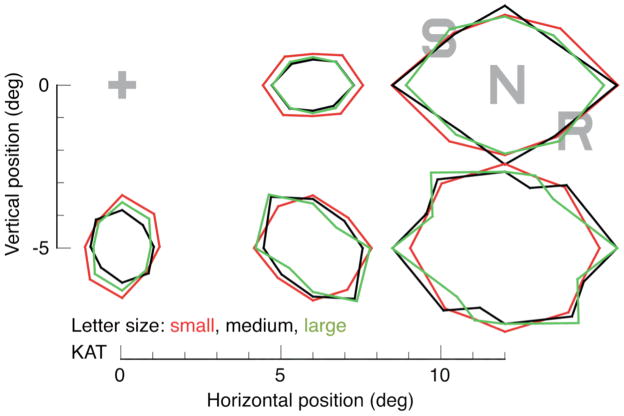
Critical spacing. The axes indicate position in the visual field, relative to the fixation point (grey “+” in upper left). In the upper right, also gray, we show a target letter between two symmetrically arranged flankers. The colored contour lines trace out the center-to-center target-to-flanker spacing the observer required to achieve 80% correct identification of the target letter. At each eccentricity, the black, red, and green curves represent different letter sizes. The results show that the critical spacing is proportional to radial eccentricity and independent of letter size. The symmetry of the plots results from the symmetry of the stimulus, which always had symmetrically opposed flankers. Each measured critical spacing is plotted as two opposing points. This is similar to the earlier measurements of Toet and Levi [3], but including several letter sizes. The anisotropy of critical spacing (radial over circumferential) is about 1.5 for this observer; Toet and Levi report an average of 2 for six observers, with large variations among observers. Letter sizes are 0.3, 0.43, and 0.55 deg at 5° and 6° ecc.; 0.43, 0.55, and 0.83 deg at 7.8° ecc.; 0.53, 0.83, and 1.2 deg at 12° ecc.; and 0.83, 1.2, and 1.5 at 13° ecc. Reprinted from [14].
Figure 3
Figure 3
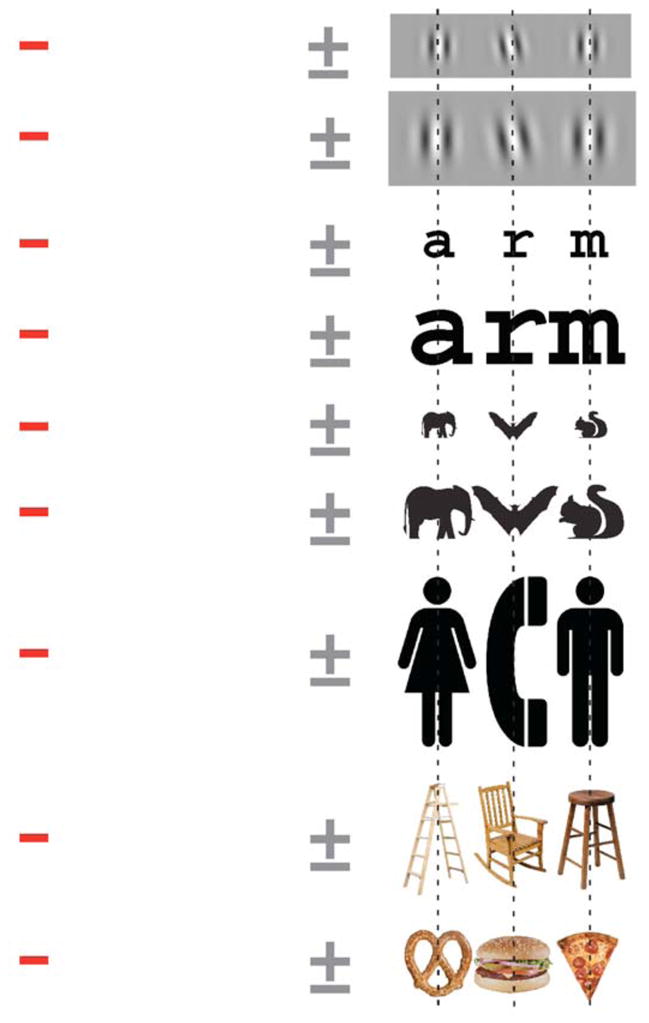
Critical spacing is independent of object and size. Fixating on the (red) minus, you will be unable to identify the middle object in each row, unless you isolate it by hiding the flanking objects with your fingers (or two pencils). Grating patches, like those in the top two rows, are often taken to be one-feature objects. In the first row, is the middle grating vertical or tilted? The ± is our estimate of the fixation point where you can just barely identify the target (Eq. 1 with b = 0.4). You can assess the accuracy of this threshold estimate by noting that the task is easy when you fixate to the right of the ±, and hard at the left. Critical spacing depends solely on position (and direction), in the visual field, which does not vary among rows in this demonstration. Note that halving object size has no effect on critical spacing. Critical spacing is independent of spatial frequency [21,61]. Reprinted, with modifications, from [19]. [Original sources: The gratings were created in MATLAB. The letters are in the Courier font. The animal silhouettes are in our Animals font, which is available for research purposes. The men, women, and telephone signs are from aiga.com [62]. The ladder is licensed from and copyright Stockbyte. The rocking chair is copyright 2008 Jupiter Images Corporation. In the following credits, we use the convention (Photographer/Name of collection/Source). The stool (C Squared Studios/Photodisc/Gettylmages), pretzel (Steve Wisbauer/Photodisc/Getty Images), hamburger (Ryan McVay/Photodisc/Getty Images), and pizza (Raimund Koch/Riser/Getty Images) are from Getty Images.]

References

    1. Bouma H. Interaction effects in parafoveal letter recognition. Nature. 1970;226:177–178. In two pages, Bouma introduced the idea of critical spacing, presented measurements as a function of eccentricity, and noted that it is roughly half the eccentricity. This was a breakthrough, counter to firmly established ideas that visibility depends on size (acuity) not spacing. - PubMed
    1. Larsson J, Heeger DJ. Two retinotopic visual areas in human lateral occipital cortex. J Neurosci. 2006;26:13128–13142. Beautiful fMRI measurements of retinotopy in six visual areas. Their exponential fit of eccentricity vs. cortical distance, ϕ =exp[β (d+α)], is equivalent to a logarithmic fit of cortical distance vs. eccentricity, d=(log ϕ)/β – α, which is our Eq. 2 above. - PMC - PubMed
    1. Toet A, Levi DM. The two-dimensional shape of spatial interaction zones in the parafovea. Vision Res. 1992;32:1349–1357. A classic paper, it shows the importance of measuring thoroughly and systematically, not just a few points. Before this paper, one would have expected maps of critical spacing to be regular and symmetric, as in [63]. The Toet and Levi maps reveal unexpected variations and asymmetries in critical spacing, within and across observers. The variations in critical spacing remain unexplained, but suggest an organic rather than a crystalline process. - PubMed
    1. Ullman S. High-level vision: object recognition and visual cognition. Cambridge, Mass: MIT Press; 2000.
    1. Duda RO, Hart PE, Stork DG. Pattern classification. 2. New York: Wiley; 2001.

Publication types