. 2009 Feb;23(2):433-41.
doi: 10.1096/fj.08-114397. Epub 2008 Oct 3.

In vivo genetic evidence for klotho-dependent, fibroblast growth factor 23 (Fgf23) -mediated regulation of systemic phosphate homeostasis

Affiliations

In vivo genetic evidence for klotho-dependent, fibroblast growth factor 23 (Fgf23) -mediated regulation of systemic phosphate homeostasis

Teruyo Nakatani et al. FASEB J. 2009 Feb.

Abstract

A major breakthrough in systemic phosphate homeostasis regulation was achieved by the demonstration of strikingly similar physical, morphological, and biochemical phenotypes of fibroblast growth factor 23 (Fgf23) and klotho ablated mice, which led to identification of klotho as an Fgf23 signaling cofactor. Here, we generated Fgf23 and klotho double-knockout (Fgf23(-/-)/klotho(-/-)) mice to test the hypothesis whether Fgf23 has a klotho-independent function. Fgf23(-/-)/klotho(-/-) mice are viable and have high serum phosphate levels, similar to Fgf23(-/-) and klotho(-/-) single-knockout mice. In addition, the Fgf23(-/-)/klotho(-/-) mice have increased renal expression of the sodium/phosphate cotransporter NaP(i)2a and of 1- alpha-hydroxylase concomitant with increased serum levels of 1,25-dihydroxyvitamin-D, as also observed in the Fgf23(-/-) and klotho(-/-) mice. Moreover, Fgf23(-/-)/klotho(-/-) mice show soft tissue and vascular calcification, severe muscle wasting, hypogonadism, pulmonary emphysema, distention of intestinal wall, and skin atrophy, all of which are also seen in Fgf23(-/-) and klotho(-/-) mice. Notably, injection of bioactive FGF23 protein into Fgf23(-/-)/klotho(-/-) and klotho(-/-) mice does not lower serum phosphate, whereas in wild-type and Fgf23(-/-) mice, it reduces serum phosphate. Together, these results provide compelling evidence that Fgf23 does not have a klotho-independent role in the regulation of systemic phosphate and vitamin D homeostasis.


Figures
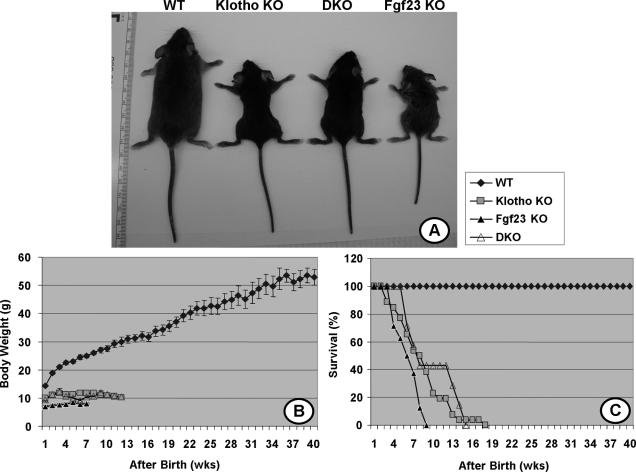
Figure 1.
Figure 1.
Macroscopic phenotype of Fgf23−/−/klotho−/− double mutants. A) Gross phenotype of wild-type, Fgf23−/−, klotho−/−, and Fgf23−/−/klotho−/− (DKO) mice at 6 wk of age. B, C) Body weight curves (B) and survival ratios (C) for all four genotypes, showing that Fgf23−/−/klotho−/− mice are smaller in size and have shorter survival times than their wild-type counterparts.
Figure 2.
Figure 2.
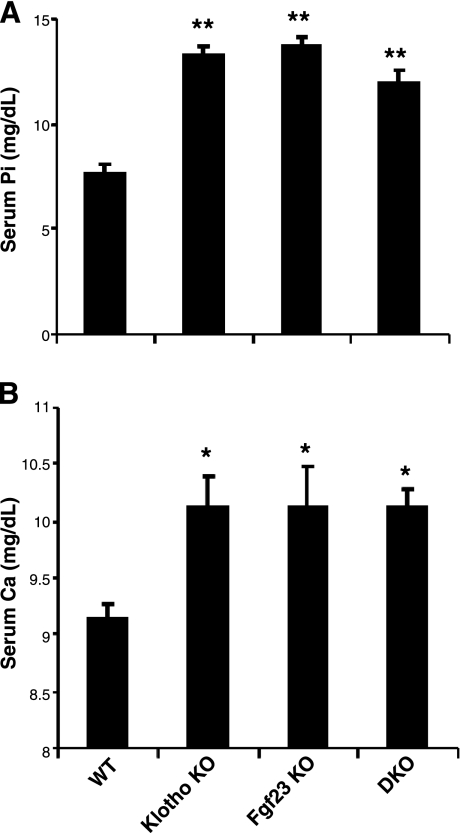
Biochemical analysis. Serum phosphate (A) and serum calcium (B) levels in control, Fgf23−/−, klotho−/−, and Fgf23−/−/klotho−/− (DKO) mice. Note that, compared to control mice, the serum phosphate and calcium levels are high in Fgf23−/−/klotho−/− mice; similar serum levels are noted in Fgf23−/− and klotho−/− mice. *P < 0.05, **P < 0.01 vs. control.
Figure 3.
Figure 3.
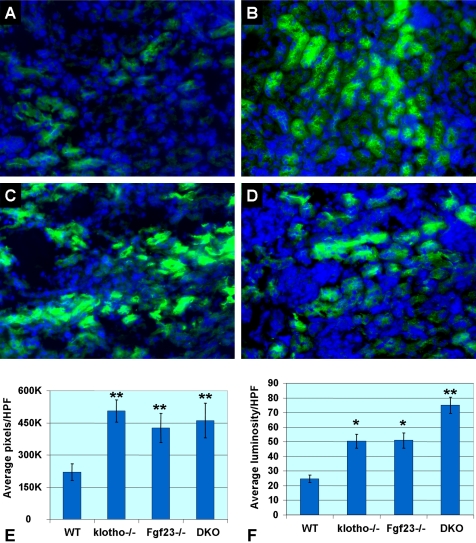
Immunofluorescence staining for NaPi2a in the kidneys obtained from 6-wk-old mice of various genotypes. Weak expression of NaPi2a (green fluorescence) is detected in wild-type kidney sections (A). In contrast, increased expression of NaPi2a protein is detected in the luminal side of the proximal tubular epithelial cells of the klotho−/− (B), Fgf23−/− (C), and Fgf23−/−/klotho−/− (DKO) (D) mice. Such increased renal expression of NaPi2a is believed to be associated with increased reabsorption of phosphate, which induces hyperphosphatemia in the Fgf23−/−, klotho−/−, and Fgf23−/−/klotho−/− mice (view ×40). DAPI staining of cell nuclei is shown as blue fluorescence. Distribution (E) and staining intensity (F) of NaPi2a expression are quantified on images taken from NaPi2a-stained slides at ×40. Relative area of staining (E) is determined by calculating the number of positively stained pixels per high-power field (HPF, ×40). Relative staining intensity (F) is determined by deducting the mean luminosity value from background value. Note that both distribution and intensity of NaPi2a expression are significantly increased in Fgf23−/−, klotho−/−, and Fgf23−/−/klotho−/− mice. *P < 0.05, **P < 0.001 vs. control.
Figure 4.
Figure 4.
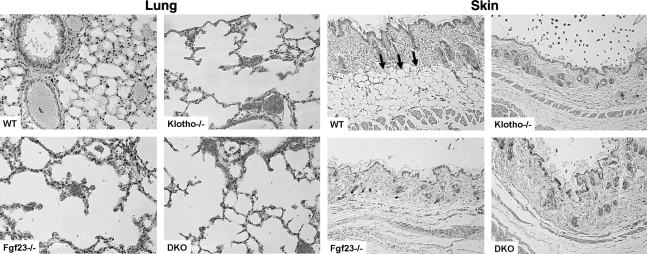
Histological analysis of lung and skin tissues. Hematoxylin and eosin-stained sections of the skin and lung of 6-wk-old wild-type, Fgf23−/−, klotho−/−, and Fgf23−/−/klotho−/− (DKO) mice. Note that compared to wild-type mice, a marked expansion of alveolar spaces is found in Fgf23−/−/klotho−/− mice. Such pulmonary emphysematous changes are also noted in Fgf23−/− and klotho−/− mice. Compared to wild-type mice, a marked atrophy of the skin in Fgf23−/−/klotho−/− mice is apparent. The subcutaneous fat tissue layer (arrows) in the wild-type skin is mostly absent in the homozygous mutant mice, either in the single Fgf23−/− and klotho−/− mice or in the Fgf23−/−/klotho−/− double mutant mice (lung and skin, ×10).
Figure 5.
Figure 5.
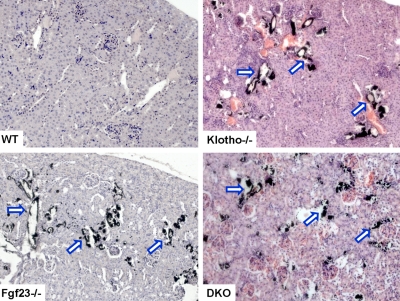
Von Kossa staining of kidney tissues. Renal sections prepared from wild-type, Fgf23−/−, klotho−/−, and Fgf23−/−/klotho−/− (DKO) mice (at 6 to 9 wk of age) showing extensive calcifications in the kidney of Fgf23−/−/ klotho−/− double-mutant mice. Similar calcification is also noted in Fgf23−/− and klotho−/− mice (view ×20).
Figure 6.
Figure 6.
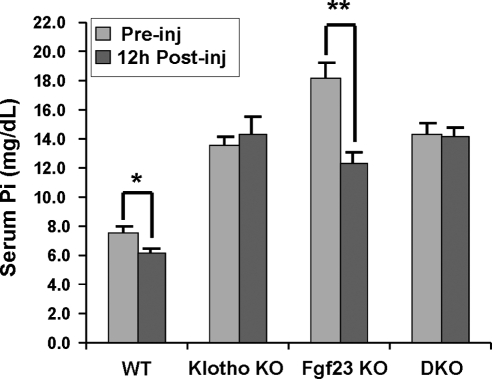
Bioactive FGF23 injection. Serum phosphate levels before and 12 h after injections of bioactive FGF23 protein. FGF23 protein injection resulted in significantly lowered serum phosphate levels in wild-type mice (preinjection 7.61±0.5 mg/dl vs. postinjection 6.11±0.3 mg/dl; P<0.05) and Fgf23−/− mice (preinjection 16.99±0.8 mg/dl vs. postinjection 12.5±0.4 mg/dl; P<0.01), but did not affect the serum phosphate levels in Fgf23−/−/klotho−/− (DKO) mice (preinjection 14.24±0.8 mg/dl vs. postinjection 14.2±0.3 mg/dl) or klotho−/− mice (preinjection 13.82±0.5 mg/dl vs. postinjection 14.27±1.2 mg/dl), suggesting that, in absence of klotho, FGF23 cannot regulate systemic phosphate homeostasis. *P < 0.05, **P < 0.01 vs. corresponding preinjection value.

References

    1. Yu X, White K E. FGF23 and disorders of phosphate homeostasis. Cytokine Growth Factor Rev. 2005;16:221–232. - PubMed
    1. Razzaque M S, St-Arnaud R, Taguchi T, Lanske B. FGF-23, vitamin D and calcification: the unholy triad. Nephrol Dial Transpl. 2005;20:2032–2035. - PubMed
    1. Memon F, El-Abbadi M, Nakatani T, Taguchi T, Lanske B, Razzaque M S. Does Fgf23-klotho activity influence vascular and soft tissue calcification through regulating mineral ion metabolism? Kidney Int. 2008;74:566–570. - PMC - PubMed
    1. Razzaque M S. Does renal ageing affect survival? Ageing Res Rev. 2007;6:211–222. - PubMed
    1. Razzaque M S, Taguchi T. Cellular and molecular events leading to renal tubulointerstitial fibrosis. Med Electron Microsc. 2002;35:68–80. - PubMed

Publication types