


Lower metabolic rate in individuals heterozygous for either a frameshift or a functional missense MC4R variant
- PMID: 18835933
- PMCID: PMC2584132
- DOI: 10.2337/db08-0577
Lower metabolic rate in individuals heterozygous for either a frameshift or a functional missense MC4R variant
Abstract
Objective: Humans with functional variants in the melanocortin 4 receptor (MC4R) are obese, hyperphagic, and hyperinsulinemic but have been reported to have no difference in energy expenditure.
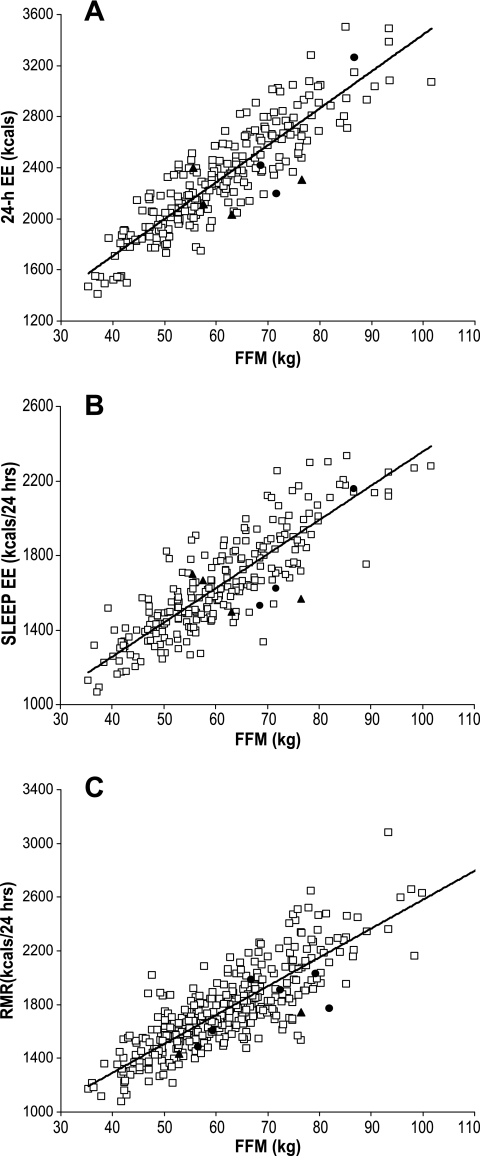
Research design and methods: We investigated the association of two MC4R variants, Arg165Gln (R165Q) and A insertion at nucleotide 100 (NT100), with adiposity in 3,074 full-heritage Pima Indians, a subset of whom had metabolic measures including 24-h energy expenditure (n = 252) and resting metabolic rate (RMR) (n = 364).
Results: Among the 3,074 subjects, 43 were heterozygous for R165Q and 14 for NT100 (frequency = 0.007 and 0.002). Mean (+/- SD) BMI was higher among subjects with R165Q (39.3 +/- 8.6 kg/m(2)) or NT100 (41.2 +/- 7.8) than subjects without either variant (37.1 +/- 8.4) (P = 0.04 and 0.02, adjusted for age, sex, and birth year and accounting for family membership). The 24-h energy expenditure (four with NT100; three with R165Q) or RMR (six with NT100; two with R165Q) was lower in heterozygous subjects but only met statistical significance when heterozygous subjects were combined and compared with subjects without either variant: least-squares means, 2,163 kcal/24 h (95% CI 2,035-2,291) vs. 2,307 kcal/24 h (2,285-2,328), P = 0.03 for 24-h energy expenditure, and 1,617 kcal/24 h (1,499-1,734) vs. 1,754 kcal/24 h (1,736-1,772), P = 0.02 for RMR; adjusted for age, sex, fat-free mass, and fat mass). For RMR, this difference persisted, even after accounting for family membership.
Conclusions: Pima Indians heterozygous for R165Q or NT100 in MC4R have higher BMIs and lower energy expenditure (by approximately 140 kcal/day), indicating that lower energy expenditure was a component of the increased adiposity.
Figures
References
-
- Barsh GS, Farooqi IS, O’Rahilly S: Genetics of body-weight regulation. Nature 404 :644 –651,2000 - PubMed
-
- Farooqi IS, Keogh JM, Yeo GS, Lank EJ, Cheetham T, O’Rahilly S: Clinical spectrum of obesity and mutations in the melanocortin 4 receptor gene. N Engl J Med 348 :1085 –1095,2003 - PubMed
-
- Huszar D, Lynch CA, Fairchild-Huntress V, Dunmore JH, Fang Q, Berkemeier LR, Gu W, Kesterson RA, Boston BA, Cone RD, Smith FJ, Campfield LA, Burn P, Lee F: Targeted disruption of the melanocortin-4 receptor results in obesity in mice. Cell 88 :131 –141,1997 - PubMed
Publication types
MeSH terms
Substances
Grants and funding
LinkOut - more resources
Full Text Sources
Miscellaneous
