. 2009 Jan 1;113(1):149-53.
doi: 10.1182/blood-2008-02-138560. Epub 2008 Oct 3.

AT-101 induces apoptosis in CLL B cells and overcomes stromal cell-mediated Mcl-1 induction and drug resistance

Affiliations

AT-101 induces apoptosis in CLL B cells and overcomes stromal cell-mediated Mcl-1 induction and drug resistance

Kumudha Balakrishnan et al. Blood. .

Abstract

Resistance to apoptosis in CLL B cells is associated with overexpression of Bcl-2 family antiapoptotic proteins. Their expression is endogenous, but is also induced by signals from the microenvironment resulting in intrinsic and extrinsic drug resistance. Because AT-101 binds to the BH3 motif of all Bcl-2-family antiapoptotic proteins, we hypothesized that this molecule could overcome resistance. AT-101 treatment (20 microM for 24 hours) resulted in a median 72% apoptosis in CLL cells (patients; n = 32, P < .001). Stromal cells protected CLL B cells from spontaneous and fludarabine-induced apoptosis (P = .003) by increasing the Mcl-1 protein levels. However, AT-101 induced similar extent of down-regulation of Mcl-1 and apoptosis in CLL lymphocytes cultured in suspension or on stroma (P = .999). Stromal cells expressed undetectable levels of antiapoptotic but high levels of activated ERK and AKT proteins and had low or no apoptosis with AT-101. Collectively, these data demonstrate that AT-101 induces apoptosis in CLL B cells and overcomes microenvironment-mediated resistance while sparing normal stromal cells.


Figures
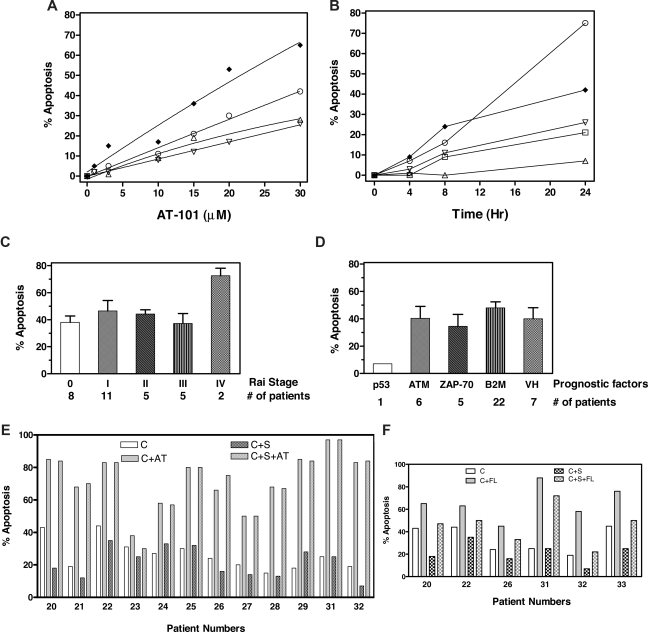
Figure 1
Figure 1
AT-101 induced cell death of CLL lymphocytes in both suspension culture as well as stromal coculture. (A,B) Dose and time response to AT-101. CLL lymphocytes in suspension culture were incubated with AT-101 at different concentrations (1, 3, 10, 15, 20, 30 μM; 1A; patients 2 ♦, 18 ○, 4 ▵, and 19 ▿) for 24 hours or with 20 μM AT-101 at 4, 8 and 24 hours; 1B; (patients 2 ♦, 16 ○, 19 ▿, 14 □, and 15 ▵) and the induction of apoptosis was measured by annexin-binding assay. (C,D) AT-101–induced apoptosis is independent of Rai stage or other prognostic factors. CLL lymphocytes in suspension culture were incubated with 20 μM AT-101 for 24 hours and assayed for annexin positivity (“% Apoptosis”). p53 indicates 17p deletion; ATM, 11q deletion; ZAP-70, > 20% ZAP-70 positivity; B2M, β2 microglobulin level higher than 2; and VH, IgVH gene mutation based on less than 96% nucleic acid sequence homology. (E) AT-101–induced apoptosis in CLL B cells was not abolished by stromal cells. CLL lymphocytes from patients (n = 12) were cultured either in suspension medium (C) in suspension medium with 20 μM AT-101 (C + AT), or with stromal cells in the absence (C + S) or presence of AT-101 (C + S + AT) and the apoptosis was measured after 24 hours (72 hours for samples from patients 31 and 32) by annexin-binding assay. The numbers below the abscissa indicate patient numbers, which coincide with the numbers given in Table S1. (F) Fludarabine-induced apoptosis in CLL B cells was reduced by stromal cell cocultures. CLL lymphocytes from patients (n = 6) were either cultured in suspension medium (C), in suspension medium with 10 μM fludarabine (C + FL) or with stromal cells in the absence (C + S) or presence (C + S + FL) of fludarabine, and the apoptosis was measured after 24 hours (72 hours for samples from patients 31 and 32) by annexin-binding assay. Numbers below the abscissa are patient identification numbers, which coincide with the numbers given in Table S1.
Figure 2
Figure 2
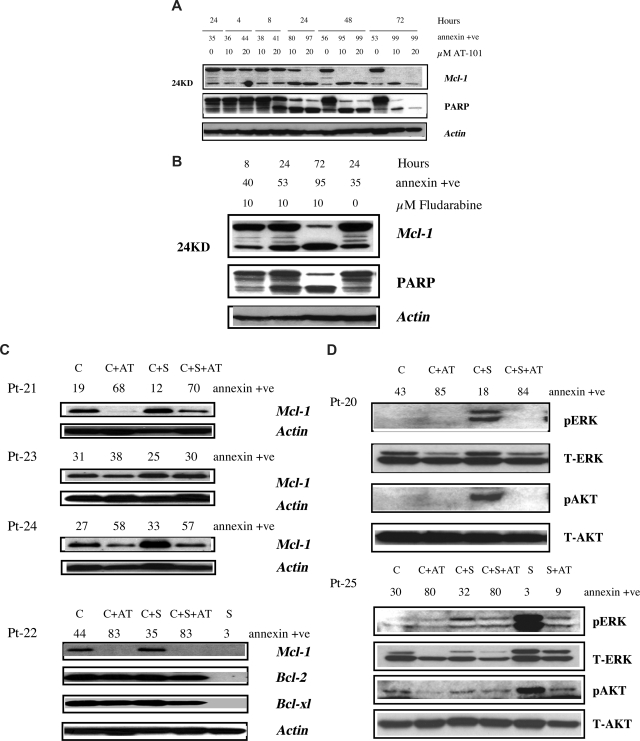
Effect of AT-101 and fludarabine on survival proteins in CLL cells in suspension culture or on stromal coculture. (A) Effect of AT-101 on Mcl-1 and PARP cleavage in CLL cells (patient 30) growing in suspension culture. CLL lymphocytes were incubated without or with 10 and 20 μM AT-101 for different time periods and the cleaved and uncleaved Mcl-1 and PARP were measured by immunoblotting. Annexin positivity for each sample is given above the immunoblots. (B) Effect of fludarabine on Mcl-1 and PARP cleavage in CLL cells (patient 30) growing in suspension culture. CLL lymphocytes were incubated without or with 10 μM fludarabine for 8, 24, and 72 hours and cleaved and uncleaved Mcl-1 and PARP were measured by immunoblotting. The annexin positivity for each sample is given above the immunoblots. (C) Antiapoptotic protein expression in CLL cells and influence of stromal microenvironment. CLL lymphocytes from patients were either cultured in suspension (C), in suspension with 20 μM AT-101 (C + AT), or with stromal cells in the absence (C + S) or presence of AT-101 (C + S + AT) for 24 hours. Antiapoptotic protein expression (Mcl-1; Bcl-2; Bcl-xl) was analyzed by immunoblotting. Actin was used as a loading control. S denotes stroma alone. Sample numbers are patient identification (Pt) numbers; see Table S1. (D) Effect of stroma and AT-101 on expression level of ERK and AKT proteins in CLL and stromal cells. CLL lymphocytes from patients were either cultured in suspension (C), in suspension with 20 μM AT-101 (C + AT), or with stromal cells in the absence (C + S) or presence of AT-101 (C + S + AT) for 24 hours. Stroma cells were cultured alone (S) or with AT-101 (S + AT) for 24 hours. pERK and pAKT were measured by immunoblotting, and the T-AKT and T-ERK were used for equal loading. Sample numbers are patient identification (Pt) numbers.

References

    1. Chiorazzi N, Rai KR, Ferrarini M. Chronic lymphocytic leukemia. N Engl J Med. 2005;352:804–815. - PubMed
    1. Schimmer AD, Munk-Pedersen I, Minden MD, Reed JC. Bcl-2 and apoptosis in chronic lymphocytic leukemia. Curr Treat Options Oncol. 2003;4:211–218. - PubMed
    1. Hanada M, Delia D, Aiello A, Stadtmauer E, Reed JC. bcl-2 gene hypomethylation and high-level expression in B-cell chronic lymphocytic leukemia. Blood. 1993;82:1820–1828. - PubMed
    1. Cimmino A, Calin GA, Fabbri M, et al. miR-15 and miR-16 induce apoptosis by targeting BCL2. Proc Natl Acad Sci U S A. 2005;102:13944–13949. - PMC - PubMed
    1. Kitada S, Andersen J, Akar S, et al. Expression of apoptosis-regulating proteins in chronic lymphocytic leukemia: correlations with In vitro and In vivo chemoresponses. Blood. 1998;91:3379–3389. - PubMed

Publication types

MeSH terms