. 2008;59(13):3621-34.
doi: 10.1093/jxb/ern217.

Purification, molecular cloning, and characterization of glutathione S-transferases (GSTs) from pigmented Vitis vinifera L. cell suspension cultures as putative anthocyanin transport proteins

Affiliations

Purification, molecular cloning, and characterization of glutathione S-transferases (GSTs) from pigmented Vitis vinifera L. cell suspension cultures as putative anthocyanin transport proteins

Simon Conn et al. J Exp Bot. 2008.

Abstract

The ligandin activity of specific glutathione S-transferases (GSTs) is necessary for the transport of anthocyanins from the cytosol to the plant vacuole. Five GSTs were purified from Vitis vinifera L. cv. Gamay Fréaux cell suspension cultures by glutathione affinity chromatography. These proteins underwent Edman sequencing and mass spectrometry fingerprinting, with the resultant fragments aligned with predicted GSTs within public databases. The corresponding coding sequences were cloned, with heterologous expression in Escherichia coli used to confirm GST activity. Transcriptional profiling of these candidate GST genes and key anthocyanin biosynthetic pathway genes (PAL, CHS, DFR, and UFGT) in cell suspensions and grape berries against anthocyanin accumulation demonstrated strong positive correlation with two sequences, VvGST1 and VvGST4, respectively. The ability of VvGST1 and VvGST4 to transport anthocyanins was confirmed in the heterologous maize bronze-2 complementation model, providing further evidence for their function as anthocyanin transport proteins in grape cells. Furthermore, the differential induction of VvGST1 and VvGST4 in suspension cells and grape berries suggests functional differences between these two proteins. Further investigation of these candidate ligandins may identify a mechanism for manipulating anthocyanin accumulation in planta and in vitro suspension cells.


Figures

Fig. 1.
Fig. 1.
Purification of glutathione-binding proteins from pigmented V. vinifera cell suspension cultures. (A) Vitis vinifera FU-01 cells were cultured in GC-2 medium (filled circles) for 4 d, then elicited with 10 μM jasmonic acid, 20 g l−1 sucrose (or an equal volume of vehicle control), and constant white light irradiation (open circles, 96.8±2.2 μmol s−1 m−2). Cultures were incubated at 27±1 °C on a reciprocating shaker at 100 strokes min−1, in 500 ml Erlenmeyer flasks containing 100 ml of B5 medium (Gamborg et al., 1968) supplemented with 30 g l−1 sucrose, 250 mg l−1 casein hydrolysate, 0.1 mg l−1 α-naphthaleneacetic acid, and 0.2 mg l−1 kinetin. GST activity, presented as the mean ±SD of three biological replicates performed in triplicate, was determined for the 60% ammonium sulphate precipitate (n=9). (B) Sixty percent ammonium sulphate precipitate from day 5, non-elicited FU-01 line subjected to GST affinity chromatography. One-dimensional gel electropherogram of fractions (0.5 ml) from the GSTrap column. (C) Corresponding GST activity on the same fractions using CDNB as the model substrate.
Fig. 2.
Fig. 2.
(A) Two-dimensional gel electropherogram of glutathione affinity chromatography fractions possessing GST activity. (B) Enlarged image of the boxed region showing grouping based on mass spectrometry fingerprints (refer to Table 1). IEF strip pI3-10NL was rehydrated in the protein precipitate from GST active fractions of the GSTrap column. This was focused for 48 kVh and then separated on a 10% polyacrylamide gel and stained with SYPRO Ruby.
Fig. 3.
Fig. 3.
(A) Genomic structure of V. vinifera GSTs cloned in this study. Exons are indicated by black arrows, and introns are indicated by double lines. (B) Phylogenetic tree of GSTs in the plant kingdom, showing classification into type I, II, and III GSTs as per Droog (1997). Sequences aligned are listed on the right-hand side of the tree and were obtained by retrieval of protein sequences from GenBank. Multiple sequence alignments were created by ClustalW (Thompson et al., 1994) and the phylogenetic tree was generated using PHYLIP under default settings and viewed with Treeview version 1.6.6. Origins of the proteins are indicated by a two-letter prefix to the protein name: At, Arabidopsis, Dc, carnation; Nt, tobacco; Sc, cucumber; St, potato; Ta, wheat; Vv, grape (highlighted); Zm, maize. An9, TT19, and Bz2 are shown without prefixes for consistency.
Fig. 4.
Fig. 4.
Western blot and GST activity performed on crude soluble protein extract from E. coli carrying vectors as indicated. –ve, E. coli carrying pQE9:VvGST5 without IPTG induction; p, E. coli carrying the pQE9 backbone only; GST coding sequences in pQE9 5, VvGST5; 1, VvGST1; 2, VvGST2; 3, VvGST3; 4, VvGST4. The arrow indicates the 6×HIS fusion product. M15:pREP4 E. coli were transformed with VvGST cDNAs in pQE9, N-terminal HIS fusion vector (Invitrogen) and grown at 37 °C. Induction of HIS fusion proteins was achieved with 1 mM IPTG for 18 h, with soluble protein extracted according to Sambrook and Maniatis (1989). Western blotting was performed using an anti-HIS detection kit (Macherey-Nagel).
Fig. 5.
Fig. 5.
Anthocyanin accumulation and relative mRNA transcript levels for key anthocyanin biosynthetic genes in cultures following induction after 4 d with sucrose, jasmonic acid, and continuous light irradiation. (A) Anthocyanin content in V. vinifera cell suspensions following induction, compared with control cultures. Data are presented as the mean ±SD of triplicate analyses. The fold increase in steady-state transcript was calculated using the ΔΔ-Ct equation (Pfaffl, 2001), with β-tubulin as internal control, for (B) phenylalanine ammonia-lyase (PAL), chalcone synthase (CHS), dihydroflavonol 4-reductase (DFR), and UDP-glucose:flavonoid glucosyltransferase (UFGT), and (C) glutathione S-transferases 1–5 (VvGST1–5). All data are expressed relative to untreated cultures at each time point and are presented as the mean of duplicate analyses.
Fig. 6.
Fig. 6.
Relative mRNA transcript levels for GSTs in post-veraison V. vinifera L. cv. Shiraz berry skins compared with pre-veraison. Fold increase in steady-state transcripts calculated using the ΔΔ-Ct equation, with VvUbiquitin1 as internal control. Data are presented as mean of triplicate analyses.
Fig. 7.
Fig. 7.
Complementation of anthocyanin transport by V. vinifera GSTs in Bronze-2-deficient corn kernels. Corn kernels 48 h after bombardment with GST constructs in pJD288 (35S) maize expression vector; 20× magnification. Bar = 300 μm. Bronze-2-deficient corn kernels were bombarded with 1 μm diameter gold particles coated with plasmid, and analysed as per Alfenito et al. (1998). Images were captured using an Olympus BX50 light microscope equipped with a Canon EOS digital camera.
Fig. 8.
Fig. 8.
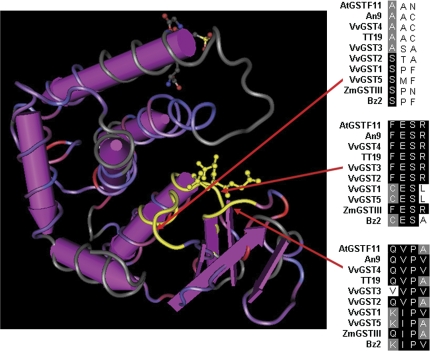
Inference of functional residues in anthocyanin transport by protein modelling. Three-dimensional model of E. coli GST chain A, interacting with its substrate (glutathione sulphonic acid). The highlighted regions are within 3 Å of the substrate and expanded to show the respective coding sequences for the aligned GSTs. Alignment of VvGSTs with known anthocyanin-transporting GSTs complementing the bz2 maize model. Amino acids shaded in black are present in ≥50% of the proteins at that residue, while alternative conserved residues at that site are shaded in grey, with other unique residues left unshaded.

References

    1. Aharoni A, Keizer LC, van den Broeck HC, Blanco-Portales R, Munoz-Blanco J, Bois G, Smit P, de Vos RC, O'Connell AP. Novel insight into vascular, stress, and auxin-dependent and -independent gene expression programs in strawberry, a non-climacteric fruit. Plant Physiology. 2002;129:1019–1031. - PMC - PubMed
    1. Alfenito MR, Souer E, Goodman CD, Buell R, Mol JNM, Koes R, Walbot V. Functional complementation of anthocyanin sequestration in the vacuole by widely divergent glutathione S-transferases. The Plant Cell. 1998;10:1135–1149. - PMC - PubMed
    1. Alonso JM, Stepanova AN, Leisse TJ, et al. Genome-wide insertional mutagenesis of Arabidopsis thaliana. Science. 2003;301:653–657. - PubMed
    1. Altschul SF, Gish W, Miller W, Myers EW, Lipman DJ. Basic local alignment search tool. Journal of Molecular Biology. 1990;215:403–410. - PubMed
    1. Bézier A, Lambert B, Baillieul F. Study of defense-related gene expression in grapevine leaves and berries infected with Botrytis cinerea. European Journal of Plant Pathology. 2002;108:111–120.

Publication types

MeSH terms

Associated data