Review
. 2008 Nov;4(11):619-26.
doi: 10.1038/ncpendmet0976. Epub 2008 Oct 7.

Mechanisms of macrophage activation in obesity-induced insulin resistance

Affiliations
Review

Mechanisms of macrophage activation in obesity-induced insulin resistance

Justin I Odegaard et al. Nat Clin Pract Endocrinol Metab. 2008 Nov.

Abstract

Chronic inflammation is now recognized as a key step in the pathogenesis of obesity-induced insulin resistance and type 2 diabetes mellitus. This low-grade inflammation is mediated by the inflammatory (classical) activation of recruited and resident macrophages that populate metabolic tissues, including adipose tissue and liver. These findings have led to the concept that infiltration by and activation of macrophages in adipose tissue are causally linked to obesity-induced insulin resistance. Studies have shown, however, that alternatively activated macrophages taking residence in adipose tissue and liver perform beneficial functions in obesity-induced metabolic disease. Alternatively activated macrophages reduce insulin resistance in obese mice by attenuating tissue inflammation and increasing oxidative metabolism in liver and skeletal muscle. The discovery that distinct subsets of macrophages are involved in the promotion or attenuation of insulin resistance suggests that pathways controlling macrophage activation can potentially be targeted to treat these comorbidities of obesity. Thus, this Review focuses on the stimuli and mechanisms that control classical and alternative activation of tissue macrophages, and how these macrophage activation programs modulate insulin action in peripheral tissues. The functional importance of macrophage activation is further discussed in the context of host defense to highlight the crosstalk between innate immunity and metabolism.


Figures
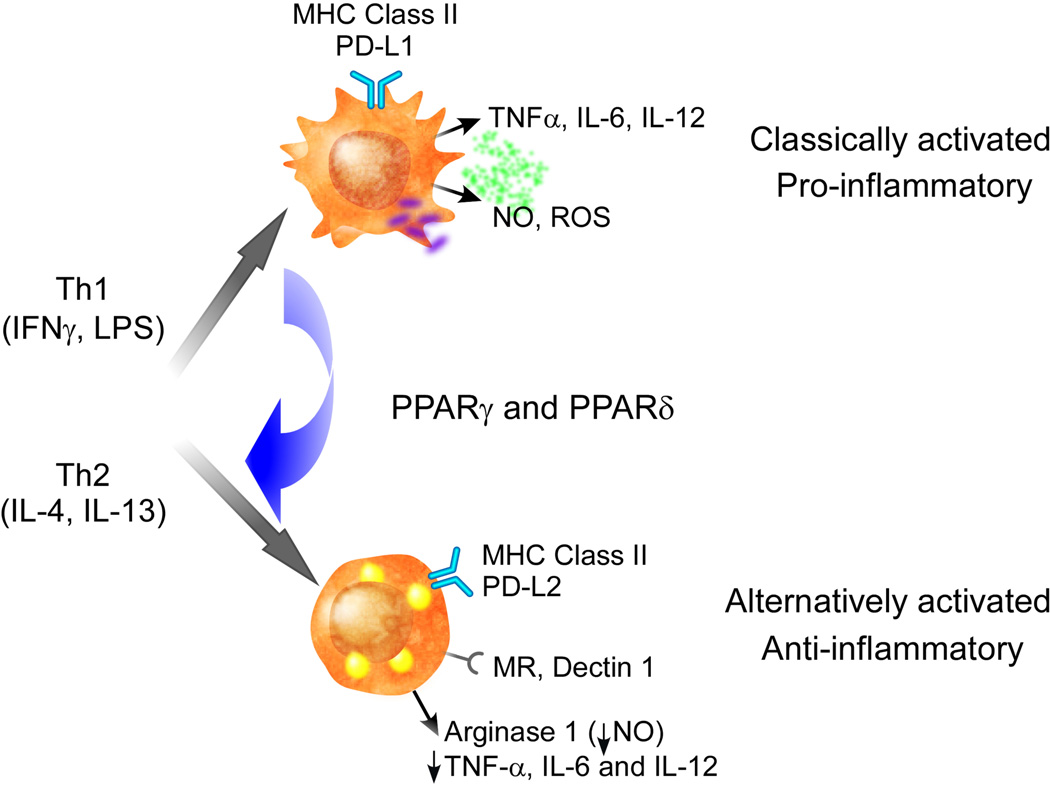
Figure 1
Figure 1
Classical and alternative activation of macrophages. Microbial stimuli, which are recognized by pattern recognition receptors, and the T-helper-1 cytokine interferon γ promote classical activation of resident and recruited macrophages. These activated cells produce proinflammatory cytokines, such as tumor necrosis factor and interleukin 6, and reactive oxygen species and nitric oxide. Induction of major histocompatability complex class II and co-stimulatory molecules increases antigen presentation by these cells. Classically activated macrophages play an essential part in antibacterial responses. By contrast, interleukins 4 and 13 promote alternative macrophage activation, which plays a critical role in allergic and antiparasitic responses. Although these cells also induce major histocompatability complex class II, their repertoire of co-stimulatory molecules and pattern recognition receptors is different. The co-stimulatory molecule program death ligand 2 and pattern recognition receptors, mannose receptor and dectin-1, are highly induced in alternatively activated macrophages. Induction of arginase 1 diverts arginine catabolism away from nitric oxide synthesis to ornithine and urea. In addition, in a paracrine and autocrine manner, alternatively activated macrophages suppress inflammation. Abbreviations: IFN, interferon; IL, interleukin; LPS, lipopolysaccharide; MHC, major histocompatability complex; MR, mannose receptor; NO, nitric oxide; PD-L, program death ligand; PPAR, peroxisome proliferator-activated receptor; ROS, reactive oxygen species; TH, T helper; TNF, tumor necrosis factor.
Figure 2
Figure 2
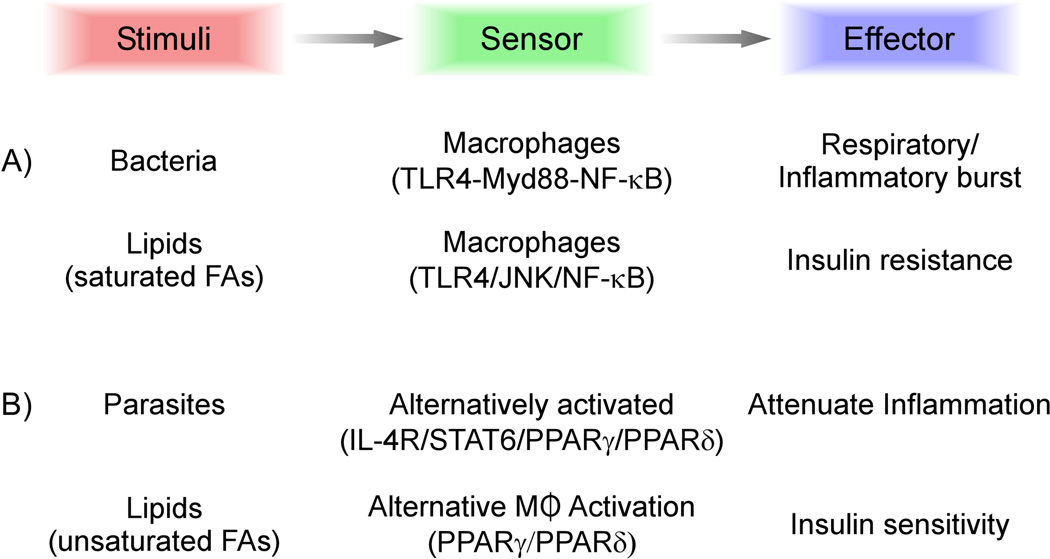
Innate immune modules deployed in host defense and obesity. Sensing of bacteria by the Toll-like receptor 4 leads to activation of NF-κB, resulting in inflammatory activation of macrophages. In obesity, ligation of Toll-like receptor 4 and activation of JNK1 by saturated fatty acids, such as myristic, palmitic andstearic No acids, causes classical activation of tissue macrophages, leading to inflammation and insulin resistance. Parasitic infections result in activation of T-helper-2 cytokine signaling pathways in macrophages to promote alternative macrophage activation, which counteracts T-helper-1-type inflammation and facilitates containment of parasites. In contrast to saturated fatty acids, monounsaturated fatty acids, such as oleic acid, activate peroxisome proliferator-activated receptors δ and γ, and synergize with T-helper-2 cytokines to polarize tissue macrophages to the alternative state. Factors released by alternatively activated macrophages attenuate tissue inflammation and promote parenchymal cell oxidative metabolism, resulting in insulin sensitization of metabolic tissues. Abbreviations: IL, interleukin; JNK, jun kinase; Myd88, Myeloid differentiation primary response gene; PPAR, peroxisome proliferator-activated receptor; STAT, signal transducer and activator of transcription; TLR4, Toll-like receptor 4.
Figure 3
Figure 3
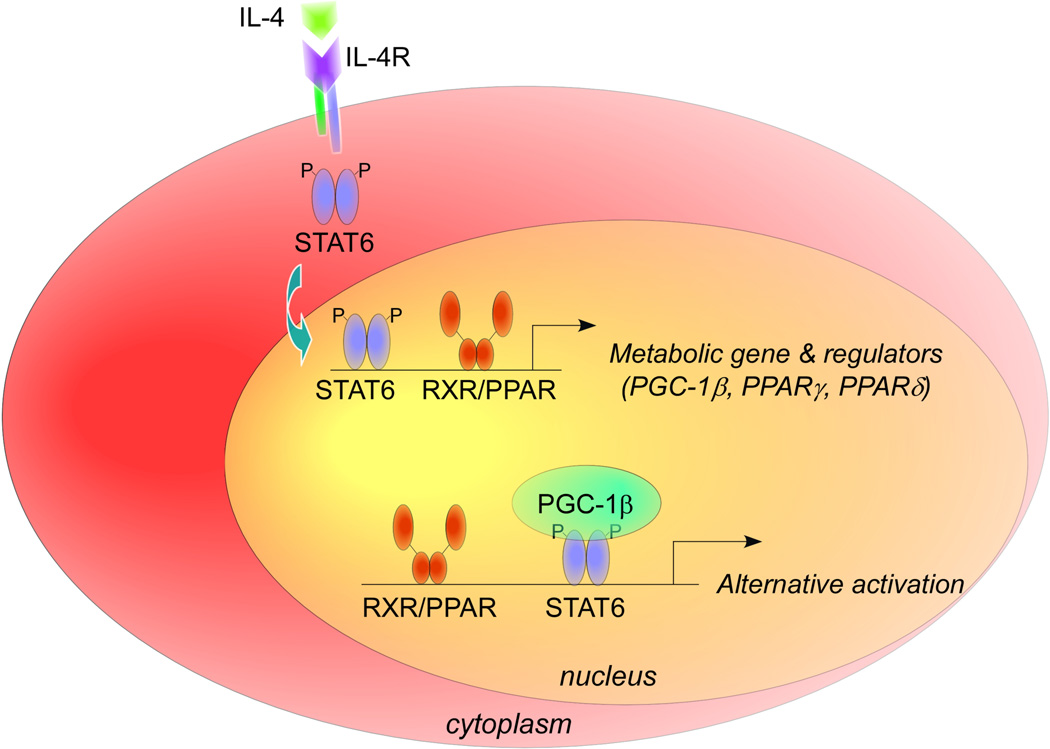
Transcriptional model for alternative macrophage activation. Stimulation of macrophages with the T-helper-2 cytokine interleukin 4 results in phosphorylation of STAT6 via the interleukin-4 receptor. Phosphorylated STAT6 proteins dimerize and translocate to the nucleus to activate transcription of target genes. In addition to inducing the expression of signature genes of alternatively activated macrophages, phosphorylated STAT6 incraeases expression of two classes of metabolic genes. First, STAT6 binds to and activates promoters of genes important in the β-oxidation of fatty acids. Second, STAT6 induces expression of transcriptional regulators (peroxisome proliferator-activated receptors δ and γ) and the coactivator protein PGC-1β, which synergize with STAT6 to amplify and stabilize macrophage programs of alternative activation. Abbreviations: IL, interleukin; PGC-1β, peroxisome proliferator-activated receptor 1β; PPAR, peroxisome proliferator-activated receptor; RXR, retinoid X receptor; STAT, signal transducer and activator of transcription;

References

    1. Flegal KM, et al. Prevalence and trends in obesity among US adults 1999–2000. JAMA. 2002;288:1723–1727. - PubMed
    1. Li Z, et al. Health ramifications of the obesity epidemic. Surg Clin North Am. 2005;85:681–701. v. - PubMed
    1. Ford ES. Risks for all-cause mortality, cardiovascular disease, and diabetes associated with the metabolic syndrome: a summary of the evidence. Diabetes Care. 2005;28:1769–1778. - PubMed
    1. Allison DB, et al. The direct health care costs of obesity in the United States. Am J Public Health. 1999;89:1194–1199. - PMC - PubMed
    1. Olshansky SJ, et al. A potential decline in life expectancy in the United States in the 21st century. N Engl J Med. 2005;352:1138–1145. - PubMed

Publication types

MeSH terms