


Biochemically silent abdominal paragangliomas in patients with mutations in the succinate dehydrogenase subunit B gene
- PMID: 18840642
- PMCID: PMC2626451
- DOI: 10.1210/jc.2008-1093
Biochemically silent abdominal paragangliomas in patients with mutations in the succinate dehydrogenase subunit B gene
Abstract
Context: Patients with adrenal and extra-adrenal abdominal paraganglioma (PGL) almost invariably have increased plasma and urine concentrations of metanephrines, the O-methylated metabolites of catecholamines. We report four cases of biochemically silent abdominal PGL, in which metanephrines were normal despite extensive disease.
Objective: Our objective was to identify the mechanism underlying the lack of catecholamine hypersecretion and metabolism to metanephrines in biochemically silent PGL.
Design: This is a descriptive study.
Setting: The study was performed at a referral center.
Patients: One index case and three additional patients with large abdominal PGL and metastases but with the lack of evidence of catecholamine production, six patients with metastatic catecholamine-producing PGL and a mutation of the succinate dehydrogenase subunit B (SDHB) gene, and 136 random patients with catecholamine-producing PGL were included in the study.
Main outcome measures: Plasma, urine, and tumor tissue concentrations of catecholamines and metabolites were calculated with electron microscopy and tyrosine hydroxylase immunohistochemistry.
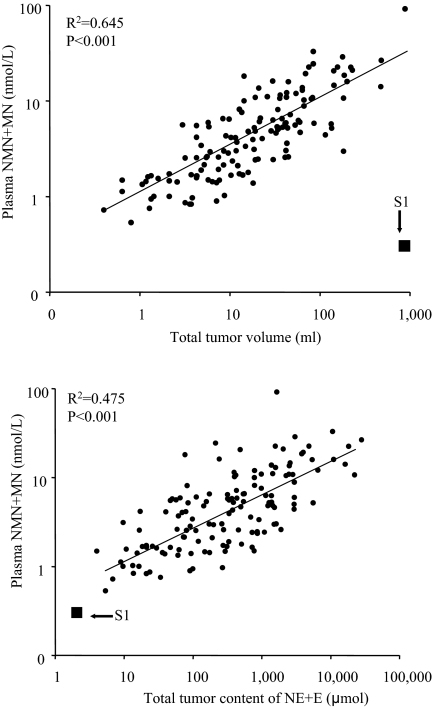
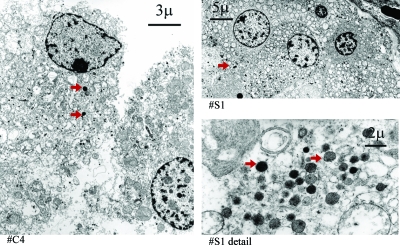
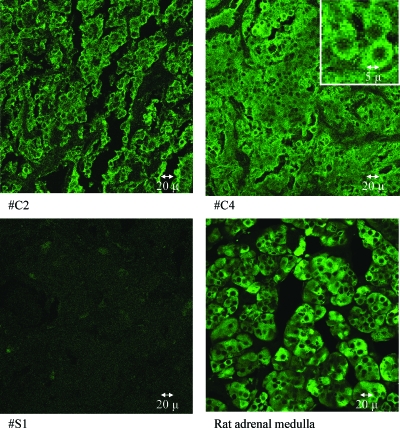
Results: All four patients with biochemically silent PGL had an underlying SDHB mutation. In the index case, the tumor tissue concentration of catecholamines (1.8 nmol/g) was less than 0.01% that of the median (20,410 nmol/g) for the 136 patients with catecholamine-producing tumors. Electron microscopy showed the presence of normal secretory granules in all four biochemically silent PGLs. Tyrosine hydroxylase immunoreactivity was negligible in the four biochemically silent PGLs but abundant in catecholamine-producing PGLs.
Conclusions: Patients with SDHB mutations may present with biochemically silent abdominal PGLs due to defective catecholamine synthesis resulting from the absence of tyrosine hydroxylase. Screening for tumors in patients with SDHB mutations should not be limited to biochemical tests of catecholamine excess.
Figures
References
-
- DeLellis RA, Lloyd RV, Heitz PU, Eng C 2004 Pathology and genetics: World Health Organization classification of tumours of endocrine organs. Oxford, UK: Oxford University Press
-
- Lenders JW, Pacak K, Walther MM, Linehan WM, Mannelli M, Friberg P, Keiser HR, Goldstein DS, Eisenhofer G 2002 Biochemical diagnosis of pheochromocytoma: which test is best? JAMA 287:1427–1434 - PubMed
-
- Eisenhofer G, Lenders JW, Goldstein DS, Mannelli M, Csako G, Walther MM, Brouwers FM, Pacak K 2005 Pheochromocytoma catecholamine phenotypes and prediction of tumor size and location by use of plasma free metanephrines. Clin Chem 51:735–744 - PubMed
-
- Eisenhofer G, Goldstein DS, Sullivan P, Csako G, Brouwers FM, Lai EW, Adams KT, Pacak K 2005 Biochemical and clinical manifestations of dopamine-producing paragangliomas: utility of plasma methoxytyramine. J Clin Endocrinol Metab 90:2068–2075 - PubMed
Publication types
MeSH terms
Substances
Grants and funding
LinkOut - more resources
Full Text Sources
Other Literature Sources
Miscellaneous
