


Anisotropic rheology and directional mechanotransduction in vascular endothelial cells
- PMID: 18840694
- PMCID: PMC2563098
- DOI: 10.1073/pnas.0804573105
Anisotropic rheology and directional mechanotransduction in vascular endothelial cells
Abstract
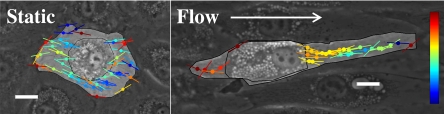
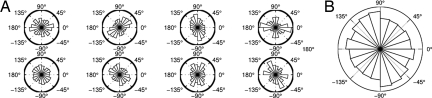
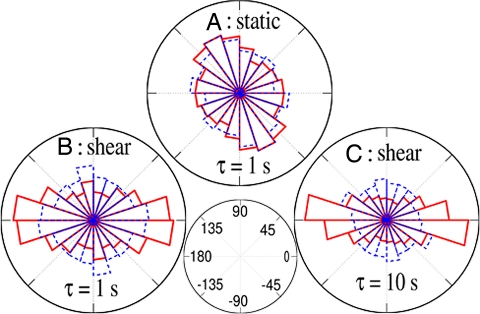
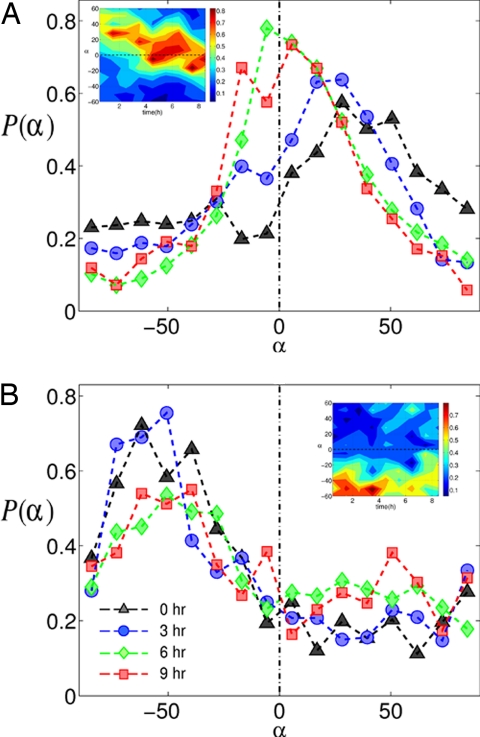
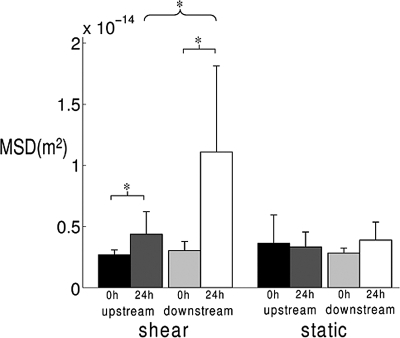
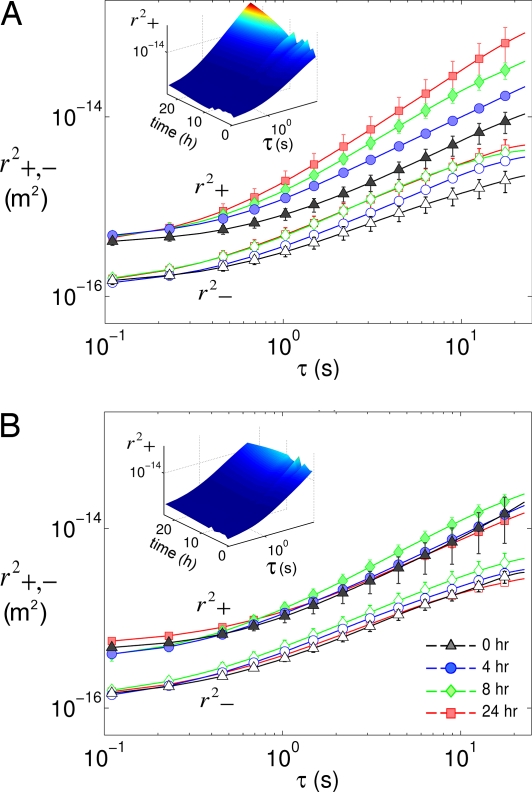
Adherent cells remodel their cytoskeleton, including its directionality, in response to directional mechanical stimuli with consequent redistribution of intracellular forces and modulation of cell function. We analyzed the temporal and spatial changes in magnitude and directionality of the cytoplasmic creep compliance (Gamma) in confluent cultures of bovine aortic endothelial cells subjected to continuous laminar flow shear stresses. We extended particle tracking microrheology to determine at each point in the cytoplasm the principal directions along which Gamma is maximal and minimal. Under static condition, the cells have polygonal shapes without specific alignment. Although Gamma of each cell exhibits directionality with varying principal directions, Gamma averaged over the whole cell population is isotropic. After continuous laminar flow shear stresses, all cells gradually elongate and the directions of maximal and minimal Gamma become, respectively, parallel and perpendicular to flow direction. This mechanical alignment is accompanied by a transition of the cytoplasm to be more fluid-like along the flow direction and more solid-like along the perpendicular direction; at the same time Gamma increases at the downstream part of the cells. The resulting directional anisotropy and spatial inhomogeneity of cytoplasmic rheology may play an important role in mechanotransduction in adherent cells by providing a means to sense the direction of mechanical stimuli.
Conflict of interest statement
The authors declare no conflict of interest.
Figures
References
-
- Fung YC, Liu SQ. Elementary mechanics of the endothelium of blood vessels. J Biomech Eng. 1993;115:1–12. - PubMed
-
- Levesque MJ, Nerem RM. The elongation and orientation of cultured endothelial cells in response to shear stress. J Biomech Eng. 1985;107:341–347. - PubMed
-
- Galbraith CG, Skalak R, Chien S. Shear stress induces spatial reorganization of the endothelial cell cytoskeleton. Cell Motility and the Cytoskeleton. 1998;40:317–330. - PubMed
Publication types
MeSH terms
Grants and funding
LinkOut - more resources
Full Text Sources
