Association between the SERPING1 gene and age-related macular degeneration: a two-stage case-control study
- PMID: 18842294
- PMCID: PMC5983350
- DOI: 10.1016/S0140-6736(08)61348-3
Association between the SERPING1 gene and age-related macular degeneration: a two-stage case-control study
Abstract
Background: Age-related macular degeneration is the most prevalent form of visual impairment and blindness in developed countries. Genetic studies have made advancements in establishing the molecular cause of this disease, identifying mutations in the complement factor H (CFH) gene and a locus on chromosome 10 encompassing the HTRA1/LOC387715/ARMS2 genes. Variants in complement 3 (C3) and an HLA locus containing both factor B and C2 genes have also been implicated. We aimed to identify further genetic risk factors for this disease.
Methods: We used a case-control study design in a UK sample of patients with age-related macular degeneration (n=479) and controls (n=479) and undertook a low-density screen of 32 genes using 93 single nucleotide polymorphisms (SNPs). Genes were selected as candidates on the basis of potential functional relevance to age-related macular degeneration. Significant initial findings were confirmed by replication in an independent US cohort of 248 unrelated patients with disease and 252 controls, and by high-density genotyping around association signals.
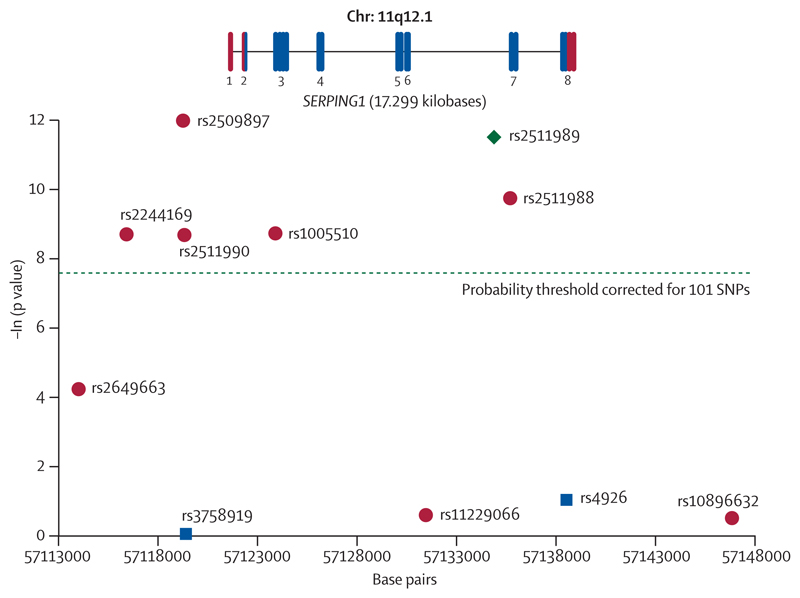
Findings: The SNP variant rs2511989, located within intron six of the SERPING1 gene, showed highly significant genotypic association with age-related macular degeneration (uncorrected p=4.0x10(-5), corrected p=0.00372). We detected no evidence for association between disease and the other 31 candidate genes. The odds ratio for age-related macular degeneration in rs2511989 G/A heterozygotes compared with wild type G/G homozygotes was 0.63 (95% CI 0.47-0.84). A similar comparison of the A/A homozygotes with the wild type yielded an odds ratio of 0.44 (0.31-0.64). We replicated the observed genotypic association in a US cohort (p=0.008). Furthermore, a secondary high-density genotyping study across the SERPING1 gene region identified five additional SNP variants similarly associated with age-related macular degeneration (rs2244169, rs2511990, rs2509897, rs1005510, and rs2511988).
Interpretation: Genetic variation in SERPING1 significantly alters susceptibility to age-related macular degeneration. SERPING1 encodes the C1 inhibitor, which has a crucial role in inhibition of complement component 1 (C1) and might implicate the classic pathway of complement activation in this disease.
Conflict of interest statement
RM is a co-applicant on patents concerning the inhibition of the complement system in age-related macular degeneration. These patent claims are unrelated to the data in this report. All other authors declare that they have no conflict of interest.
Figures
Comment in
-
The SERPING1 gene and age-related macular degeneration.Lancet. 2008 Nov 22;372(9652):1788-9. doi: 10.1016/S0140-6736(08)61349-5. Epub 2008 Oct 6. Lancet. 2008. PMID: 18842295 No abstract available.
-
SERPING1 rs2511988 and age-related macular degeneration.Lancet. 2009 Feb 7;373(9662):461-2. doi: 10.1016/S0140-6736(09)60168-9. Lancet. 2009. PMID: 19200915 No abstract available.
-
The SERPING1 gene and age-related macular degeneration.Lancet. 2009 Sep 12;374(9693):875-6; author reply 876-7. doi: 10.1016/S0140-6736(09)61618-4. Lancet. 2009. PMID: 19748388 Free PMC article. No abstract available.
References
-
- Lotery A, Trump D. Progress in defining the molecular biology of age related macular degeneration. Hum Genet. 2007;122:219–36. - PubMed
-
- Friedman DS, O’Colmain BJ, Munoz B, et al. Prevalence of age-related macular degeneration in the United States. Arch Ophthalmol. 2004;122:564–72. - PubMed
-
- de Jong PT. Age-related macular degeneration. N Engl J Med. 2006;355:1474–85. - PubMed
-
- Bonastre J, Le PC, Anderson P, Ganz A, Berto P, Berdeaux G. The epidemiology, economics and quality of life burden of age-related macular degeneration in France, Germany, Italy and the United Kingdom. Eur J Health Econ. 2002;3:94–102. - PubMed
Publication types
MeSH terms
Substances
Grants and funding
LinkOut - more resources
Full Text Sources
Other Literature Sources
Medical
Research Materials
Miscellaneous