. 2008 Dec 12;283(50):35086-95.
doi: 10.1074/jbc.M803531200. Epub 2008 Oct 8.

The p300 acetylase is critical for ligand-activated farnesoid X receptor (FXR) induction of SHP

Affiliations

The p300 acetylase is critical for ligand-activated farnesoid X receptor (FXR) induction of SHP

Sungsoon Fang et al. J Biol Chem. .

Abstract

The primary bile acid receptor farnesoid X receptor (FXR) maintains lipid and glucose homeostasis by regulating expression of numerous bile acid-responsive genes, including an orphan nuclear receptor and metabolic regulator SHP. Using SHP as a model gene, we studied how FXR activity is regulated by p300 acetylase. FXR interaction with p300 and their recruitment to the SHP promoter and acetylated histone levels at the promoter were increased by FXR agonists in mouse liver and HepG2 cells. In contrast, p300 recruitment and acetylated histones at the promoter were not detected in FXR-null mice. p300 directly interacted with and acetylated FXR in vitro. Overexpression of p300 wild type increased, whereas a catalytically inactive p300 mutant decreased, acetylated FXR levels and FXR transactivation in cells. While similar results were observed with a related acetylase, CBP, GCN5 did not enhance FXR transactivation, and its recruitment to the promoter was not increased by FXR agonists, suggesting functional specificity of acetylases in FXR signaling. Down-regulation of p300 by siRNA decreased acetylated FXR and acetylated histone levels, and occupancy of FXR at the promoter, resulting in substantial inhibition of SHP expression. These results indicate that p300 acts as a critical coactivator of FXR induction of SHP by acetylating histones at the promoter and FXR itself. Surprisingly, p300 down-regulation altered expression of other metabolic FXR target genes involved in lipoprotein and glucose metabolism, such that beneficial lipid and glucose profiles would be expected. These unexpected findings suggest that inhibition of hepatic p300 activity may be beneficial for treating metabolic diseases.


Figures

FIGURE 1.
FIGURE 1.
CA feeding increases p300 interaction with FXR in mouse liver. A, mice were tail vein-injected with Ad-3Flag-FXR or control Ad-empty and 5 days later, were fed normal (-) or 0.5% CA-supplemented (+) chow for 6 h. p300 was immunoprecipitated from liver nuclear extracts, and Flag-FXR in the immunoprecipitates was detected by Western blotting. B and C, uninfected mice were fed normal or 0.5% CA chow for 6 h, and livers were collected for further studies. B, the Shp and Cyp7a1 mRNA levels were determined by q-RTPCR, and normalized to those of 36B4. The S.E. was calculated using the Student's t test (n = 3); *, p < 0.05. C, interaction between endogenous p300, and FXR was detected by coimmunoprecipitation. FXR was immunoprecipitated from liver nuclear extracts, and p300 in the immunoprecipitates were detected by Western blotting. p300 and IgG heavy chain are indicated by an arrow and asterisk, respectively.
FIGURE 2.
FIGURE 2.
p300 enhances FXR transactivation. HepG2 cells were infected with increasing amounts (5-25 MOI, indicated by triangles) of Ad-sip300 or Ad-empty, and 2 days later, the cells were transfected with 200 ng of (FXRE)3-luc (A) or SHP promoter-luc (B) vectors along with expression plasmids for FXR and RXR. Cells were treated with ligands overnight and luciferase and β-galactosidase activities. The values for firefly luciferase activities were normalized by dividing by the β-galactosidase activities. The S.E. was calculated using the Student's t test (n = 3), *, p < 0.05 and NS, not statistically significant, compared with control lanes 9 or 16.
FIGURE 3.
FIGURE 3.
CA feeding increases association of p300, FXR, and acetylated histone H3 K9/K14 with the Shp promoter. A and B, mice were fed normal or CA chow for 6 h, and livers were collected for ChIP analyses. B, the FXR band intensity was measured by densitometry, and the band intensity from control samples was set as 1. The S.E. was calculated using the Student's t test (n = 3). C, mice were fed CA chow for indicated times, and livers were collected for ChIP assays. D, FXR knockout (k/o) mice or normal mice were fed normal or CA chow for 6 h and association of indicated factors or acetylated histones with the Shp promoter were determined by ChIP analyses. For ChIP assays, sheared chromatin was precipitated with the indicated antibodies, and SHP promoter DNA was amplified by PCR. DNA from samples before immunoprecipitation was used for amplification in the total sample.
FIGURE 4.
FIGURE 4.
FXR agonists increase association of p300, FXR, and acetylated histones at the SHP promoter in HepG2 cells. A, HepG2 cells were treated for 6 h with FXR ligands as indicated and acetylated histone H3 K9/14 levels at the SHP promoter. GS denotes gugglesterone. B-E, HepG2 cells were treated with GW4064 (B) or CDCA (C) for 3 h. HepG2 cells were treated with CDCA for indicated times (D). A-D, samples were analyzed by ChIP assay as described in the legend to Fig. 3. E, in re-ChIP assays, chromatin was first immunoprecipitated with antisera to FXR and then, re-immunoprecipitated with IgG or p300 antibody.
FIGURE 5.
FIGURE 5.
Increased FXR binding and histone acetylation at the SHP promoter after treatment with FXR agonists are p300-dependent. HepG2 cells were infected with Ad-sip300 (sip300) or Ad-empty (empty) and 3 days later, cells were treated with GW4064 (A and B) or CDCA (C and D). Cells were harvested for q-RTPCR (A and C) or ChIP (B and D) assays as described in the legends to Figs. 1 and 3, respectively. The S.E. was determined by the Student's t test; *, p < 0.05 (n = 3).
FIGURE 6.
FIGURE 6.
FXR is acetylated by p300 in vitro and in cells. A, GST-FXR or control GST was incubated with purified p300 and [3H]acetyl-CoA, and acetylated proteins were detected by fluorography after SDS-PAGE. Acetylated FXR bands are indicated by arrows and auto-acetylated p300 is indicated by an asterisk. The dotted arrow denotes a degraded fragment of FXR, which was confirmed by Western analysis using FXR antibody. B, isolated Flag-FXR from HepG2 cells were incubated with p300 and acetyl-CoA in vitro, and acetylated FXR and FXR were detected by Western blotting as indicated. C and D, COS-1 cells were transfected with plasmids for Flag-FXR and p300 wild type (WT). The cells were treated with 200 nm GW4064 and HDAC inhibitors, 500 nm TSA and 5 mm Nam, for 5 h, and cell extracts were prepared. Flag-FXR was immunoprecipitated with M2 and acetylated FXR in the immunoprecipitates were detected by Western blotting using acetyl lysine antibody (upper panel). The membrane was stripped, and FXR was detected by FXR antibody (lower panel). IgG heavy chain is indicated by an asterisk. E, HepG2 cells were infected with Ad-3Flag-FXR and adenoviral vectors expressing p300 WT, p300 siRNA (sip300), or a catalytically inactive p300 mutant (MT), as indicated. Flag-FXR was immunoprecipitated with goat FXR antibody and acetylated FXR in the immunoprecipitates were detected by Western blotting using acetyl lysine (upper panel). The use of goat FXR antibody increases separation of the Flag-FXR from the nonspecific IgG heavy chain compared with the mouse M2 antibody. FXR in the immunoprecipitates were detected with rabbit FXR antibody (lower panel). Above the upper panel, the numbers in parentheses are the intensities for the acetylated protein bands relative to the corresponding total FXR (lower panel) with control sample (lane 1) set to 1.0. F, HepG2 cells were cotransfected with plasmids of 200 ng of Gal4-TATA-luc reporter and 5 ng of Gal4-DBD or Gal4-FXR in the presence of p300 wild type or mutant as indicated. Cells were treated with vehicle or 200 nm GW4064 overnight and harvested for reporter assays. The values for firefly luciferase activities were normalized by dividing by the β-galactosidase activities. The S.E. was calculated using the Student's t test (n = 3); *, p < 0.05.
FIGURE 7.
FIGURE 7.
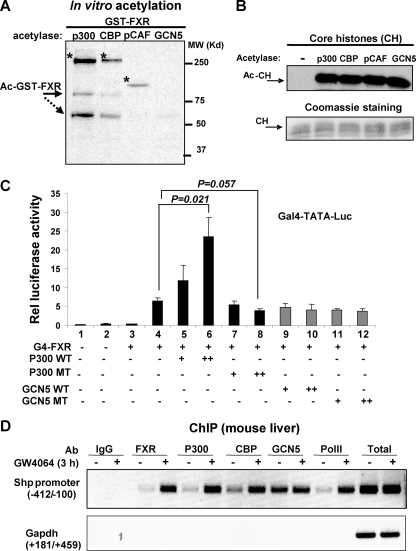
Functional specificity of acetylases in ligand-activated FXR signaling. A, purified p300, CBP, pCAF, or GCN5, were incubated with GST-FXR and [3H]acetyl-CoA. The positions of acetylated FXR and FXR fragment are indicated by solid and dotted arrows, respectively. Auto-acetylated p300, CBP, and pCAF are indicated by asterisks. B, as a control, core histones (CH) were also incubated with each of acetylases and subjected to fluorography (upper panel) or Coomassie Blue staining (lower panel) after SDS-PAGE. C, HepG2 cells were cotransfected with Gal4-TATA-luc reporter and Gal4-DBD or Gal4-FXR in the presence of p300 or GCN wild type (WT) or catalytically inactive mutants (MT). Cells were treated with vehicle or 200 nm GW4064 overnight and harvested for reporter assays. The values for firefly luciferase activities were normalized by dividing by the β-galactosidase activities. The S.E. was calculated using the Student's t test (n = 3). D, mice were treated with GW4064 using oral gavage and 3-h later, liver were collected for ChIP assays as described in the legend to Fig. 3.
FIGURE 8.
FIGURE 8.
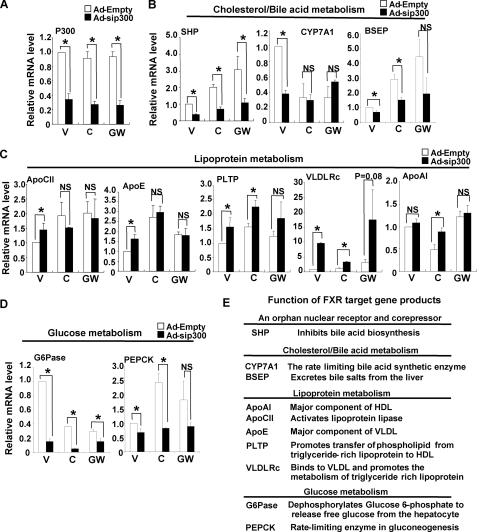
Down-regulation of p300 results in differential effects on the expression of FXR target genes. A-D, HepG2 cells were infected with Ad-sip300 or Ad-empty, 3 days later, cells were treated with ligands overnight, and the mRNA levels of FXR target genes were determined by q-RTPCR. V, C, and GW indicate vehicle, 50 μm CDCA, and 100 nm GW4064, respectively. Statistical significance was determined by the Student's t test; *, p < 0.05; NS indicates not statistically significant (n = 3). E, representative FXR target genes examined in this study are listed with a brief description of the function of their gene products.
FIGURE 9.
FIGURE 9.
A proposed molecular mechanism by which p300 coactivates ligand-activated FXR induction of SHP. Unliganded FXR/RXR heterodimer is associated with the SHP promoter and acetylated histone H3 levels are minimal, resulting in basal levels of SHP expression. Activation of FXR signaling by bile acids or GW4064 increases the FXR interaction with p300 and recruits p300 to the SHP promoter. The recruited p300 increases both histone H3 acetylation at K9/14 (a gene activation histone mark) and FXR acetylation, which would increase the association of FXR, coactivator complexes, and RNA polymerase II with the SHP promoter (the solid circle denotes increased FXR binding, compared with the dotted circle in the basal state). These processes at the promoter lead to the SHP gene induction in hepatocytes in response to ligand-activated FXR signaling.

References

    1. Makishima, M., Okamoto, A. Y., Repa, J. J., Tu, H., Learned, M., Luk, A., Hull, M. V., Lustig, K. D., Mangelsdorf, D. J., and Shan, B. (1999) Science 284 1362-1365 - PubMed
    1. Mangelsdorf, D. J., and Evans, R. M. (1995) Cell 83 841-850 - PubMed
    1. Wang, H., Chen, J., Hollister, K., Sowers, L., and Forman, B. M. (1999) Mol. Cell 3 543-553 - PubMed
    1. Parks, D. J., Blanchard, S. G., Bledsoe, R. K., Chandra, G., Consler, T. G., Kliewer, S. A., Stimmel, J. B., Willson, T. M., Zavacki, A. M., Moore, D. D., and Lehmann, J. M. (1999) Science 284 1365-1368 - PubMed
    1. Kalaany, N. Y., and Mangelsdorf, D. J. (2006) Annu. Rev. Physiol. 68 159-191 - PubMed

Publication types

MeSH terms