. 2009 Jan;37(Database issue):D77-82.
doi: 10.1093/nar/gkn660. Epub 2008 Oct 8.

UniPROBE: an online database of protein binding microarray data on protein-DNA interactions

Affiliations

UniPROBE: an online database of protein binding microarray data on protein-DNA interactions

Daniel E Newburger et al. Nucleic Acids Res. 2009 Jan.

Abstract

The UniPROBE (Universal PBM Resource for Oligonucleotide Binding Evaluation) database hosts data generated by universal protein binding microarray (PBM) technology on the in vitro DNA-binding specificities of proteins. This initial release of the UniPROBE database provides a centralized resource for accessing comprehensive PBM data on the preferences of proteins for all possible sequence variants ('words') of length k ('k-mers'), as well as position weight matrix (PWM) and graphical sequence logo representations of the k-mer data. In total, the database hosts DNA-binding data for over 175 nonredundant proteins from a diverse collection of organisms, including the prokaryote Vibrio harveyi, the eukaryotic malarial parasite Plasmodium falciparum, the parasitic Apicomplexan Cryptosporidium parvum, the yeast Saccharomyces cerevisiae, the worm Caenorhabditis elegans, mouse and human. Current web tools include a text-based search, a function for assessing motif similarity between user-entered data and database PWMs, and a function for locating putative binding sites along user-entered nucleotide sequences. The UniPROBE database is available at http://thebrain.bwh.harvard.edu/uniprobe/.


Figures
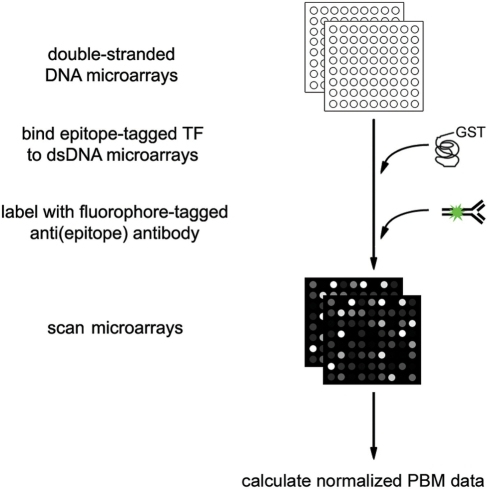
Figure 1.
Figure 1.
Universal PBM schema. Universal PBMs containing all possible 10-mers within 60-mer probes are first synthesized as single-stranded oligonucleotide arrays, to which a common primer is annealed and extended in order to biochemically convert the single-stranded array to a double-stranded DNA (dsDNA) array (these steps are not shown in the figure) (2). The dsDNA array is then bound by protein, stained with a fluorophore-conjugated antibody, and scanned; the quantified array data are then normalized by the relative amounts of DNA in each spot, and used to calculate k-mer binding data (2). PWMs can be calculated either from the k-mer binding data using our Seed-and-Wobble algorithm (2) or from the 60-mer probe data using other motif finding algorithms (34).
Figure 2.
Figure 2.
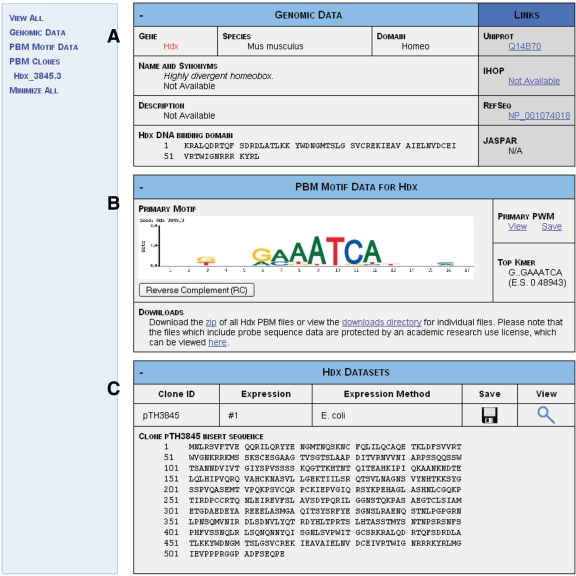
Details Page for the Mus musculus TF Hdx. This page includes (A) gene and protein annotations for Hdx, (B) PBM-derived motif data for the factor and (C) PBM experimental information for the Hdx data.
Figure 3.
Figure 3.
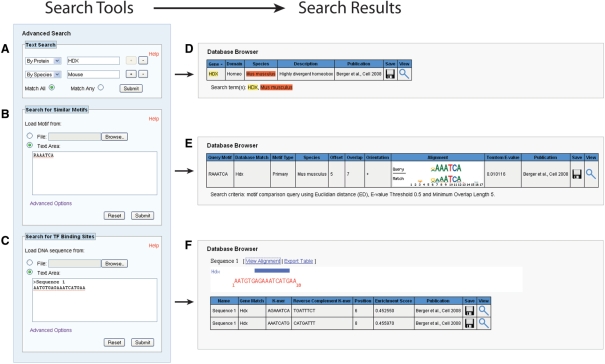
Database search tools and formatted query results. Search options include (A) a text-based search, (B) a tool for comparing standard motif representations against PBM-derived motifs in the database using the Tomtom program (33) from the Meta-MEME suite (22) and (C) a tool for scanning FASTA-formatted nucleotide sequences for matches to TF 8-mer binding profiles in the UniPROBE database. The Database Browser table formats the search results for viewing by (D) highlighting text search term matches, (E) presenting a graphical view of motif alignment and (F) illustrating 8-mer binding site matches along the input sequence (x-axis).

References

    1. Bulyk ML. DNA microarray technologies for measuring protein–DNA interactions. Curr. Opin. Biotechnol. 2006;17:422–430. - PMC - PubMed
    1. Berger MF, Philippakis AA, Qureshi AM, He FS, Estep P.W., 3rd, Bulyk ML. Compact, universal DNA microarrays to comprehensively determine transcription-factor binding site specificities. Nat. Biotechnol. 2006;24:1429–1435. - PMC - PubMed
    1. Mukherjee S, Berger MF, Jona G, Wang XS, Muzzey D, Snyder M, Young RA, Bulyk ML. Rapid analysis of the DNA-binding specificities of transcription factors with DNA microarrays. Nat. Genet. 2004;36:1331–1339. - PMC - PubMed
    1. Reid JL, Iyer VR, Brown PO, Struhl K. Coordinate regulation of yeast ribosomal protein genes is associated with targeted recruitment of Esa1 histone acetylase. Mol. Cell. 2000;6:1297–1307. - PubMed
    1. Ren B, Robert F, Wyrick JJ, Aparicio O, Jennings EG, Simon I, Zeitlinger J, Schreiber J, Hannett N, Kanin E, et al. Genome-wide location and function of DNA binding proteins. Science. 2000;290:2306–2309. - PubMed

Publication types