The performance of human papillomavirus high-risk DNA testing in the screening and diagnostic settings
- PMID: 18843032
- PMCID: PMC2705895
- DOI: 10.1158/1055-9965.EPI-08-0137
The performance of human papillomavirus high-risk DNA testing in the screening and diagnostic settings
Abstract
Objective: We sought to evaluate the performance of the human papillomavirus high-risk DNA test in patients 30 years and older.
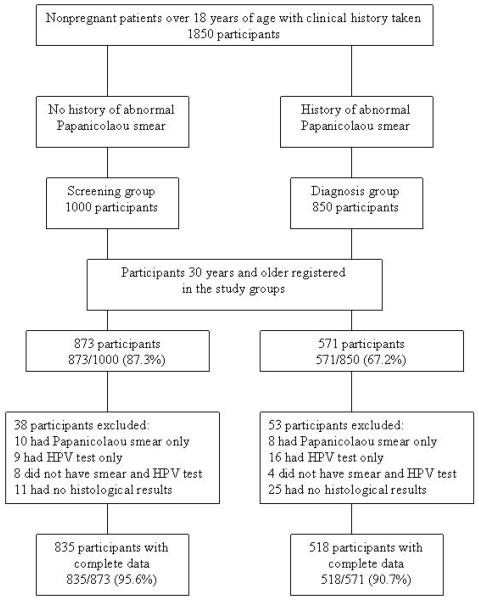
Materials and methods: Screening (n=835) and diagnosis (n=518) groups were defined based on prior Papanicolaou smear results as part of a clinical trial for cervical cancer detection. We compared the Hybrid Capture II (HCII) test result with the worst histologic report. We used cervical intraepithelial neoplasia (CIN) 2/3 or worse as the reference of disease. We calculated sensitivities, specificities, positive and negative likelihood ratios (LR+ and LR-), receiver operating characteristic (ROC) curves, and areas under the ROC curves for the HCII test. We also considered alternative strategies, including Papanicolaou smear, a combination of Papanicolaou smear and the HCII test, a sequence of Papanicolaou smear followed by the HCII test, and a sequence of the HCII test followed by Papanicolaou smear.
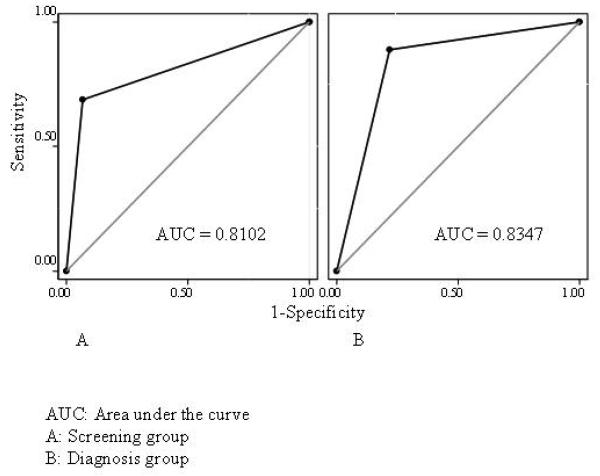
Results: For the screening group, the sensitivity was 0.69 and the specificity was 0.93; the area under the ROC curve was 0.81. The LR+ and LR- were 10.24 and 0.34, respectively. For the diagnosis group, the sensitivity was 0.88 and the specificity was 0.78; the area under the ROC curve was 0.83. The LR+ and LR- were 4.06 and 0.14, respectively. Sequential testing showed little or no improvement over the combination testing.
Conclusions: The HCII test in the screening group had a greater LR+ for the detection of CIN 2/3 or worse. HCII testing may be an additional screening tool for cervical cancer in women 30 years and older.
Figures
References
-
- American College of Obstetricians and Gynecologists ACOG Practice Bulletin. Clinical Management Guidelines for Obstetrician-Gynecologists. Number 61, April 2005. Human papillomavirus. Obstet Gynecol. 2005;105:905–18. - PubMed
-
- Wright TC, Jr., Cox JT, Massad LS, Twiggs LB, Wilkinson EJ. 2001 Consensus Guidelines for the Management of Women with Cervical Cytological Abnormalities. J Low Genit Tract Dis. 2002;6:127–43. - PubMed
-
- Koliopoulos G, Arbyn M, Martin-Hirsch P, Kyrgiou M, Prendiville W, Paraskevaidis E. Diagnostic accuracy of human papillomavirus testing in primary cervical screening: a systematic review and meta-analysis of non-randomized studies. Gynecol Oncol. 2007;104:232–46. - PubMed
-
- Mayrand MH, Duarte-Franco E, Rodrigues I, et al. Human papillomavirus DNA versus Papanicolaou screening tests for cervical cancer. N Engl J Med. 2007;357:1579–88. - PubMed