


The relation between bisphosphonate use and non-union of fractures of the humerus in older adults
- PMID: 18843515
- PMCID: PMC2886010
- DOI: 10.1007/s00198-008-0759-z
The relation between bisphosphonate use and non-union of fractures of the humerus in older adults
Abstract
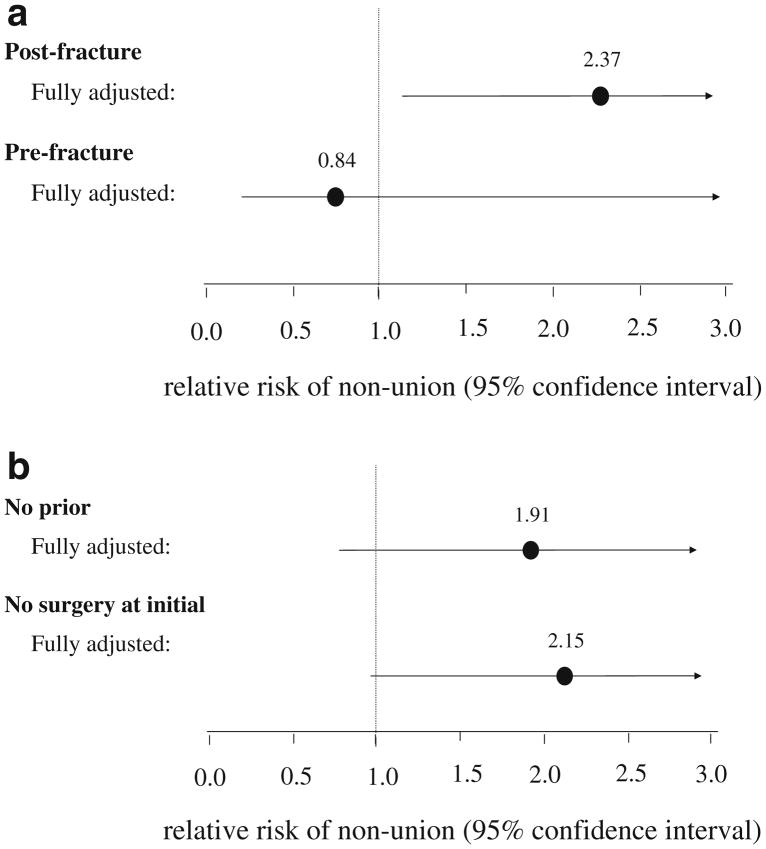
Summary: While nitrogen-containing bisphosphonates have been shown to reduce fracture risk in postmenopausal women and men, their safety in the period after a fracture is unclear. In fully adjusted multivariable regression models, bisphosphonate use in the post-fracture period was associated with an increased probability of non-union [odds ratio (OR) 2.37, 95% confidence interval (CI) 1.13-4.96]. Clinicians might consider waiting for several months before introduction of a bisphosphonate after a fracture.
Introduction: While nitrogen-containing bisphosphonates have been shown to reduce fracture risk in postmenopausal women and men, their safety in the period after a fracture is unclear. We examined the risk of non-union associated with post-fracture bisphosphonate use among a group of older adults who had experienced a humerus fracture.
Methods: We conducted a nested case-control study among subjects who had experienced a humerus fracture. From this cohort, cases of non-union were defined as those with an orthopedic procedure related to non-union 91-365 days after the initial humerus fracture. Bisphosphonate exposure was assessed during the 365 days prior to the non-union among cases or the matched date for controls. Multivariable logistic regression models were examined to calculate the OR and 95% CI for the association of post-fracture bisphosphonate use with non-union.
Results: From the cohort of 19,731 patients with humerus fractures, 81 (0.4%) experienced a non-union. Among the 81 cases, 13 (16.0%) were exposed to bisphosphonates post-fracture, while 69 of the 810 controls (8.5%) were exposed in the post-fracture interval. In fully adjusted multivariable regression models, bisphosphonate use in the post-fracture period was associated with an increased odds of non-union (OR 2.37, 95% CI 1.13-4.96). Albeit limited by small sample sizes, the increased risk associated with bisphosphonate use persisted in the subgroup of patients without a history of osteoporosis or prior fractures (OR 1.91, 95% CI 0.75-4.83).
Conclusions: In this study of older adults, non-union after a humerus fracture was rare. Bisphosphonate use after the fracture was associated with an approximate doubling of the risk of non-union.
Conflict of interest statement
Figures
References
-
- Cranney A, Guyatt G, Griffith L, et al. Meta-analyses of therapies for postmenopausal osteoporosis. IX: Summary of meta-analyses of therapies for postmenopausal osteoporosis. Endocr Rev. 2002;23(4):570–578. - PubMed
-
- Little DG, Ramachandran M, Schindeler A. The anabolic and catabolic responses in bone repair. J Bone Jt Surg, Br Vol. 2007;89 (4):425–433. - PubMed
-
- Fleisch H. Can bisphosphonates be given to patients with fractures? J Bone Miner Res. 2001;16(3):437–440. [comment] - PubMed
-
- Cao Y, Mori S, Mashiba T, et al. Raloxifene, estrogen, and alendronate affect the processes of fracture repair differently in ovariectomized rats. J Bone Miner Res. 2002;17(12):2237–2246. - PubMed
-
- Peter CP, Cook WO, Nunamaker DM, Provost MT, Seedor JG, Rodan GA. Effect of alendronate on fracture healing and bone remodeling in dogs. J Orthop Res. 1996;14(1):74–79. - PubMed
Publication types
MeSH terms
Substances
Grants and funding
LinkOut - more resources
Full Text Sources
Medical
