


Long-term effects of calorie or protein restriction on serum IGF-1 and IGFBP-3 concentration in humans
- PMID: 18843793
- PMCID: PMC2673798
- DOI: 10.1111/j.1474-9726.2008.00417.x
Long-term effects of calorie or protein restriction on serum IGF-1 and IGFBP-3 concentration in humans
Abstract
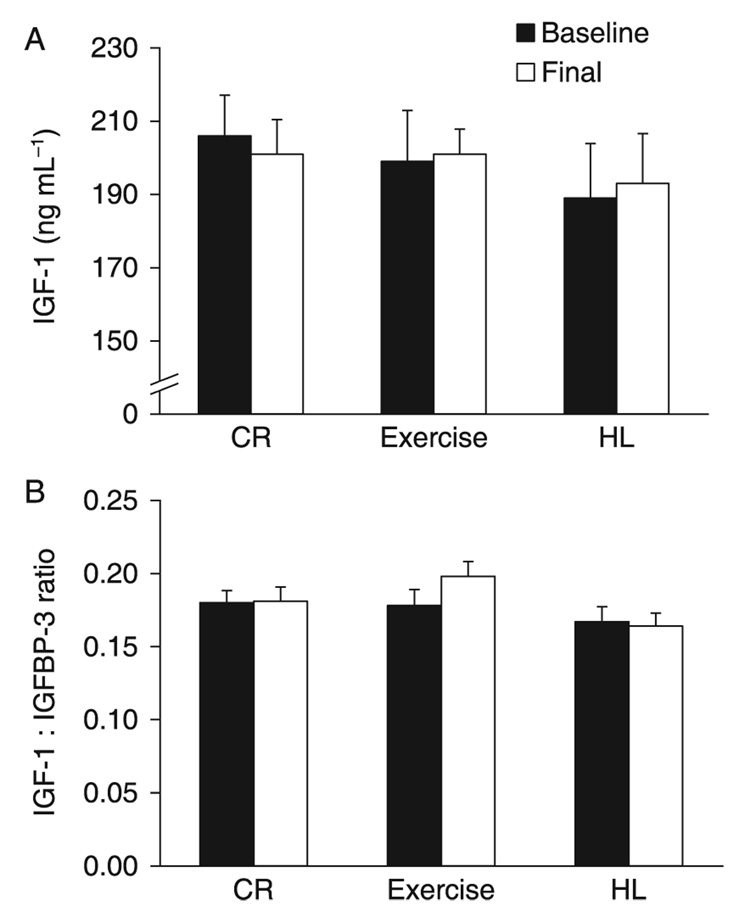
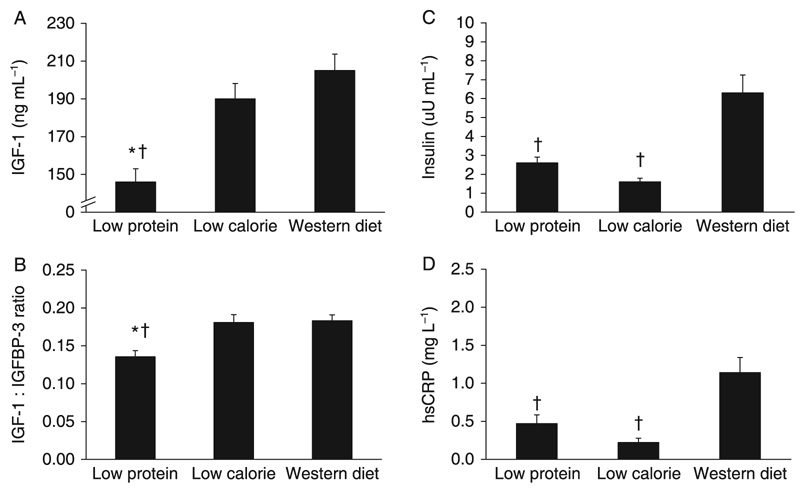
Reduced function mutations in the insulin/IGF-I signaling pathway increase maximal lifespan and health span in many species. Calorie restriction (CR) decreases serum IGF-1 concentration by ~40%, protects against cancer and slows aging in rodents. However, the long-term effects of CR with adequate nutrition on circulating IGF-1 levels in humans are unknown. Here we report data from two long-term CR studies (1 and 6 years) showing that severe CR without malnutrition did not change IGF-1 and IGF-1 : IGFBP-3 ratio levels in humans. In contrast, total and free IGF-1 concentrations were significantly lower in moderately protein-restricted individuals. Reducing protein intake from an average of 1.67 g kg(-1) of body weight per day to 0.95 g kg(-1) of body weight per day for 3 weeks in six volunteers practicing CR resulted in a reduction in serum IGF-1 from 194 ng mL(-1) to 152 ng mL(-1). These findings demonstrate that, unlike in rodents, long-term severe CR does not reduce serum IGF-1 concentration and IGF-1 : IGFBP-3 ratio in humans. In addition, our data provide evidence that protein intake is a key determinant of circulating IGF-1 levels in humans, and suggest that reduced protein intake may become an important component of anticancer and anti-aging dietary interventions.
Figures
Comment in
-
Aging, IGF-1, and diet.Aging Cell. 2009 Apr;8(2):214; author reply 215. doi: 10.1111/j.1474-9726.2009.00450.x. Aging Cell. 2009. PMID: 19281498 No abstract available.
References
-
- Clemmons DR, Klibanski A, Underwood LE, McArthur JW, Ridgway EC, Beitins IZ, Van Wyk JJ. Reduction of plasma immunoreactive somatomedin C during fasting in humans. J. Clin. Endocrinol. Metab. 1981;53:1247–1250. - PubMed
-
- Dunn SE, Kari FW, French J, Leininger JR, Travlos G, Wilson R, Barrett JC. Dietary restriction reduces insulin-like growth factor I levels, which modulates apoptosis, cell proliferation, and tumor progression in p53-deficient mice. Cancer Res. 1997;57:4667–4672. - PubMed
-
- Fontana L, Klein S. Aging, adiposity, and calorie restriction. JAMA. 2007;297:986–994. - PubMed
Publication types
MeSH terms
Substances
Grants and funding
LinkOut - more resources
Full Text Sources
Other Literature Sources
Medical
Miscellaneous
