


Serum pepsinogens and risk of esophageal squamous dysplasia
- PMID: 18844222
- PMCID: PMC2605159
- DOI: 10.1002/ijc.23918
Serum pepsinogens and risk of esophageal squamous dysplasia
Abstract
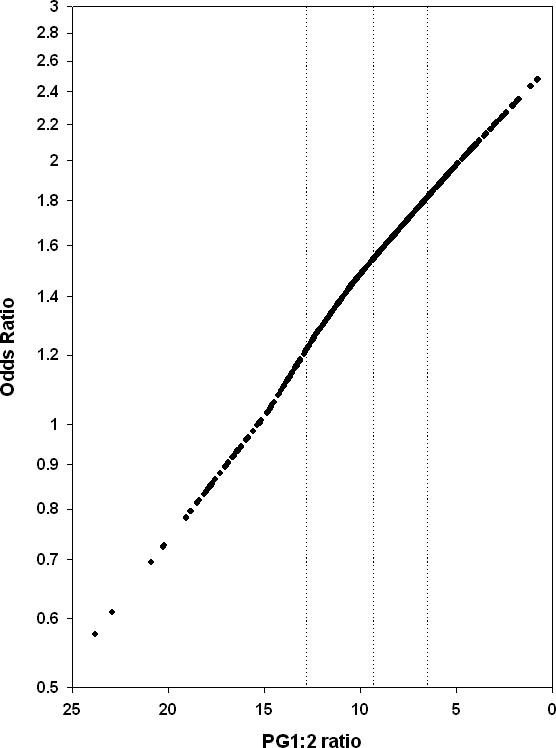
Pepsinogens are a class of endopeptidases that are secreted by the gastric epithelium and released into the circulation. Low serum pepsinogen I (PGI) and low serum pepsinogen I/pepsinogen II ratio (PGI/II ratio) are markers of gastric fundic atrophy, and have recently been shown to be associated with increased risk of esophageal squamous cell carcinoma (ESCC). We conducted the current study to test whether these markers are also associated with esophageal squamous dysplasia (ESD), the precursor lesion of ESCC. We measured serum PGI and PGII, using enzyme-linked immunosorbent assays, in 125 case subjects (patients with moderate or severe ESD) and 250 sex-matched control subjects (no ESD) selected from an endoscopic screening study in Linxian, China. We used conditional logistic regression models adjusted for age, smoking and place of residence to calculate odds ratios (ORs) and 95% confidence intervals (95% CIs). Serum PGI showed no statistically significant association with ESD, whether analyzed as a dichotomous, ordinal (quartiles) or continuous variable. Lower serum PGI/II ratio, however, showed a dose-response association with increased risk of ESD, with an adjusted OR (95% CI) of 2.12 (1.08-4.18), comparing the lowest versus the highest quartile. The association between the lower serum PGI/II ratio and log OR of ESD was nearly linear, and the p-value for the continuous association was 0.03. Lower serum PGI/II ratio was linearly associated with higher risk of ESD. This result is consistent with recent findings that gastric atrophy may increase the risk of ESCC.
Figures
References
-
- Samloff IM, Taggart RT. Pepsinogens, pepsins, and peptic ulcer. Clin Invest Med. 1987;10:215–21. - PubMed
-
- Ley C, Mohar A, Guarner J, Herrera-Goepfert R, Figueroa LS, Halperin D, Parsonnet J. Screening markers for chronic atrophic gastritis in Chiapas, Mexico. Cancer Epidemiol Biomarkers Prev. 2001;10:107–12. - PubMed
-
- Samloff IM, Varis K, Ihamaki T, Siurala M, Rotter JI. Relationships among serum pepsinogen I, serum pepsinogen II, and gastric mucosal histology. A study in relatives of patients with pernicious anemia. Gastroenterology. 1982;83:204–9. - PubMed
-
- Correa P. Human gastric carcinogenesis: a multistep and multifactorial process--First American Cancer Society Award Lecture on Cancer Epidemiology and Prevention. Cancer Res. 1992;52:6735–40. - PubMed
Publication types
MeSH terms
Substances
Grants and funding
LinkOut - more resources
Full Text Sources
Medical
Miscellaneous
