. 2008 Dec;180(4):2251-66.
doi: 10.1534/genetics.108.092577. Epub 2008 Oct 9.

A genomewide suppressor and enhancer analysis of cdc13-1 reveals varied cellular processes influencing telomere capping in Saccharomyces cerevisiae

Affiliations

A genomewide suppressor and enhancer analysis of cdc13-1 reveals varied cellular processes influencing telomere capping in Saccharomyces cerevisiae

S G Addinall et al. Genetics. 2008 Dec.

Abstract

In Saccharomyces cerevisiae, Cdc13 binds telomeric DNA to recruit telomerase and to "cap" chromosome ends. In temperature-sensitive cdc13-1 mutants telomeric DNA is degraded and cell-cycle progression is inhibited. To identify novel proteins and pathways that cap telomeres, or that respond to uncapped telomeres, we combined cdc13-1 with the yeast gene deletion collection and used high-throughput spot-test assays to measure growth. We identified 369 gene deletions, in eight different phenotypic classes, that reproducibly demonstrated subtle genetic interactions with the cdc13-1 mutation. As expected, we identified DNA damage checkpoint, nonsense-mediated decay and telomerase components in our screen. However, we also identified genes affecting casein kinase II activity, cell polarity, mRNA degradation, mitochondrial function, phosphate transport, iron transport, protein degradation, and other functions. We also identified a number of genes of previously unknown function that we term RTC, for restriction of telomere capping, or MTC, for maintenance of telomere capping. It seems likely that many of the newly identified pathways/processes that affect growth of budding yeast cdc13-1 mutants will play evolutionarily conserved roles at telomeres. The high-throughput spot-testing approach that we describe is generally applicable and could aid in understanding other aspects of eukaryotic cell biology.


Figures
F<sc>igure</sc> 1.—
Figure 1.—
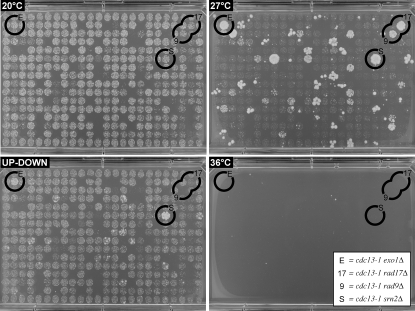
High-throughput robotic yeast growth assay in 384-spot format. A total of 384 yeast strains were spotted onto four solid agar plates, each of which was incubated under different conditions, indicated in the top left corner of each panel (20°, 27°, 36°, and the UP–DOWN assay). Circles are drawn around examples of UDS (9, rad9Δ; 17, rad17Δ) and UDR (E, exo1Δ; S, srn2Δ) strains, all four of which are also cdc13-1 suppressors.
F<sc>igure</sc> 2.—
Figure 2.—
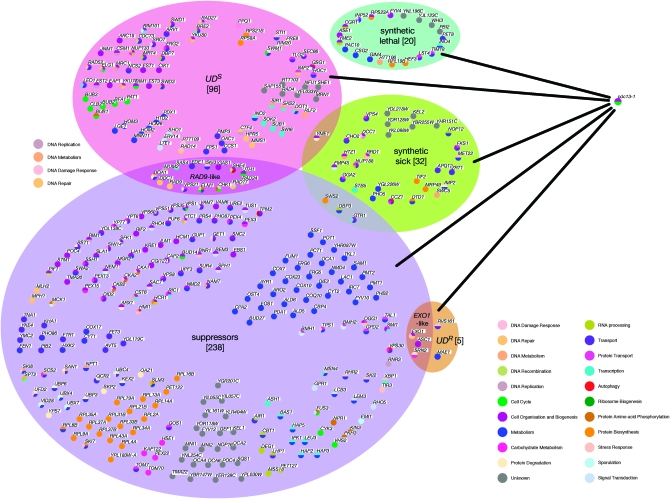
Summary of cdc13-1 interactors. Genes designated as cdc13-1 suppressors (purple shaded area), UDS (red), UDR (orange), synthetic sick (green), and synthetic lethal with cdc13-1 (blue) were arranged using OSPREY. Genes belonging to more than one category (including RAD9-like and EXO1-like genes) are indicated in the overlap regions of shaded areas. Individual genes are represented as solid circles, color coded by OSPREY with each color representing a gene ontology term, up to a maximum of four. Relevant gene ontology terms are indicated in the color key.
F<sc>igure</sc> 3.—
Figure 3.—
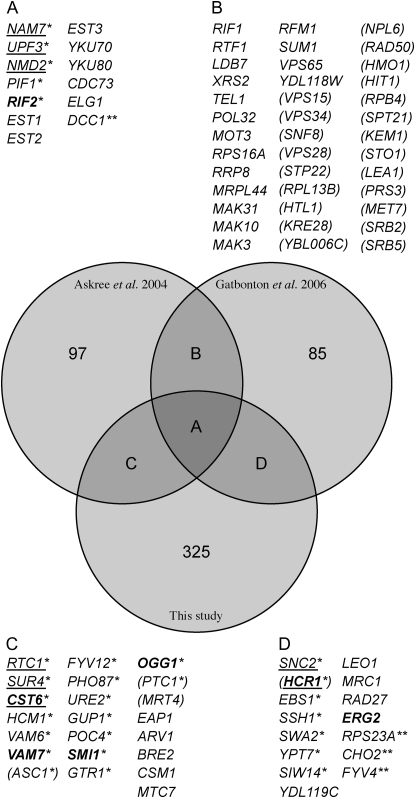
Comparison of CDC13-interacting genes with telomere length genes. A Venn diagram shows hits from two separate genomewide screens for telomere length regulating genes compared to a list of cdc13-1 interactors. Lists of genes that make up the cross sections between studies are displayed and indicated by letters. The numbers of genes in each segment are indicated. Boldface text highlights genes that have neighboring genes in the genome whose deletion results in a similar phenotype. *cdc13-1 suppressor (strong suppressors are underlined); **synthetic (sick or lethal) with cdc13-1; genes in parentheses either were not tested in this study due to slow growth or were identified previously as giving consistently poor performance in SGA studies.
F<sc>igure</sc> 4.—
Figure 4.—
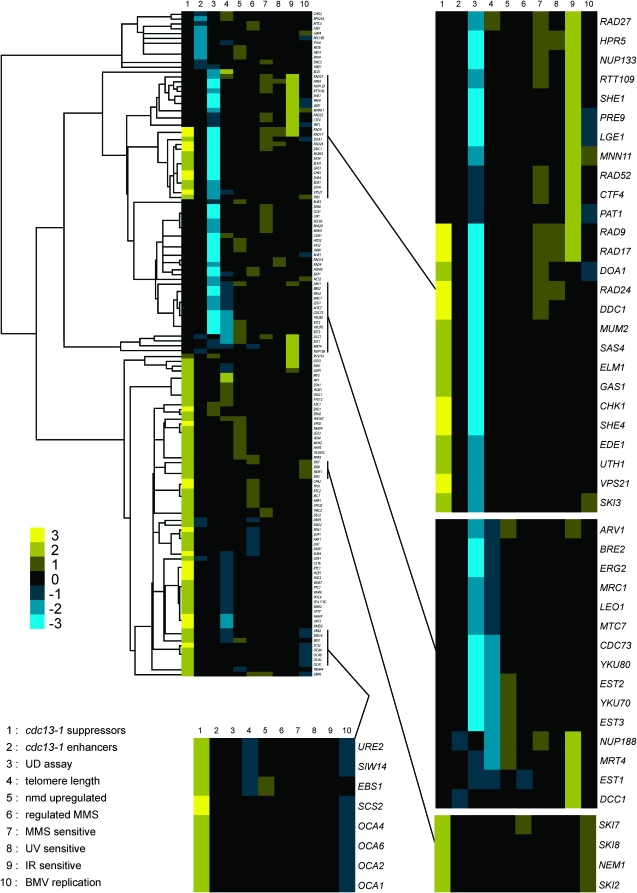
Hierarchical clustering of cdc13-1 genetic interactions with data from multiple genomewide studies. cdc13-1 suppressor and enhancer data are combined with data from genomewide studies of telomere length, nonsense-mediated decay (nmd upregulated), the effect of MMS on gene transcriptions (regulated MMS), MMS sensitivity, UV sensitivity, ionizing radiation sensitivity (IR sensitive), and Brome mosaic virus (BMV) replication. cdc13-1 synthetic sick and synthetic lethal interactions are grouped under the heading “cdc13-1 enhancers,” separately from interactors identified in the UP–DOWN (UD) assay. Yellow and blue shading on the heat map indicate positive and negative values, respectively (as defined in the supplemental Methods). Four interesting clusters are highlighted with magnified heat maps. One of these clusters (center, right) contains the previously uncharacterized MTC7 gene, identified in this study (see discussion).

References

    1. Alic, N., V. J. Higgins and I. W. Dawes, 2001. Identification of a Saccharomyces cerevisiae gene that is required for G1 arrest in response to the lipid oxidation product linoleic acid hydroperoxide. Mol. Biol. Cell 12 1801–1810. - PMC - PubMed
    1. Alvaro, D., M. Lisby and R. Rothstein, 2007. Genomewide analysis of Rad52 foci reveals diverse mechanisms impacting recombination. PLoS Genet. 3 e228. - PMC - PubMed
    1. Askree, S. H., T. Yehuda, S. Smolikov, R. Gurevich, J. Hawk et al., 2004. A genome-wide screen for Saccharomyces cerevisiae deletion mutants that affect telomere length. Proc. Natl. Acad. Sci. USA 101 8658–8663. - PMC - PubMed
    1. Baetz, K., V. Measday and B. Andrews, 2006. Revealing hidden relationships among yeast genes involved in chromosome segregation using systematic synthetic lethal and synthetic dosage lethal screens. Cell Cycle 5 592–595. - PubMed
    1. Bennett, C. B., L. K. Lewis, G. Karthikeyan, K. S. Lobachev, Y. H. Jin et al., 2001. Genes required for ionizing radiation resistance in yeast. Nat. Genet. 29 426–434. - PubMed

Publication types

MeSH terms

Substances