


Unnatural substrate repertoire of A, B, and X family DNA polymerases
- PMID: 18847263
- PMCID: PMC2675700
- DOI: 10.1021/ja803833h
Unnatural substrate repertoire of A, B, and X family DNA polymerases
Abstract
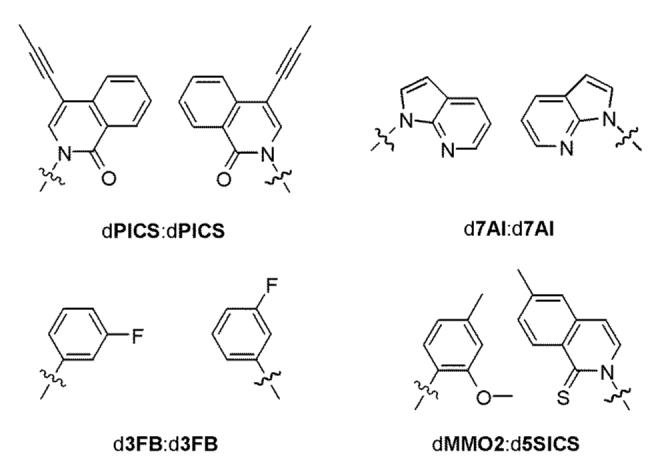
As part of an effort to develop unnatural base pairs that are stable and replicable in DNA, we examined the ability of five different polymerases to replicate DNA containing four different unnatural nucleotides bearing predominantly hydrophobic nucleobase analogs. The unnatural pairs were developed based on intensive studies using the Klenow fragment of DNA polymerase I from E. coli (Kf) and found to be recognized to varying degrees. The five additional polymerases characterized here include family A polymerases from bacteriophage T7 and Thermus aquaticus, family B polymerases from Thermococcus litoralis and Thermococcus 9(o)N-7, and the family X polymerase, human polymerase beta. While we find that some aspects of unnatural base pair recognition are conserved among the polymerases, for example, the pair formed between two d3FB nucleotides is typically well recognized, the detailed recognition of most of the unnatural base pairs is generally polymerase dependent. In contrast, we find that the pair formed between d5SICS and dMMO2 is generally well recognized by all of the polymerases examined, suggesting that the determinants of efficient and general recognition are contained within the geometric and electronic structure of these unnatural nucleobases themselves. The data suggest that while the d3FB:d3FB pair is sufficiently well recognized by several of the polymerases for in vitro applications, the d5SICS:dMMO2 heteropair is likely uniquely promising for in vivo use. T7-mediated replication is especially noteworthy due to strong mispair discrimination.
Figures
References
Publication types
MeSH terms
Substances
Grants and funding
LinkOut - more resources
Full Text Sources
Other Literature Sources
Research Materials
