


Do the malnutrition universal screening tool (MUST) and Birmingham nutrition risk (BNR) score predict mortality in older hospitalised patients?
- PMID: 18847458
- PMCID: PMC2572058
- DOI: 10.1186/1471-2318-8-26
Do the malnutrition universal screening tool (MUST) and Birmingham nutrition risk (BNR) score predict mortality in older hospitalised patients?
Abstract
Background: Undernutrition is common in older hospitalised patients, and routine screening is advocated. It is unclear whether screening tools such as the Birmingham Nutrition Risk (BNR) score and the Malnutrition Universal Screening Tool (MUST) can successfully predict outcome in this patient group.
Methods: Consecutive admissions to Medicine for the Elderly assessment wards in Dundee were assessed between mid-October 2003 and mid-January 2004. Body Mass Index (BMI), MUST and BNR scores were prospectively collected. Time to death was obtained from the Scottish Death Register and compared across strata of risk.
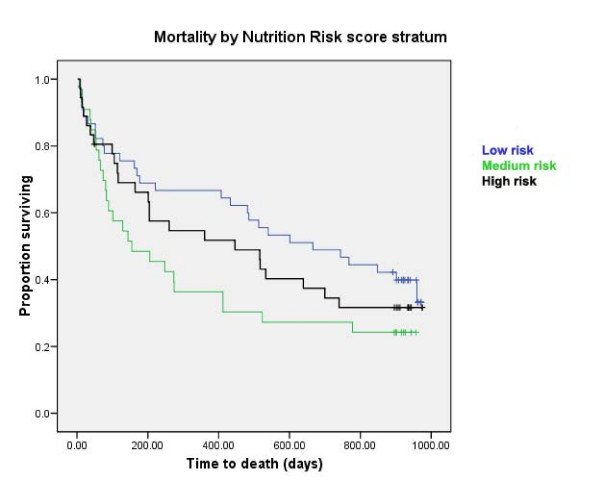
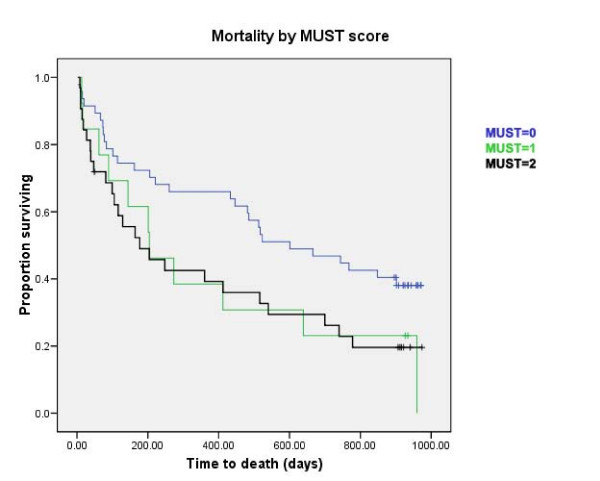
Results: 115 patients were analysed, mean age 82.1 years. 39/115 (34%) were male. 20 patients were identified as high risk by both methods of screening. A further 10 were categorised high risk only with the Birmingham classification and 12 only with MUST.80/115 (67%) patients had died at the time of accessing death records. MUST category significantly predicted death (log rank test, p = 0.022). Neither BMI (log rank p = 0.37) or Birmingham nutrition score (log rank p = 0.35) predicted death.
Conclusion: The MUST score, but not the BNR, is able to predict increased mortality in older hospitalised patients.
Figures
References
-
- Reilly HM. Symposium on Nutrition in clinical management: malnutrition in our midst. Proc Nutrition Soc. 1996;55:841–853.
-
- Stratton RJ, Dixon R, Longmore D, Stroud M, Elia M. Effect of recalled weight and height on malnutrition risk. Clin Nutr. 2003;22:S9. doi: 10.1016/S0261-5614(03)80033-X. - DOI
Publication types
MeSH terms
LinkOut - more resources
Full Text Sources
Medical
