Review
. 2008 Nov;18(11):545-51.
doi: 10.1016/j.tcb.2008.08.008. Epub 2008 Oct 9.

Canonical and non-canonical JAK-STAT signaling

Affiliations
Review

Canonical and non-canonical JAK-STAT signaling

Willis X Li. Trends Cell Biol. 2008 Nov.

Abstract

Aberrant activation of the JAK-STAT pathway has been implicated in many human cancers. It has widely been assumed that the effects of STAT activation are mediated by direct transcriptional induction of STAT target genes. However, recent findings in Drosophila have identified a non-canonical mode of JAK-STAT signaling, which directly controls heterochromatin stability. This indicates that the JAK-STAT pathway also controls cellular epigenetic status, which affects expression of genes beyond those under direct STAT transcriptional control. Given the evolutionary conservation of the canonical pathway among different species, the non-canonical mode of JAK-STAT signaling might also operate in vertebrates. In this review, canonical versus non-canonical JAK-STAT signaling and the implications for gene regulation and cancer formation are discussed.


Figures
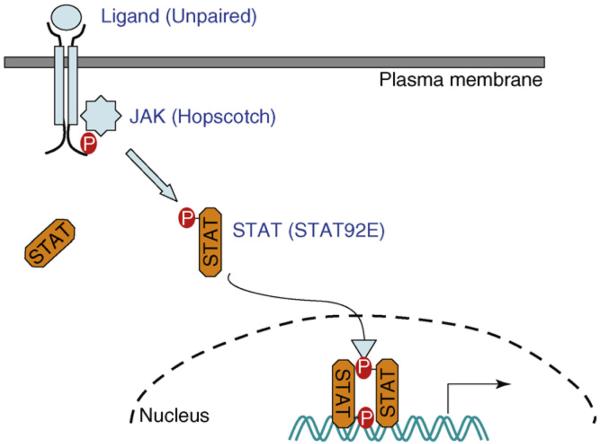
Figure 1
Figure 1
Canonical JAK–STAT signaling. A simplified schematic representation of the Drosophila JAK–STAT pathway, which is typical of the canonical JAK–STAT pathway, in which unphosphorylated STAT resides in the cytoplasm. JAK activates STAT by phosphorylation, leading to nuclear translocation of dimerized phospho-STAT, which functions as a transcription factor. Names of the Drosophila homologs are in parentheses.
Figure 2
Figure 2
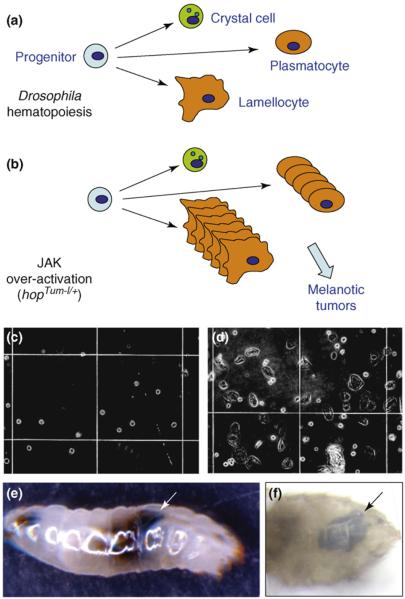
Drosophila hemocyte development and blood-tumor formation. (a) The circulating hemocytes in the larval hemolymph (blood) consist of small crystal cells, intermediate phagocytic plasmatocytes and large, terminally differentiated phagocytic lamellocytes that are derived from a common stem cell or progenitor [51,52]. (b) The JAK-activating mutation hopTum-l causes overproliferation of plasmatocytes and lamellocytes, resulting in their aggregation and formation of melanotic tumors. (c,d) Micrographs show samples of larval blood from wild-type (c) and a hopTum-l+ (d) larva. Note the presence of large flat cells (lamellocytes) in (d). (e,f) Examples of melanotic tumors (arrows), which are visible without staining, in hopTum-l+ larvae (e) and adult flies (f).
Figure 3
Figure 3
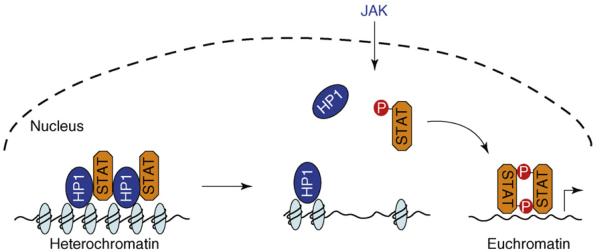
Non-canonical JAK–STAT signaling. In the non-canonical mode of JAK–STAT signaling, unphosphorylated STAT is localized on heterochromatin in association with HP1 in the nucleus. Increasing STAT phosphorylation (by JAK or other tyrosine kinases) reduces the amount of unphosphorylated STAT localized on heterochromatin. This, in turn, leads to HP1 displacement from heterochromatin and heterochromatin instability. Dispersed phospho-STAT binds to cognitive sites in euchromatin to induce target-gene expression. Genes originally localized in heterochromatin are now accessible to STAT or other transcription factors.

References

    1. Aaronson DS, Horvath CM. A road map for those who don't know JAK-STAT. Science. 2002;296:1653–1655. - PubMed
    1. Levy DE, Darnell JE., Jr Stats: transcriptional control and biological impact. Nat. Rev. Mol. Cell Biol. 2002;3:651–662. - PubMed
    1. Fu XY, et al. The proteins of ISGF-3, the interferon α-induced transcriptional activator, define a gene family involved in signal transduction. Proc. Natl. Acad. Sci. U.S.A. 1992;89:7840–7843. - PMC - PubMed
    1. Schindler C, et al. Interferon-dependent tyrosine phosphorylation of a latent cytoplasmic transcription factor. Science. 1992;257:809–813. - PubMed
    1. Bromberg J. Stat proteins and oncogenesis. J. Clin. Invest. 2002;109:1139–1142. - PMC - PubMed

Publication types

LinkOut - more resources