


Two-way traffic on the road to plasma membrane repair
- PMID: 18848451
- PMCID: PMC2593466
- DOI: 10.1016/j.tcb.2008.09.001
Two-way traffic on the road to plasma membrane repair
Abstract
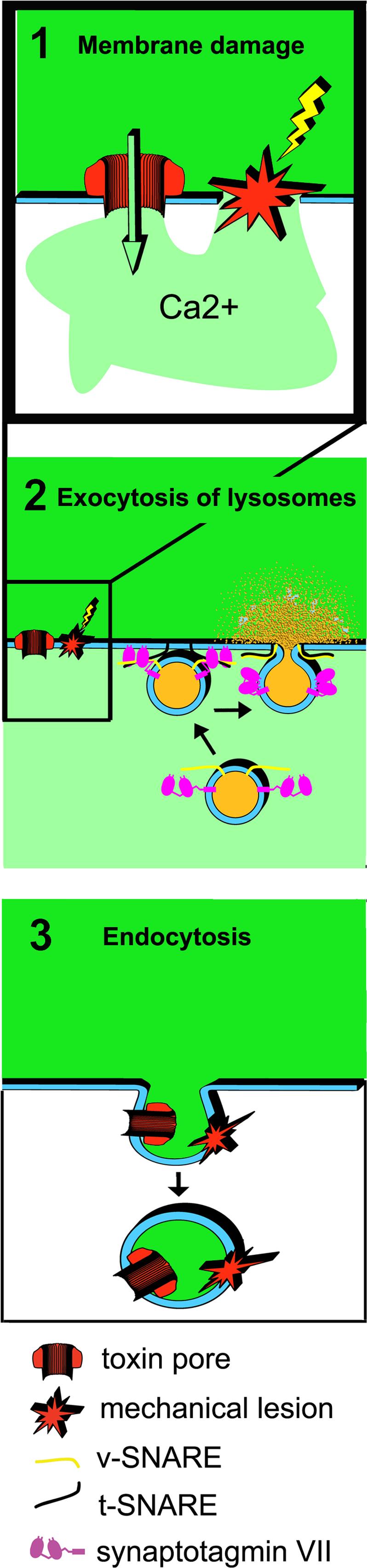
Ca(2+) influx through plasma membrane wounds triggers a rapid-repair response that is essential for cell survival. Earlier studies showed that repair requires the exocytosis of intracellular vesicles. Exocytosis was thought to promote resealing by 'patching' the plasma membrane lesion or by facilitating bilayer restoration through reduction in membrane tension. However, cells also rapidly repair lesions created by pore-forming proteins, a form of injury that cannot be resealed solely by exocytosis. Recent studies indicate that, in cells injured by pores or mechanical abrasions, exocytosis is followed by lesion removal through endocytosis. Describing the relationship between wound-induced exocytosis and endocytosis has implications for the understanding of muscular degenerative diseases that are associated with defects in plasma membrane repair.
Figures
References
-
- Steinhardt RA, et al. Cell membrane resealing by a vesicular mechanism similar to neurotransmitter release. Science. 1994;263:390–393. - PubMed
-
- Reddy A, et al. Plasma membrane repair is mediated by Ca2+-regulated exocytosis of lysosomes. Cell. 2001;106:157–169. - PubMed
-
- Andrews NW. Membrane resealing: synaptotagmin VII keeps running the show. Sci STKE. 20052005:pe19. - PubMed
-
- Gurcel L, et al. Caspase-1 activation of lipid metabolic pathways in response to bacterial pore-forming toxins promotes cell survival. Cell. 2006;126:1135–1145. - PubMed
Publication types
MeSH terms
Substances
Grants and funding
LinkOut - more resources
Full Text Sources
Miscellaneous
