. 2009 Feb;34(2):172-180.
doi: 10.1016/j.psyneuen.2008.08.020. Epub 2008 Oct 11.

Changes in plasma levels of BDNF and NGF reveal a gender-selective vulnerability to early adversity in rhesus macaques

Affiliations

Changes in plasma levels of BDNF and NGF reveal a gender-selective vulnerability to early adversity in rhesus macaques

Francesca Cirulli et al. Psychoneuroendocrinology. 2009 Feb.

Abstract

Early stressful events can increase vulnerability for psychopathology, although knowledge on the effectors is still limited. Here we tested the hypothesis that peripheral levels of brain-derived neurotrophic factor (BDNF) and nerve growth factor (NGF), which are involved in the response to stress and in the pathophysiology of anxiety and depression, might be affected in a non-human primate model of adverse rearing. Males and females rhesus macaques reared with their mothers (MR) or in peer-only groups (PR) were used as experimental subjects. BDNF, NGF, adrenocorticotropic hormone (ACTH), cortisol and growth hormone (GH) were determined at baseline on postnatal days (PND) 14, 30 and 60 by means of specific ELISA and RIA procedures. In addition, behavior was assessed on PND 7, 14, 21, 30 (Brazelton test) and 60 (home cage observation). Data indicate gender differences in basal levels of BDNF throughout development. Peer-rearing increased significantly BDNF levels only in females. In addition, while all peer-reared subjects showed high levels of stereotypies and self-directed behaviors, behavioral passivity was selectively increased in females. By contrast, NGF levels were increased in response to peer-rearing only in males, and correlated positively with other "classic" endocrine responses to stress, such as cortisol and GH. Our data identify BDNF and NGF as neuroendocrine markers underlying differential responses to maternal deprivation in males and females rhesus macaques. The selective changes in BDNF levels in females could help explain the greater vulnerability to mood disorders of this gender reported in humans.


Figures
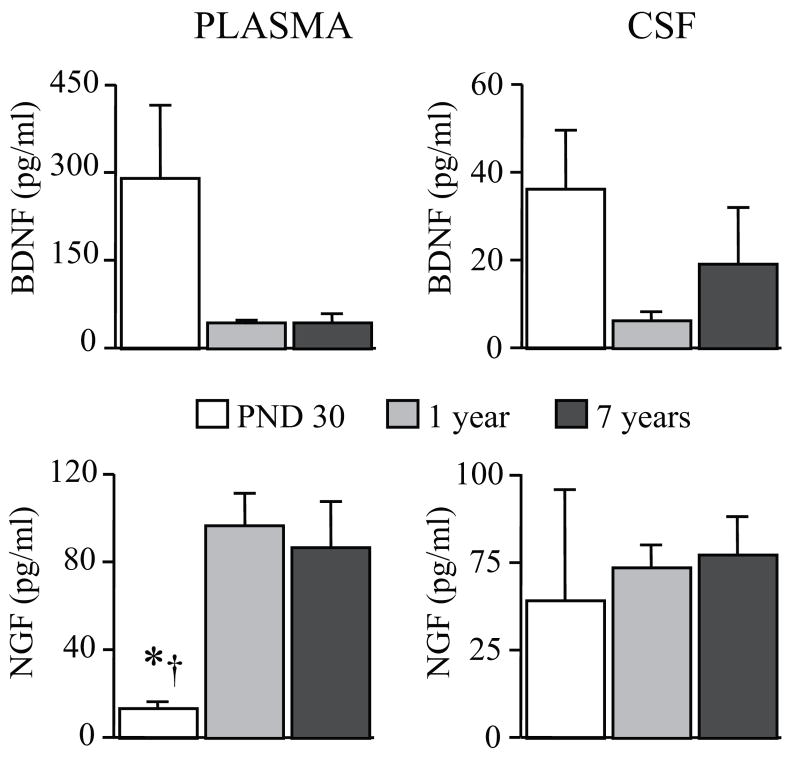
Figure 1
Figure 1
Developmental changes in BDNF and NGF levels in rhesus macaques. Plasma and CSF levels of BDNF and NGF in PND 30 and in 1 and 7 years-old mother-reared rhesus macaques (n = 4 males in each age group) showed important developmental changes. Compared to BDNF, NGF levels showed an opposite developmental curve, increasing from 1 month to 1 and 7 years of life (1 month vs * 1 year, or 7 years; p < 0.05). CSF = cerebrospinal fluid; PND = Postnatal day. All data expressed as means (+SEM).
Figure 2
Figure 2
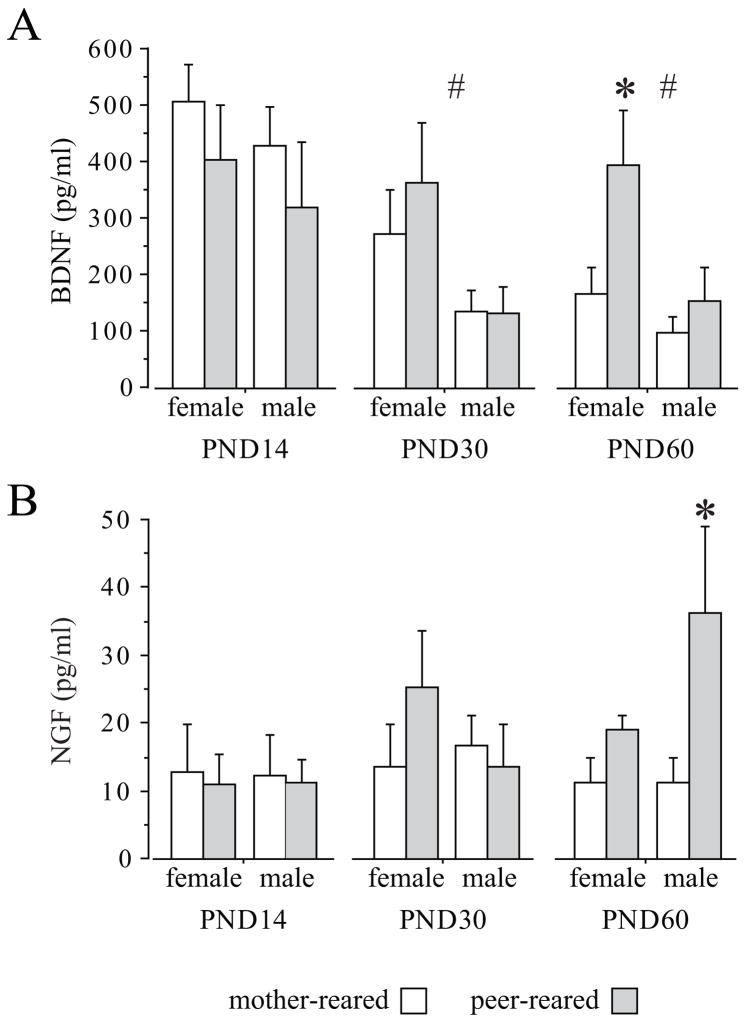
Rearing condition affects BDNF and NGF plasma levels in rhesus macaques. A. Effects of rearing condition on BDNF plasma levels in 14-, 30- and 60-day-old subjects (MR: 9 females and 9 males; PR: 8 females and 6 males). BDNF levels were higher in females compared to males starting on PND 30 (# p < 0.05). On PND 60 also a rearing effect was found, peer-rearing increasing levels of BDNF in females only (PR females vs MR females * p <0.05). B. Effects of rearing condition on NGF plasma levels in 14-, 30- and 60-day-old subjects (MR: 5 females and 7 males; PR: 4 females and 4 males). Levels of NGF where higher in PR compared to MR males only on PND 60 (* p <0.05). MR = Mother-reared; PR = Peer-only reared. All data expressed as means (+SEM); other abbreviations as in Figure 1.
Figure 3
Figure 3
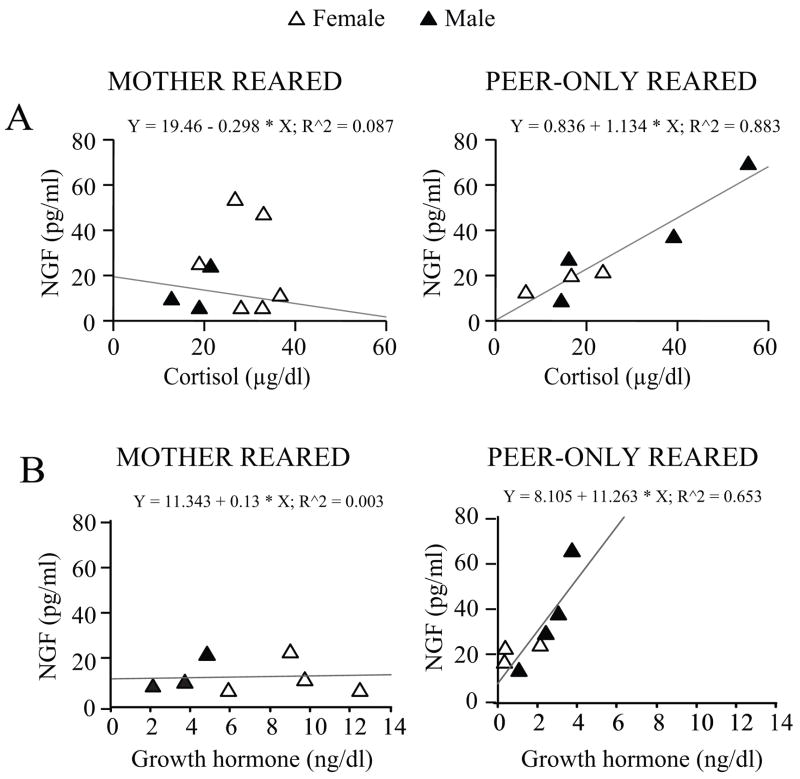
Correlation between peripheral levels of NGF and neuroendocrine activity in rhesus monkeys. (A) NGF plasma levels correlated with cortisol in PR 60-days-old rhesus monkeys. For the PR monkey group a positive linear correlation between NGF and cortisol plasma levels was found (Pearson’s correlation coefficient, r = 0.940, p = 0.0017; MR: 6 females and 3 males; PR: 3 females and 4 males). (B) NGF plasma levels were found to correlate with GH in PR but not MR 60-days-old rhesus monkeys (Pearson’s correlation coefficient, r = 0.808, p < 0.05; MR: 4 females and 3 males; PR: 3 females and 4 males). All data expressed as means (+ SEM). GH = growth hormone; other abbreviations as in Figure 1 and 2.
Figure 4
Figure 4
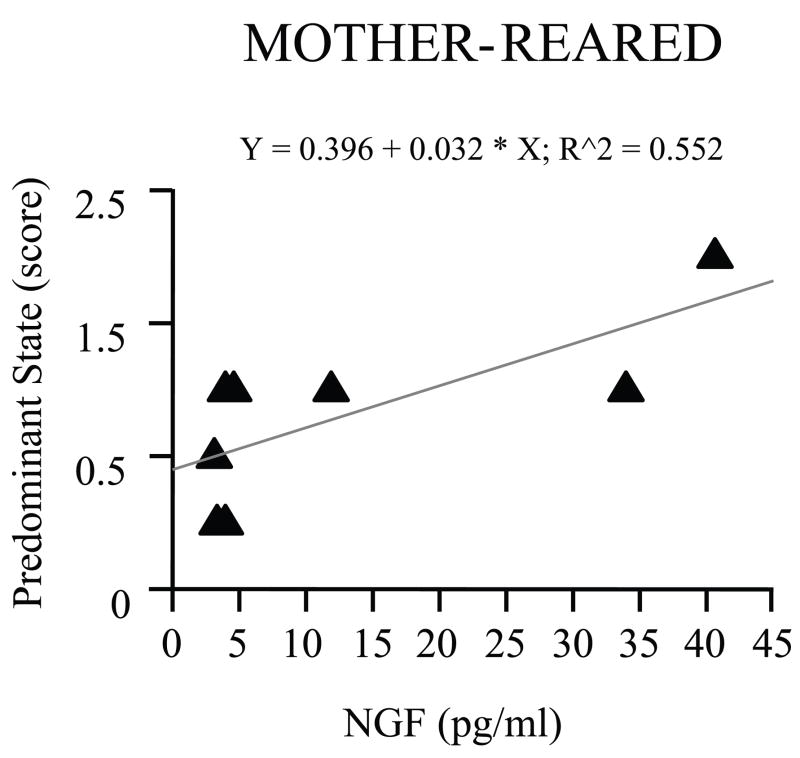
Correlation between plasma levels of NGF and Predominant state score in mother-reared rhesus macaques. A positive correlation between NGF and agitated behavior (scored as “Predominant state”) was found on day 14 of postnatal life (Pearson’s correlation coefficient, r = 0.743, p < 0.05; 5 females and 3 males).
Figure 5
Figure 5
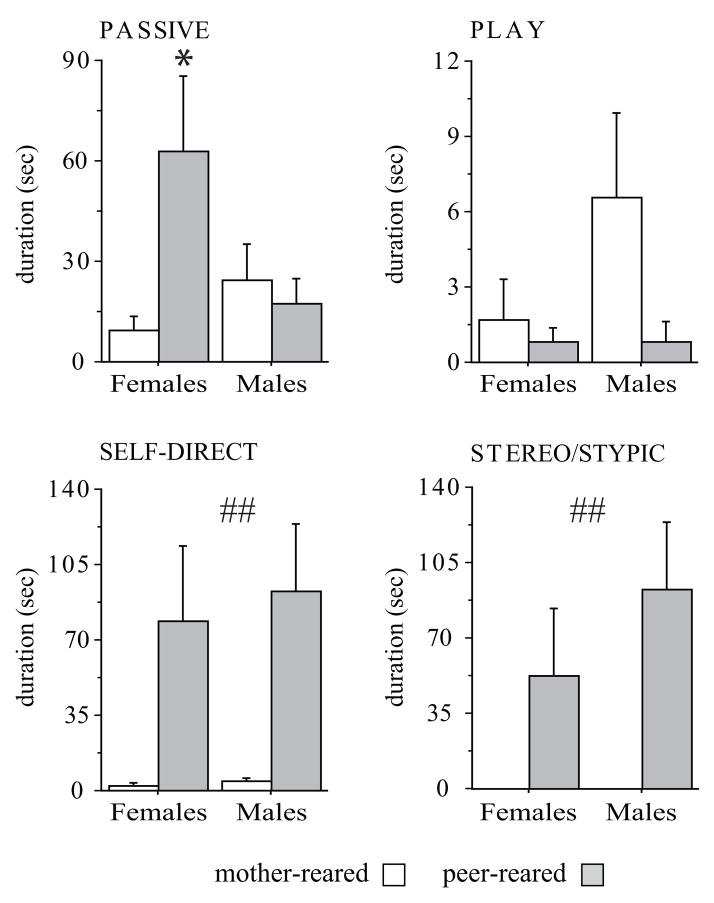
Behavior assessed in 60-days-old rhesus macaques in their home cage. Only peer-reared infants showed high levels of abnormal behaviors such as Self-direct and Stero/Stypic behaviors (## = main effect of rearing condition; p < 0.01). PR females showed higher levels of passive behavior compared to MR subjects (* = interaction between sex and rearing condition; p < 0.05). MR: 5 females and 10 males; PR: 7 females and 5 males. All data expressed as means (+ SEM). Abbreviations as in Figure 2.

References

    1. Alleva E, Aloe L. Physiological roles of nerve growth factor in adult rodents: a biobehavioral perspective. Int J Comp Psychol. 1989;2:147–163.
    1. Alleva E, Branchi I. NGF: a social molecule. Psychoneuroendocrinology. 2006;31:295–296. author reply 297–298. - PubMed
    1. Aloe L, Alleva E, Bohm A, Levi-Montalcini R. Aggressive behavior induces release of nerve growth factor from mouse salivary gland into the bloodstream. Proc Natl Acad Sci U S A. 1986;83:6184–6187. - PMC - PubMed
    1. Aloe L, Bracci-Laudiero L, Alleva E, Lambiase A, Micera A, Tirassa P. Emotional stress induced by parachute jumping enhances blood nerve growth factor levels and the distribution of nerve growth factor receptors in lymphocytes. Proc Natl Acad Sci U S A. 1994;91:10440–10444. - PMC - PubMed
    1. Aydemir C, Yalcin ES, Aksaray S, Kisa C, Yildirim SG, Uzbay T, Goka E. Brain-derived neurotrophic factor (BDNF) changes in the serum of depressed women. Prog Neuropsychopharmacol Biol Psychiatry. 2006;30:1256–1260. - PubMed

Publication types