


Review. The epidemiology of kuru: monitoring the epidemic from its peak to its end
- PMID: 18849286
- PMCID: PMC2577135
- DOI: 10.1098/rstb.2008.0071
Review. The epidemiology of kuru: monitoring the epidemic from its peak to its end
Abstract
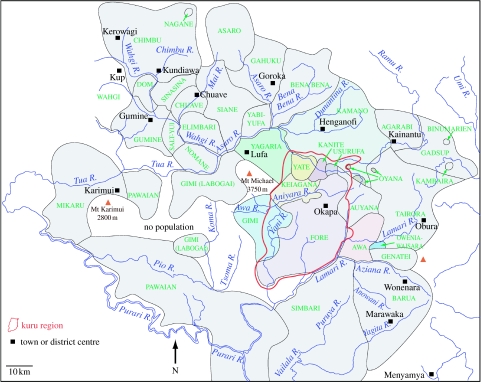
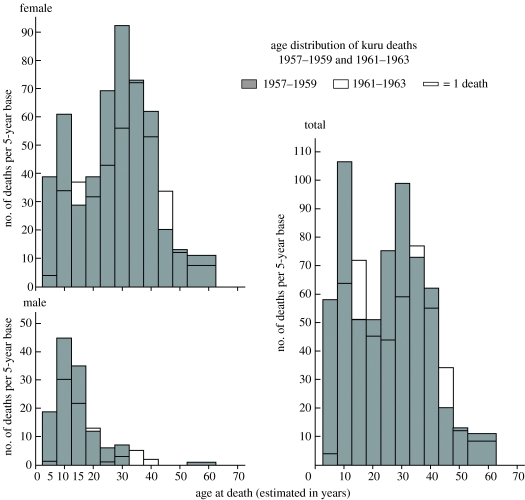
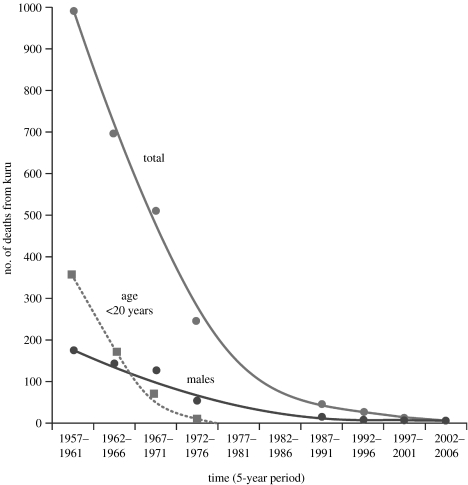
Kuru is a fatal transmissible spongiform encephalopathy restricted to the Fore people and their neighbours in a remote region of the Eastern Highlands of Papua New Guinea. When first investigated in 1957 it was found to be present in epidemic proportions, with approximately 1000 deaths in the first 5 years, 1957-1961. The changing epidemiological patterns and other significant findings such as the transmissibility of kuru are described in their historical progression. Monitoring the progress of the epidemic has been carried out by epidemiological surveillance in the field for 50 years. From its peak, the number of deaths from kuru declined to 2 in the last 5 years, indicating that the epidemic is approaching its end. The mode of transmission of the prion agent of kuru was the local mortuary practice of transumption. The prohibition of this practice in the 1950s led to the decline in the epidemic, which has been prolonged into the present century by incubation periods that may exceed 50 years. Currently, the epidemiological surveillance is being maintained and further studies on human genetics and the past mortuary practices are being conducted in the kuru-affected region and in communities beyond it.
Figures
References
-
- Alpers, M. P. 1964a Kuru: a clinical study, 38 pp. Department of Medicine, University of Adelaide.
-
- Alpers, M. P. 1964b Kuru: age and duration studies, 12 pp. Department of Medicine, University of Adelaide.
-
- Alpers M.P. Epidemiological changes in kuru, 1957 to 1963. In: Gajdusek D.C., Gibbs C.J. Jr, Alpers M.P., editors. Slow, latent and temperate virus infections, NINDB Monograph No. 2, Proc. Workshop and Symposium on Slow, Latent and Temperate Virus Infections, Bethesda, Maryland, 7–9 Dec 1964. National Institute of Neurological Diseases and Blindness; Bethesda, MD: 1965. pp. 65–82.
-
- Alpers M.P. Kuru: implications of its transmissibility for the interpretation of its changing epidemiologic pattern. In: Bailey O.T., Smith D.E., editors. The central nervous system, some experimental models of neurological diseases, International Academy of Pathology Monograph No. 9, Proc. Fifty-sixth Annual Meeting of the International Academy of Pathology, Washington, DC, 12–15 Mar 1967. Williams and Wilkins; Baltimore, MD: 1968. pp. 234–251.
-
- Alpers, M. P. 1979 Epidemiology and ecology of kuru. In Slow transmissible diseases of the nervous system, vol. 1, Clinical, epidemiological, genetic and pathological aspects of the spongiform encephalopathies (eds S. B. Prusiner & W. J. Hadlow), pp. 67–90. New York, NY: Academic Press.
Publication types
MeSH terms
Grants and funding
LinkOut - more resources
Full Text Sources
Miscellaneous
