Review
. 2008 Nov 27;363(1510):3747-53.
doi: 10.1098/rstb.2008.0069.

Review. The origin of the prion agent of kuru: molecular and biological strain typing

Affiliations
Review

Review. The origin of the prion agent of kuru: molecular and biological strain typing

Jonathan D F Wadsworth et al. Philos Trans R Soc Lond B Biol Sci. .

Abstract

Kuru is an acquired human prion disease that primarily affected the Fore linguistic group of the Eastern Highlands of Papua New Guinea. The central clinical feature of kuru is progressive cerebellar ataxia and, in sharp contrast to most cases of sporadic Creutzfeldt-Jakob disease (CJD), dementia is a less prominent and usually late clinical feature. In this regard, kuru is more similar to variant CJD, which also has similar prodromal symptoms of sensory disturbance and joint pains in the legs and psychiatric and behavioural changes. Since a significant part of the clinicopathological diversity seen in human prion disease is likely to relate to the propagation of distinct human prion strains, we have compared the transmission properties of kuru prions with those isolated from patients with sporadic, iatrogenic and variant CJD in both transgenic and wild-type mice. These data have established that kuru prions have prion strain properties equivalent to those of classical (sporadic and iatrogenic) CJD prions but distinct from variant CJD prions. Here, we review these findings and discuss how peripheral routes of infection and other factors may be critical modifiers of the kuru phenotype.


Figures
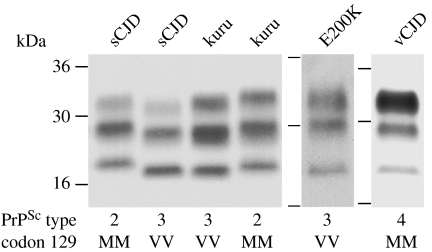
Figure 1
Figure 1
PrPSc strain types in human prion disease. Immunoblots of proteinase K digested brain homogenates from patients with human prion disease. Disease aetiology of each brain sample is designated above each lane and the PrPSc type (using the London classification of human PrPSc types; Collinge et al. 1996; Hill et al. 2003, 2006) and PRNP codon 129 genotype of the patient (M, methionine; V, valine) are designated below. Immunoblots were developed with anti-PrP monoclonal antibody 3F4 using a chemiluminescent substrate.
Figure 2
Figure 2
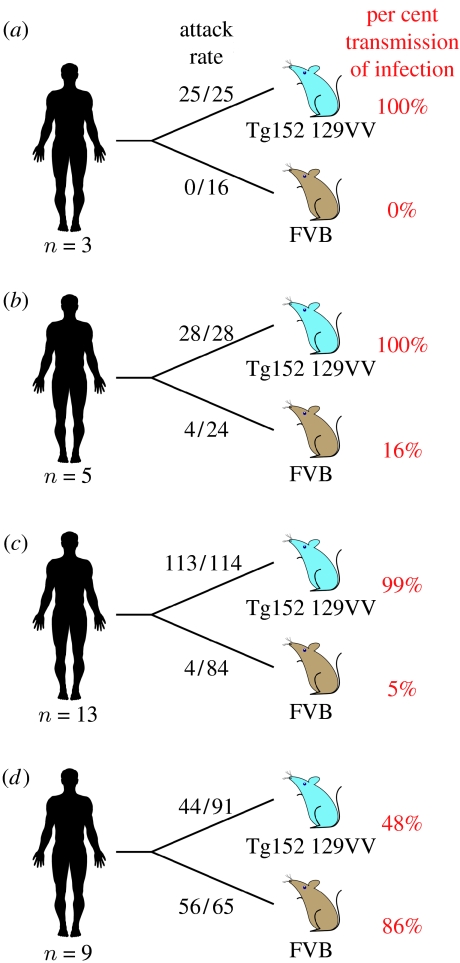
Summary of rates of transmission of human prions to transgenic and wild-type mice. Brain homogenate from patients with neuropathologically confirmed (a) kuru, (b) iatrogenic CJD, (c) sporadic CJD and (d) variant CJD were inoculated intra-cerebrally into transgenic mice homozygous for a human PrP 129V transgene array and murine PrP null alleles (Prnpo/o) designated Tg(HuPrP129V+/+ Prnpo/o)-152 mice (129VV Tg152 mice; Collinge et al. 1995), and into wild-type FVB/NHsd mice (genotype Prnpa). The number of prion disease isolates examined is designated below each schematic patient. Attack rate is defined as the total number of both clinically affected and sub-clinically infected mice as a proportion of the number of inoculated mice. In mice that were asymptomatic, sub-clinical prion infection was assessed by immunoblotting and/or immunohistochemical examination of brain. Primary data are described in references (Collinge et al. , ; Hill et al. 1997; Wadsworth et al. 2004, 2008).
Figure 3
Figure 3
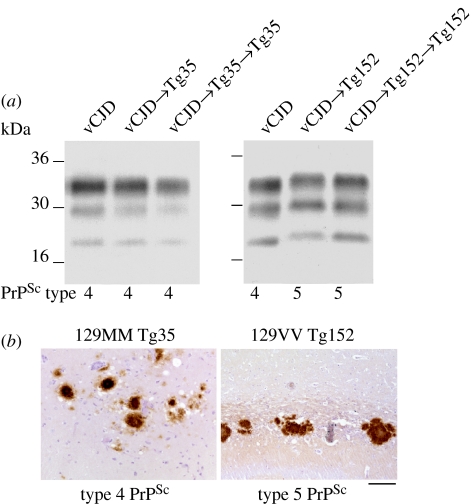
Summary of transmission of vCJD prions to transgenic mice expressing human PrP. Primary and secondary transmission of vCJD prions in transgenic Tg(HuPrP129M+/+ Prnpo/o)-35 mice (Tg35) results in faithful propagation of type 4 PrPSc and the occurrence of abundant florid PrP plaques throughout the cortex which are the neuropathological hallmark of vCJD. By contrast, primary and secondary transmission of vCJD prions to transgenic Tg(HuPrP129V+/+ Prnpo/o)-152 mice (Tg152) results in the propagation of a novel prion strain characterized by type 5 PrPSc and the occurrence of large, non-florid PrP plaques in the corpus callosum. (a) Representative immunoblots of proteinase K-treated brain homogenates from variant CJD and transgenic mice analysed with anti-PrP monoclonal antibody 3F4. The identity of the brain sample is designated above each lane with the type of PrPSc present in the sample designated below (using the London classification of human PrPSc types; Collinge et al. 1996; Hill et al. 2003; Wadsworth et al. 2004). (b) Representative immunohistochemical analysis of transgenic mouse brain showing abnormal PrP-positive plaques stained with anti-PrP monoclonal antibody 3F4. Scale bar, 100 μm.
Figure 4
Figure 4
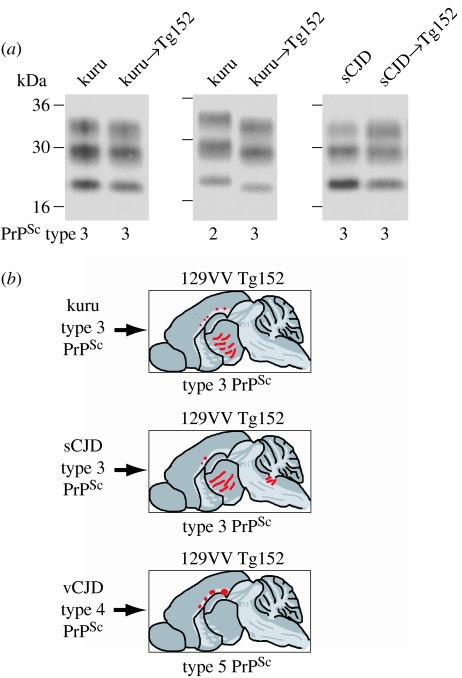
Summary of molecular and neuropathological phenotypes in transgenic mice. (a) Molecular strain typing of human prion transmissions to mice. Immunoblots of proteinase K-digested brain homogenates from human patients or transgenic mice analysed by enhanced chemiluminescence with anti-PrP monoclonal antibody 3F4. The provenance of each brain sample is designated above each lane and the type of human PrPSc detected in each sample (using the London classification of human PrPSc types; Collinge et al. 1996; Hill et al. 2003) is designated below. (b) Neuropathological analysis of transgenic mouse brain. An equivalent pattern of neuropathology is seen in 129VV Tg152 mice that propagate type 3 PrPSc following primary transmission of kuru prions or sporadic CJD prions, which is distinct from 129VV Tg152 mice that propagate type 5 PrPSc following primary transmission of vCJD prions. Sketches represent the regional distribution of abnormal PrP deposition in transgenic mouse brain visualized with anti-PrP monoclonal antibody ICSM 35; bars, diffuse synaptic PrP deposition and circles, PrP plaques.

References

    1. Alpers M. Epidemiology and clinical aspects of kuru. In: Prusiner S.B., McKinley M.P., editors. Prions: novel infectious pathogens causing scrapie and Creutzfeldt–Jakob disease. Academic Press; San Diego, CA: 1987. pp. 451–465.
    1. Alpers M., Rail L. Kuru and Creutzfeldt–Jakob disease: clinical and aetiological aspects. Proc. Aust. Assoc. Neurol. 1971;8:7–15. - PubMed
    1. Asante E.A., et al. BSE prions propagate as either variant CJD-like or sporadic CJD-like prion strains in transgenic mice expressing human prion protein. EMBO J. 2002;21:6358–6366. doi:10.1093/emboj/cdf653 - DOI - PMC - PubMed
    1. Asante E.A., et al. Dissociation of pathological and molecular phenotype of variant Creutzfeldt–Jakob disease in transgenic human prion protein 129 heterozygous mice. Proc. Natl Acad. Sci. USA. 2006;103:10 759–10 764. doi:10.1073/pnas.0604292103 - DOI - PMC - PubMed
    1. Bessen R.A., Marsh R.F. Distinct PrP properties suggest the molecular basis of strain variation in transmissible mink encephalopathy. J. Virol. 1994;68:7859–7868. - PMC - PubMed