


Long-term fungal inhibitory activity of water-soluble extracts of Phaseolus vulgaris cv. Pinto and sourdough lactic acid bacteria during bread storage
- PMID: 18849463
- PMCID: PMC2592913
- DOI: 10.1128/AEM.01420-08
Long-term fungal inhibitory activity of water-soluble extracts of Phaseolus vulgaris cv. Pinto and sourdough lactic acid bacteria during bread storage
Abstract
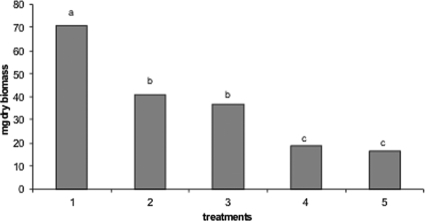
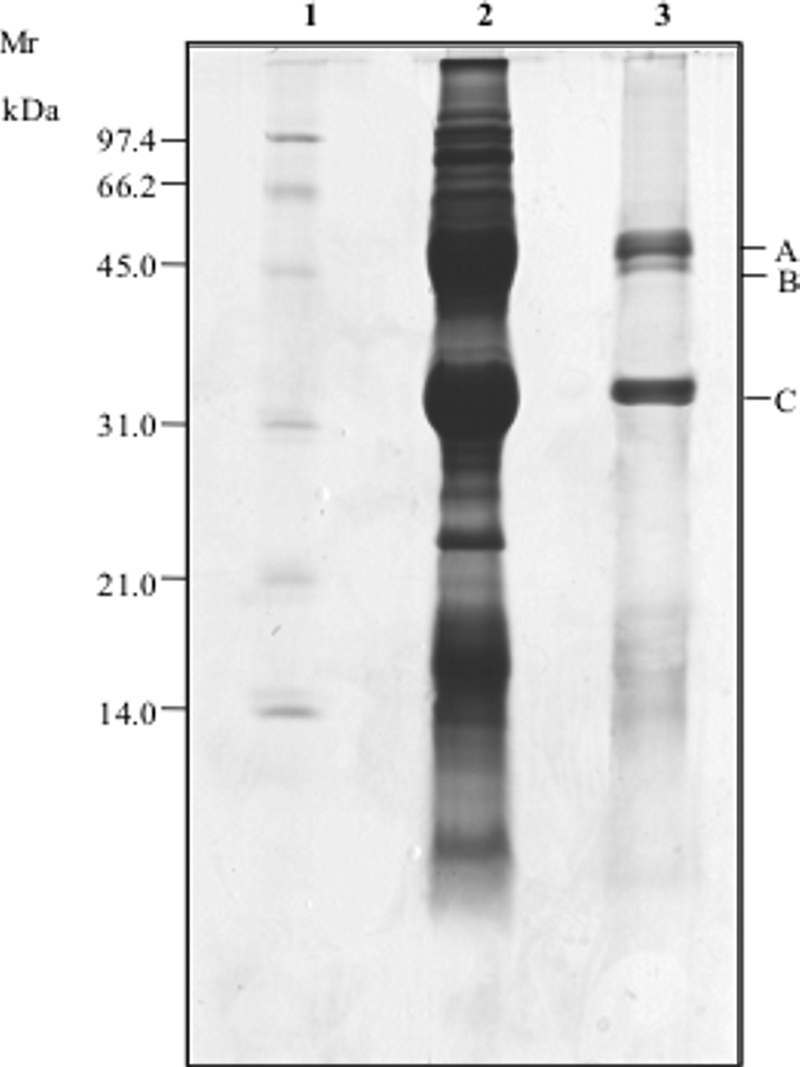
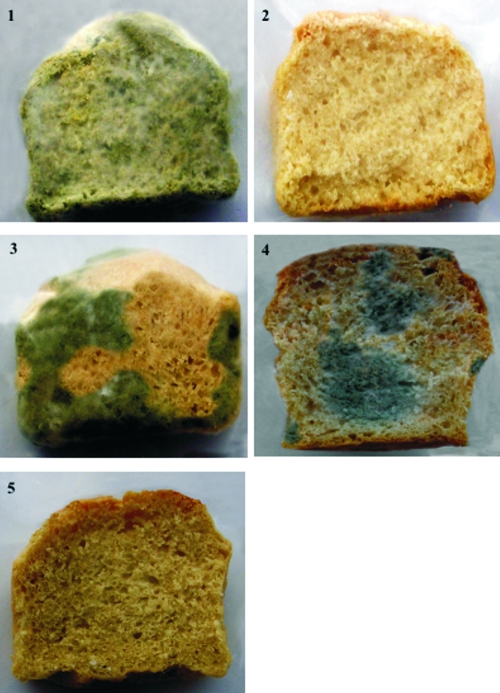
The antifungal activity of proteinaceous compounds from different food matrices was investigated. In initial experiments, water-soluble extracts of wheat sourdoughs, cheeses, and vegetables were screened by agar diffusion assays with Penicillium roqueforti DPPMAF1 as the indicator fungus. Water-soluble extracts of sourdough fermented with Lactobacillus brevis AM7 and Phaseolus vulgaris cv. Pinto were selected for further study. The crude water-soluble extracts of L. brevis AM7 sourdough and P. vulgaris cv. Pinto had a MIC of 40 mg of peptide/ml and 30.9 mg of protein/ml, respectively. MICs were markedly lower when chemically synthesized peptides or partially purified protein fractions were used. The water-soluble extract of P. vulgaris cv. Pinto showed inhibition toward a large number of fungal species isolated from bakeries. Phaseolin alpha-type precursor, phaseolin, and erythroagglutinating phytohemagglutinin precursor were identified in the water-soluble extract of P. vulgaris cv. Pinto by nano liquid chromatography-electrospray ionization-tandem mass spectrometry. When the antifungal activity was assayed by sodium dodecyl sulfate-polyacrylamide gel electrophoresis, all three proteins were inhibitory. A mixture of eight peptides was identified from the water-soluble extract of sourdough L. brevis AM7, and five of these exhibited inhibitory activity. Bread was made at the pilot plant scale by sourdough fermentation with L. brevis AM7 and addition of the water-soluble extract (27%, vol/wt; 5 mg of protein/ml) of P. vulgaris cv. Pinto. Slices of bread packed in polyethylene bags did not show contamination by fungi until at least 21 days of storage at room temperature, a level of protection comparable to that afforded by 0.3% (wt/wt) calcium propionate.
Figures
References
-
- Abellana, M., L. Torres, V. Sanchis, and A. J. Ramos. 1997. Caracterización de diferentes productos de bollería industrial. II. Estudio de la microflora. Alimentaria 287:51-56.
-
- American Association of Cereal Chemists. 1983. Methods 08-01, 44-15 A, 46-13, and 54-20. Approved methods of the American Association of Cereal Chemists, 8th ed. American Association of Cereal Chemists, St. Paul, MN.
-
- Atanassova, M., Y. Choiset, M. Dalgalarrondo, J. M. Chobert, X. Dousset, I. Ivanova, and T. Haertle. 2003. Isolation and partial biochemical characterization of a proteinaceous anti-bacteria and anti-yeast compound produced by Lactobacillus paracasei subsp. paracasei strain M3. Int. J. Food Microbiol. 87:63-73. - PubMed
-
- Bradford, M. M. 1976. A rapid and sensitive method for the quantification of microgram quantities of protein utilizing the principle of protein-dye binding. Anal. Biochem. 72:248-254. - PubMed
-
- Chen, Y., S. W. Know, S. C. Kim, and Y. Zhao. 2005. Integrated approach for manual evaluation of peptides identified by searching protein sequence databases with tandem mass spectra. J. Proteome Res. 4:998-1005. - PubMed
Publication types
MeSH terms
Substances
LinkOut - more resources
Full Text Sources
