


doi: 10.1038/nsmb.1501.
Epub 2008 Oct 12.
The 'glutamate switch' provides a link between ATPase activity and ligand binding in AAA+ proteins
Affiliations
- PMID: 18849995
- PMCID: PMC2806578
- DOI: 10.1038/nsmb.1501
Item in Clipboard
The 'glutamate switch' provides a link between ATPase activity and ligand binding in AAA+ proteins
Nat Struct Mol Biol.
2008 Nov.
Abstract
AAA+ proteins carry out diverse functions in cells. In most cases, their ATPase activity is tightly regulated by protein partners and target ligands, but the mechanism for this control has remained unclear. We have identified a conserved link between the ligand binding and ATPase sites in AAA+ proteins. This link, which we call the 'glutamate switch', regulates ATPase activity directly in response to the binding of target ligands by controlling the orientation of the conserved glutamate residue in the DExx motif, switching it between active and inactive conformations. The reasons for this level of control of the ATPase activity are discussed in the context of the biological processes catalyzed by AAA+ proteins.
Figures
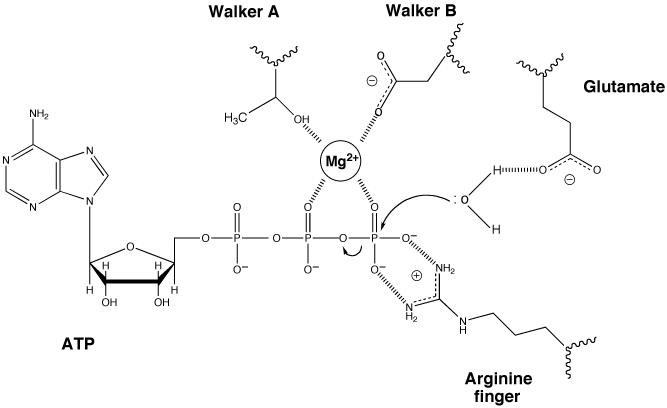
ATP hydrolysis is promoted by several residues in this generalised active site of ATPases. Only residues with an established role in catalysis rather than binding are shown. When present, the “arginine finger” is usually provided in trans from an adjacent subunit or domain. The magnesium ion can be coordinated in different ways but that shown is one of the most common involving interactions with a threonine (or serine) from the Walker A motif, an aspartate from the Walker B motif and oxygens from the β and γ phosphates of the ATP. The role of the glutamate residue (in the DExx motif of AAA+ proteins) is to activate a water molecule by making the oxygen more electronegative and hence a better nucleophile for attack of the γ-phosphorus.
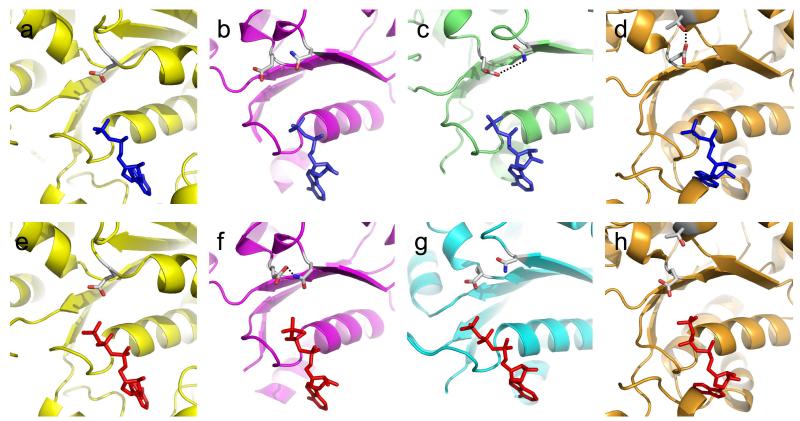
(a) – F1 ATPase β-subunit active site with bound ADP (1BMF). (b) – PspF complexed with ADP (2C98). (c) – ORC1 complexed with ADP + DNA (2V1U). (d) – HslU complexed with ADP (1G41). (e) – F1 ATPase β-subunit active site with bound ADPNP (1BMF). (f) – PspF complexed with ATP (2C96). (g) – ORC2 complexed with ADPNP (1W5T). (h) – HslU complexed with ATP (1DO0). PDB ID codes are shown in parentheses. When formed, the glutamate switch is indicated by dotted lines (panels c, d, and f).
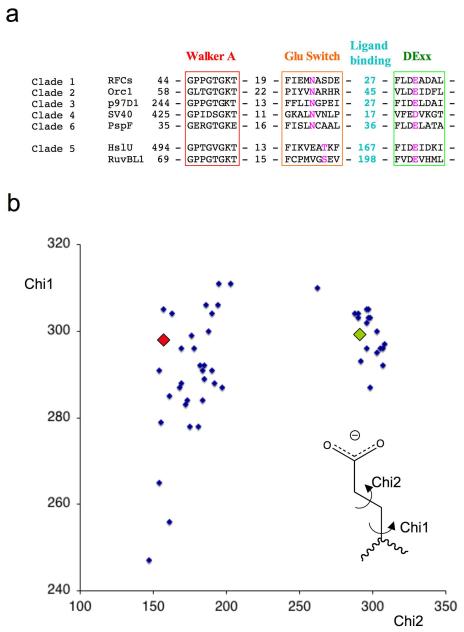
(a) Sequence alignments of selected members of each clade for which crystal structures are known. The colour scheme follows that used in Figure 4. RFCs – Replication factor C small subunit A.fulgidus, Orc1 – Orc1 protein A.pernix, p97D1 - p97 D1 AAA+ domain M.musculus, SV40 – SV40 Large T antigen, PspF – PspF E.coli, HslU – HslU E.coli, RuvBL1 – RuvB-like 1 (TIP49a, Pontin) H.sapiens. (b) Plot of side chain torsion angles for 50 active site glutamate (DExx box) residues from AAA+ protein structures in the protein database (www.rcsb.org ) with a resolution better than 3.5Å. Only one copy from the asymmetric unit was used if angles were similar to reduce redundancy. The appropriate glutamate residue was selected from individual PDB files and the side chain torsion angles were calculated using the CCP4 program ANGLES then normalized to 0-360 degrees for display. The values for the PspF-ADP complex (green diamond) and PspF-ATP complex (red diamond) are overlaid as examples of residues in the two conformations.
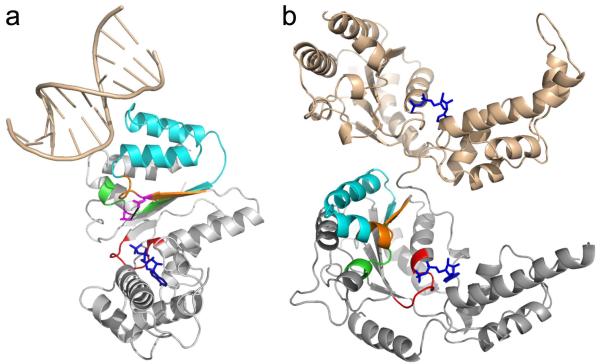
(a) Glutamate switch pair location within a typical AAA+ domain and the linkage to the ligand binding site. The example shown is A.pernix ORC1 DNA complex (Clade 2, PDB ID code 2V1U). The Walker A motif is shown in red, the glutamate switch region in orange (with the E-N pair in magenta), the ligand binding site between the glutamate switch and the DExx box in cyan, the DExx box in green and the bound ADP in blue. A portion of the bound DNA is shown in wheat. (b) D1 (wheat) and D2 (grey) domains of p97 (PDB ID code 3CF3) showing the interaction between the two ATPase domains in a type II AAA+ protein. The colouring of the D2 domain follows the same scheme as part (a).
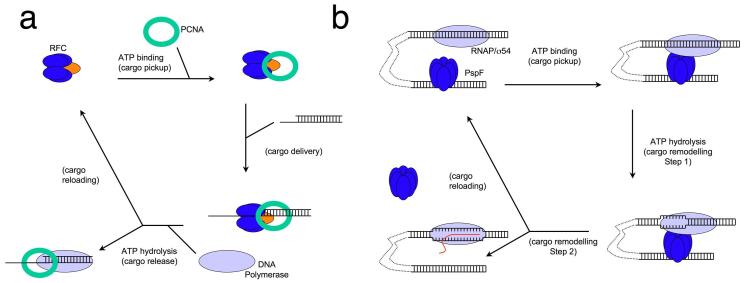
(a) PCNA clamp loading by Replication Factor C. Upon ATP binding, RFC forms a stable complex with PCNA (cargo pickup) that is competent to load onto DNA at primer-template junctions (cargo delivery). ATP hydrolyis by the small subunits (blue) releases PCNA (cargo release) which is then bound by DNA polymerase. Finally, ATP hydrolysis at the large subunit (orange) recycles the RFC and allows pick up of the next PCNA (cargo reloading). (b) Bacterial transcription activation by PspF. Upon ATP binding, PspF, which binds to the DNA sequence upstream of transcription start site, interacts with RNAP/σ54 through DNA looping (cargo pickup). At the point of ATP hydrolysis, PspF forms a stable complex with RNAP/σ54 and initial remodelling of RNAP/σ54/DNA occurs (cargo remodelling). Upon the completion of ATP hydrolysis, transcription proceeds and PspF dissociates from the complex (cargo remodelling and reloading).
References
-
- Kunau WH, et al. Two complementary approaches to study peroxisome biogenesis in Saccharomyces cerevisiae: forward and reversed genetics. Biochimie. 1993;75:209–24. - PubMed
-
- Neuwald AF, Aravind L, Spouge JL, Koonin EV. AAA+: A class of chaperone-like ATPases associated with the assembly, operation, and disassembly of protein complexes. Genome Res. 1999;9:27–43. - PubMed
-
- Iyer LM, Leipe DD, Koonin EV, Aravind L. Evolutionary history and higher order classification of AAA+ ATPases. J Struct Biol. 2004;146:11–31. - PubMed
-
- Erzberger JP, Berger JM. Evolutionary relationships and structural mechanisms of AAA+ proteins. Annu Rev Biophys Biomol Struct. 2006;35:93–114. - PubMed
-
- Browning DF, Busby SJ. The regulation of bacterial transcription initiation. Nat Rev Microbiol. 2004;2:57–65. - PubMed
Publication types
MeSH terms
Substances
Grants and funding
LinkOut - more resources
Full Text Sources
Miscellaneous
