. 2008 Dec;76(12):5608-14.
doi: 10.1128/IAI.00085-08. Epub 2008 Oct 13.

Functional characterization of AasP, a maturation protease autotransporter protein of Actinobacillus pleuropneumoniae

Affiliations

Functional characterization of AasP, a maturation protease autotransporter protein of Actinobacillus pleuropneumoniae

Tehmeena Ali et al. Infect Immun. 2008 Dec.

Abstract

Actinobacillus pleuropneumoniae is the etiological agent of porcine pleuropneumonia, a highly contagious respiratory infection in pigs. AasP, a putative subtilisin-like serine protease autotransporter, has recently been identified in A. pleuropneumoniae. We hypothesized that, similarly to other autotransporters of this type, AasP may undergo autocatalytic cleavage resulting in release of the passenger domain of the protein. Furthermore, AasP may be responsible for cleavage of other A. pleuropneumoniae outer membrane proteins. To address these hypotheses, the aasP gene was cloned and the expressed recombinant AasP protein used to raise monospecific rabbit antiserum. Immunoblot analysis of whole-cell lysates and secreted proteins demonstrated that AasP does not undergo proteolytic cleavage. Immunoblot analysis also confirmed that AasP is universally expressed by A. pleuropneumoniae. Confirmation of the maturation protease function of AasP was obtained through phenotypic analysis of an A. pleuropneumoniae aasP deletion mutant and by functional complementation. Comparison of the secreted proteins of the wild type, an aasP mutant derivative, and an aasP mutant complemented in trans led to the identification of OmlA protein fragments that were present only in the secreted-protein preparations of the wild-type and complemented strains, indicating that AasP is involved in modification of OmlA. This is the first demonstration of a function for any autotransporter protein in Actinobacillus pleuropneumoniae.


Figures
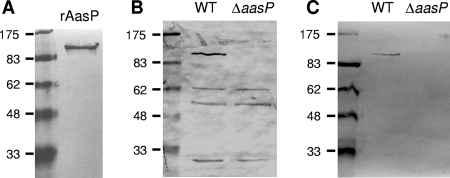
FIG. 1.
FIG. 1.
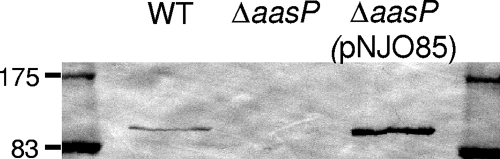
Immunoblot analysis confirms that RαAasP recognizes recombinant AasP (rAasP) (A) and the corresponding ca. 104-kDa AasP protein in whole-cell lysates (B) and secreted proteins (C) of wild-type (WT) A. pleuropneumoniae 4074 but not in the ΔaasP mutant derivative. No additional AasP-specific bands are apparent, suggesting that intact AasP is the active form of the protein.
FIG. 2.
FIG. 2.
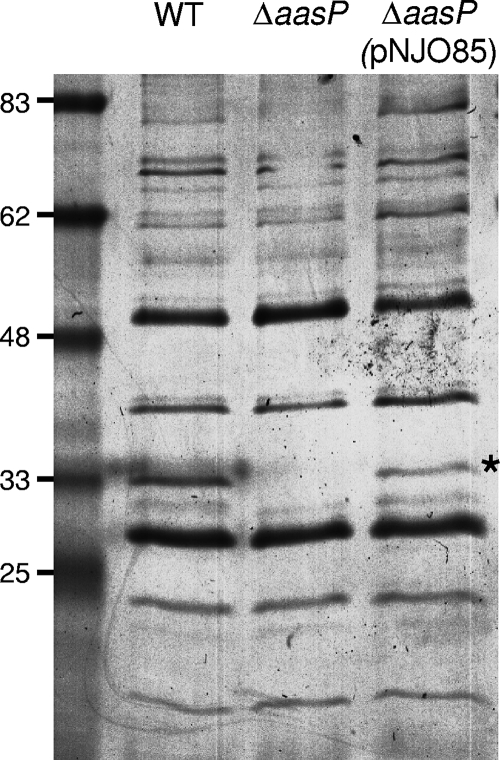
SDS-PAGE analysis of secreted proteins from the A. pleuropneumoniae 4074 wild type (WT), the ΔaasP mutant derivative, and a mutant harboring the complementation plasmid pNJO85 reveals the presence of a ca. 33-kDa protein (marked with a star) that is absent in the ΔaasP mutant preparation.
FIG. 3.
FIG. 3.
Immunoblot analysis of whole-cell lysates confirms the high-level expression of AasP in ΔaasP(pNJO85). Equivalent amounts of protein were loaded in each well. WT, wild type.
FIG. 4.
FIG. 4.
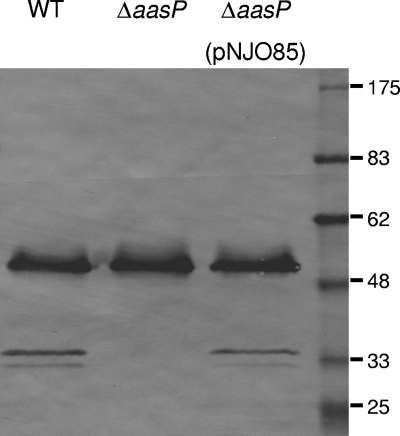
Immunoblot detection of OmlA fragments in the secreted protein fractions of the A. pleuropneumoniae 4074 wild type (WT), the ΔaasP mutant derivative, and ΔaasP(pNJO85).
FIG. 5.
FIG. 5.
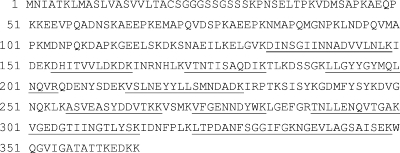
Amino acid sequence of the A. pleuropneumoniae 4074 OmlA protein (GenBank accession number AAD00608). Underlined regions correspond to peptides identified by nanoelectrospray ionization-Q-TOF MS-MS from the ca. 33-kDa OmlA fragment found in the secreted proteins of the A. pleuropneumoniae 4074 wild-type and complemented strains but not the ΔaasP mutant derivative.
FIG. 6.
FIG. 6.
AasP is expressed across divergent lineages and serogroups of A. pleuropneumoniae. Immunoblot analysis using RαAasP confirmed that AasP is detected in whole-cell lysates of all strains tested. Lane numbers correspond to serogroups; the strains tested were A. pleuropneumoniae S1536 (serogroup 2), S1421 (serogroup 3), M62 (serogroup 4), K17 (serogroup 5a), L20 (serogroup 5b), FEMØ (serogroup 6), WF83 (serogroup 7), 405 (serogroup 8), 13261 (serogroup 9), 13039 (serogroup 10), 56153 (serogroup 11), 8329 (serogroup 12), N273 (serogroup 13), 3606 (serogroup 14), and HS143 (serogroup 15).

References

    1. Baltes, N., F. F. R. Buettner, and G. F. Gerlach. 2007. Selective capture of transcribed sequences (SCOTS) of Actinobacillus pleuropneumoniae in the chronic stage of disease reveals an HlyX-regulated autotransporter protein. Vet. Microbiol. 123110-121. - PubMed
    1. Baltes, N., I. Hennig-Pauka, and G. F. Gerlach. 2002. Both transferrin binding proteins are virulence factors in Actinobacillus pleuropneumoniae serotype 7 infection. FEMS Microbiol. Lett. 209283-287. - PubMed
    1. Baltes, N., M. N′diaye, I. D. Jacobsen, A. Maas, F. F. R. Buettner, and G. F. Gerlach. 2005. Deletion of the anaerobic regulator HlyX causes reduced colonization and persistence of Actinobacillus pleuropneumoniae in the porcine respiratory tract. Infect. Immun. 734614-4619. - PMC - PubMed
    1. Bandara, A. B., M. L. Lawrence, H. P. Veit, and T. J. Inzana. 2003. Association of Actinobacillus pleuropneumoniae capsular polysaccharide with virulence in pigs. Infect. Immun. 713320-3328. - PMC - PubMed
    1. Bélanger, M., D. Dubreuil, J. Harel, C. Girard, and M. Jacques. 1990. Role of lipopolysaccharides in adherence of Actinobacillus pleuropneumoniae to porcine tracheal rings. Infect. Immun. 583523-3530. - PMC - PubMed

Publication types

MeSH terms

Substances

LinkOut - more resources