Prevalence of vitamin d insufficiency in patients with Parkinson disease and Alzheimer disease
- PMID: 18852350
- PMCID: PMC2746037
- DOI: 10.1001/archneur.65.10.1348
Prevalence of vitamin d insufficiency in patients with Parkinson disease and Alzheimer disease
Abstract
Background: A role for vitamin D deficiency in Parkinson disease (PD) has recently been proposed.
Objective: To compare the prevalence of vitamin D deficiency in a research database cohort of patients with PD with the prevalence in age-matched healthy controls and patients with Alzheimer disease (AD).
Design: Survey study and blinded comparison of plasma 25-hydroxyvitamin D (25[OH]D) concentrations of stored samples in a clinical research database at Emory University School of Medicine.
Setting: Referral center (PD and AD patients), primary care clinics, and community setting (controls).
Participants: Participants were recruited into the study between May 1992 and March 2007. Every fifth consecutively enrolled PD patient was selected from the clinical research database. Unrelated AD (n = 97) and control (n = 99) participants were randomly selected from the database after matching for age, sex, race, APOE genotype, and geographic location.
Main outcome measures: Prevalence of suboptimal vitamin D and mean 25(OH)D concentrations.
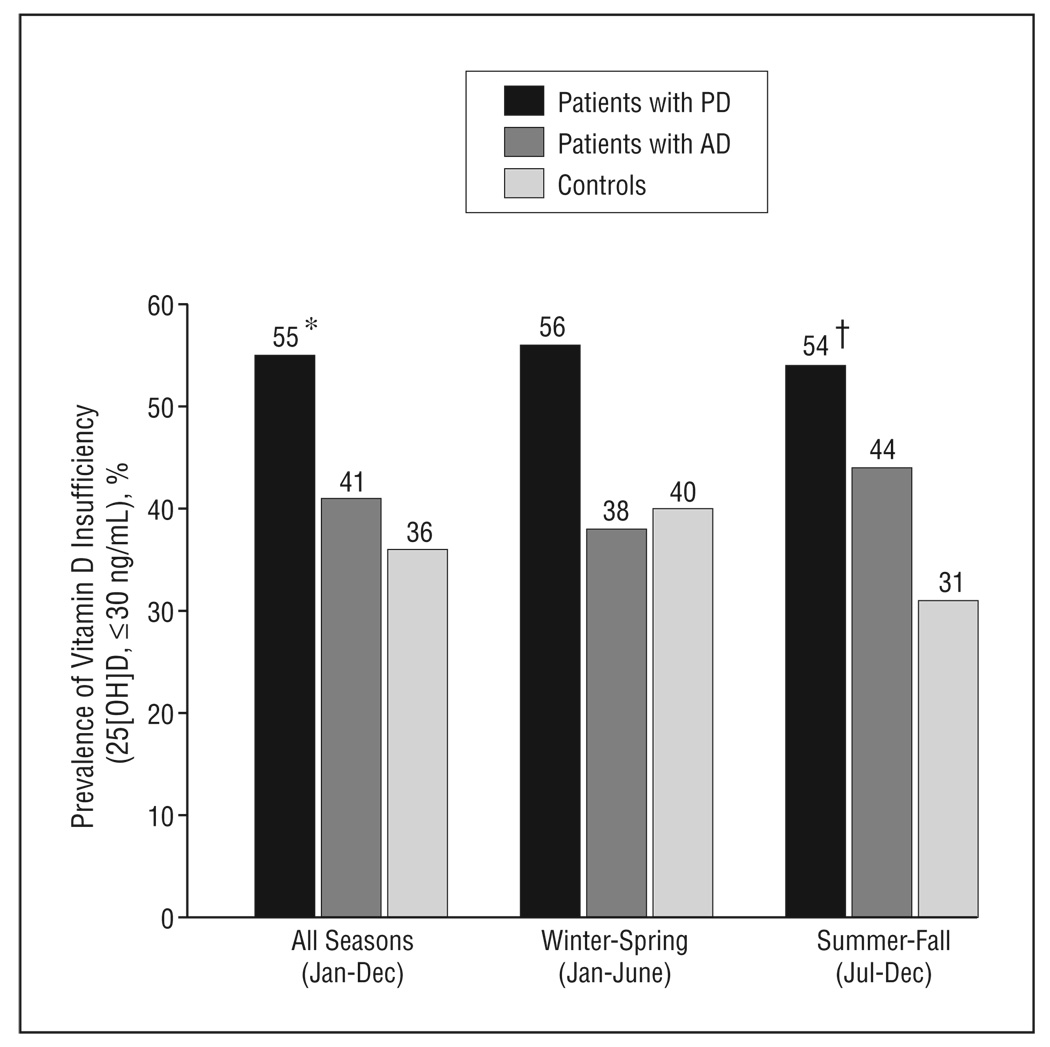
Results: Significantly more patients with PD (55%) had insufficient vitamin D than did controls (36%) or patients with AD (41%; P = .02, chi(2)test). The mean (SD) 25(OH)D concentration in the PD cohort was significantly lower than in the AD and control cohorts (31.9 [13.6] ng/mL vs 34.8 [15.4] ng/mL and 37.0 [14.5] ng/mL, respectively; P = .03).
Conclusions: This report of 25(OH)D concentrations in a predominantly white PD cohort demonstrates a significantly higher prevalence of hypovitaminosis in PD vs both healthy controls and patients with AD. These data support a possible role of vitamin D insufficiency in PD. Further studies are needed to determine the factors contributing to these differences and elucidate the potential role of vitamin D in pathogenesis and clinical course of PD.
Figures
References
-
- Holick MF. Vitamin D deficiency. N Engl J Med. 2007;357(3):266–281. - PubMed
-
- Nagpal S, Na S, Rathnachalam R. Noncalcemic actions of vitamin D receptor ligands. Endocr Rev. 2005;26(5):662–687. - PubMed
-
- Bischoff-Ferrari HA, Dietrich T, Orav EJ, et al. Higher 25-hydroxyvitamin D concentrations are associated with better lower-extremity function in both active and inactive persons aged > or =60 y. Am J Clin Nutr. 2004;80(3):752–758. - PubMed
-
- Grant WB, Garland CF, Gorham ED. An estimate of cancer mortality rate reductions in Europe and the US with 1,000 IU of oral vitamin D per day. Recent Results Cancer Res. 2007;174:225–234. - PubMed
-
- Gorham ED, Garland CF, Garland FC, et al. Optimal vitamin D status for colorectal cancer prevention: a quantitative meta analysis. Am J Prev Med. 2007;32(3):210–216. - PubMed
Publication types
MeSH terms
Substances
Grants and funding
LinkOut - more resources
Full Text Sources
Medical
Miscellaneous